
Ingredients
Batter
- 400 gbutter, softened
- 200 gcondensed milk
- 10egg yolks
- 5whole eggs
- 150 gcaster sugar
- 150 gplain flour
- 50 gmilk powder
- 1 tspbaking powder
- 1 tspvanilla
Colours
- food colouring in several colours
- 1 tspmixed spice, for a spiced layer
To assemble
- apricot jam, warmed
- a ruler and a sharp knife
Directions
- This is a construction project as much as a cake, and a full patterned kek lapis can take a whole day.
- Cream the butter, condensed milk and sugar until very pale and light, then beat in the yolks and whole eggs one at a time.
- Fold in the sifted flour, milk powder, baking powder and vanilla.
- Divide the batter into as many bowls as you have colours, weighing each portion.
- Weigh every portion. Layers of different thickness are immediately visible in the finished slice and there is no hiding them.
- Grease and line a square tin, taking the paper up the sides so the finished slab lifts out whole.
- Spread one portion into the tin in a thin, absolutely even layer and level it with a palette knife.
- Grill it, do not bake it. Put the tin under a hot grill for 4 to 6 minutes until the surface is golden and set.
- Each layer is cooked under the grill from above, which is the whole technique. A conventional bake cooks the layers into one another and the definition is lost.
- Press the cooked layer down firmly and evenly with the flat base of a smaller tin or a spatula.
- Press every layer. It expels air, compacts the crumb, and it is what makes the finished cake dense enough to cut into shapes without crumbling.
- Add the next colour, spread, grill, press, and repeat until all the batter is used.
- Cool the slab completely, and preferably leave it overnight.
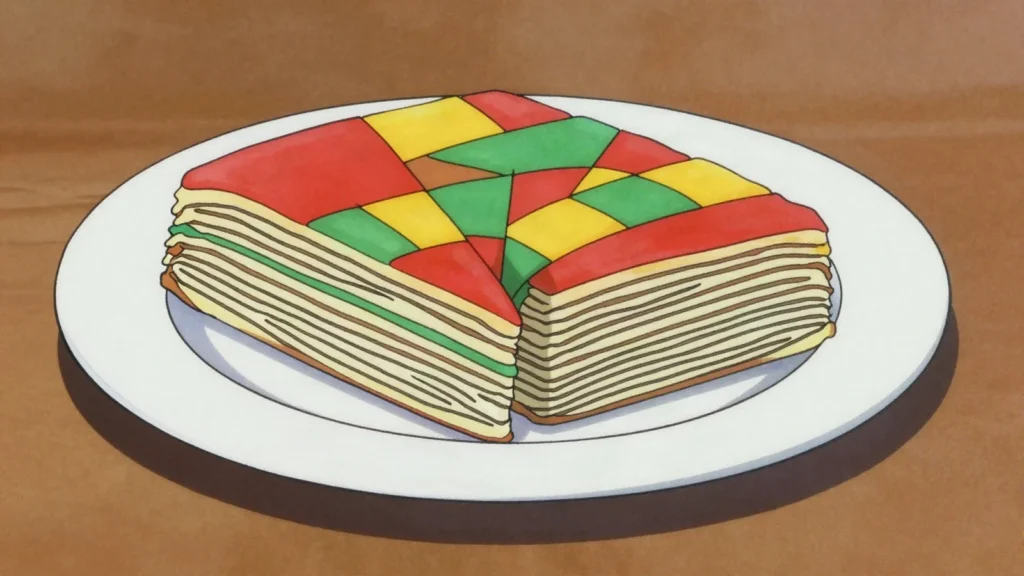
- For a plain striped cake, that is the finished article; slice it across to show the bands.
- For a patterned cake, the real work starts here. Cut the cooled slab into strips, batons or triangles with a ruler and a sharp knife.
- Brush each piece with warmed jam and reassemble them in a new tin in the pattern you want, sometimes wrapping the whole thing in a final outer layer.
- The jam is the glue and it must be brushed on every mating face, or the pattern falls apart when the cake is sliced.
- Chill the assembled cake for several hours before cutting.
- It is baked in Sarawak for Eid, Christmas, Gawai and weddings, and the patterns are named and competed over.
Technique
- The high yolk and butter content is what makes it so rich and dense, and it is meant to be eaten in thin slices.
- Sarawak bakers work to patterns with names, and a good one is priced by its complexity.
- It keeps well for a week and freezes.
Substitutions
- Fewer colours and a simple stripe, which is a real version and far quicker.
- Strawberry jam or seedless raspberry in place of apricot.
Variations
- Plain striped, which is the everyday version.
- Kek lapis Betawi, the Indonesian spiced layer cake with cinnamon and clove.
- With prunes or cherries set into the layers.
History
Developed in Sarawak from Indonesian and Dutch layer cakes, and made for Hari Raya, Christmas and Gawai in Kuching’s home bakeries.
Frequently asked questions
What is Kek Lapis Sarawak?
Kek Lapis Sarawak is a dessert from Malaysia: layer cake built up grill by grill into intricate patterns, sliced to show the design. Developed in Sarawak from Indonesian and Dutch layer cakes, and made for Hari Raya, Christmas and Gawai in Kuching’s home bakeries.
How long does Kek Lapis Sarawak take to make?
Kek Lapis Sarawak takes 1 hr of preparation and 2 hr of cooking. The recipe makes 1 cake. It is rated hard to make.
What can I substitute in Kek Lapis Sarawak?
Yes, within limits. Fewer colours and a simple stripe, which is a real version and far quicker. Strawberry jam or seedless raspberry in place of apricot.
What is the most important thing to get right in Kek Lapis Sarawak?
Grill it, do not bake it. Put the tin under a hot grill for 4 to 6 minutes until the surface is golden and set.