
Ingredients
The fish
- 1.2 kgfirm white fish
- in thick steaks or large chunks
- snapper, grouper, tuna or mackerel
- on the bone if possible
- or a mixture of fish
- salt, to season
The vegetables
- 800 gpotatoes
- peeled and sliced thickly
- 3large onions, sliced
- 4ripe tomatoes, sliced
- or 1 tin chopped tomatoes
- 2peppers, sliced
- red and green
- 6 clovesgarlic, sliced
The liquid and seasoning
- 6 tablespoonsolive oil
- plus more to finish
- 200 mlwater or fish stock
- or 150 ml white wine
- and 100 ml water
- 2bay leaves
- 1 teaspoonsweet paprika
- a pinch of chilli, to taste
- salt and black pepper
- juice of half a lemon
To finish
- a large handful of coriander
- or parsley, chopped
To serve
- bread, to mop the broth
- or plain rice
- a chilli sauce
- lemon wedges
Directions
- Use a firm fish that holds together. Soft-fleshed fish disintegrates completely. Bone it properly for small children. The eyes should be clear and slightly bulging.
- Salt the fish pieces and leave them twenty minutes. Pat them dry before layering. Slice them fairly thickly. About a centimetre is right. Use a wide heavy pot with a lid. Pour a good glug of olive oil into the base.
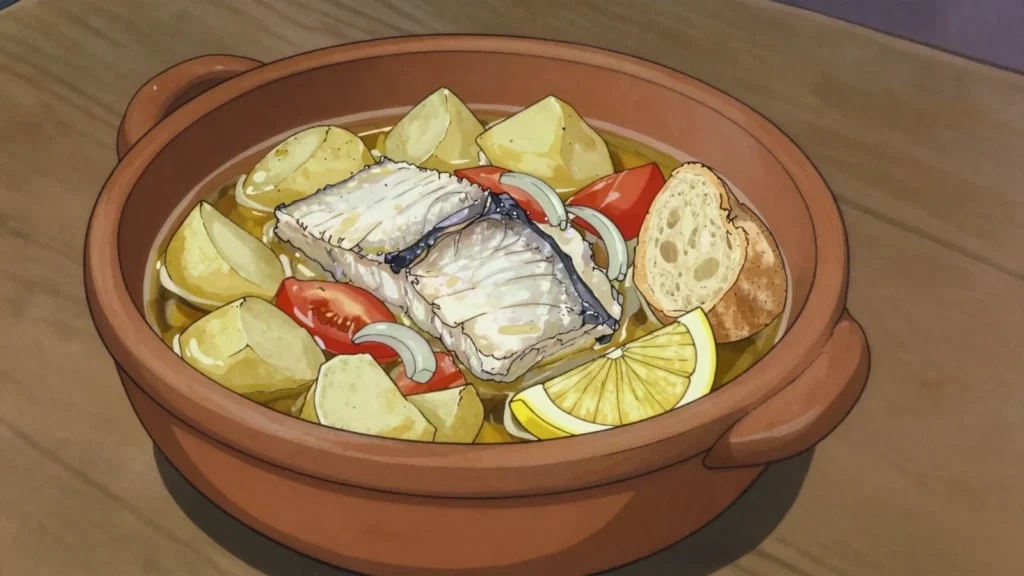
- Lay a layer of sliced onion over it. Add a layer of potato slices. Add a layer of tomato and pepper. Scatter over garlic, paprika, salt and pepper. Lay the fish pieces over. Add another layer of onion. Add potato, tomato and pepper. Season each layer as you go. Season every layer, not just the top.
- Pour over the rest of the olive oil. Add the water, stock or wine. Add far less liquid than seems right. About two hundred millilitres is enough. Cover the pot tightly. Bring it to a gentle simmer. Simmer it for about forty minutes. Do not lift the lid unnecessarily.
- Shake the pot gently now and then. Lift the lid once at thirty minutes. Check the potatoes with a knife tip. Add a little hot water if it looks dry. The potatoes should be tender right through.
- Squeeze over the lemon juice. Add a final glug of good olive oil. Scatter chopped coriander or parsley over. Taste the broth and correct the salt. Serve it from the pot at the table.
- Serve plenty of bread to mop the broth. Serve a chilli sauce for those who want heat. Serve lemon wedges. It keeps two days refrigerated.
Technique
- Layer it and never stir it. Fish and potatoes both break apart when stirred, so shake the pot gently instead — the layers are what keep everything intact.
- Season every layer as you build it, not just the top. There is no stirring to distribute seasoning, and unseasoned layers stay that way — the commonest failure with any layered stew.
- Add far less liquid than seems right, about two hundred millilitres. The onions, tomatoes and fish all release liquid into a covered pot that loses almost nothing to evaporation, so too much added water gives a soup.
- Put onion in the base above the oil. It stops everything above from catching and releases the liquid that starts the stew — a structural choice rather than a flavour one.
- End with vegetables on top rather than fish, so the fish steams gently between the layers instead of drying out.
- Slice the potatoes about a centimetre thick — thin enough to cook in the time the fish needs, thick enough not to dissolve. If the potatoes need longer than the fish, the fish overcooks.
- Use a firm fish in thick steaks, on the bone if you can. Soft-fleshed fish and thin fillets disintegrate, and the bone adds flavour to the broth. Warn anyone unused to picking bones out, and bone it properly for small children.
- Pour raw olive oil over at the end as well as cooking in it. It tastes quite different from cooked oil and gives fragrance the dish needs — a Portuguese habit worth keeping.
- Salt the fish twenty minutes ahead and pat it dry. It firms the flesh and seasons it through.
- Taste and correct the broth at the end. That is the only real chance to adjust a dish you have not stirred.
- The broth is the best part. Serve enough bread to mop it.
- Kaldeirada sits in the Portuguese layer of Timorese cooking, alongside Indonesian and indigenous traditions. Timor-Leste was a Portuguese colony until 1975, then occupied by Indonesia until 1999 with very large loss of life, with independence restored in 2002 — documented history the atlas records once.
Substitutions
- Any firm fish serves — snapper, grouper, tuna, mackerel — and a mixture is common.
- Tinned chopped tomatoes replace fresh out of season.
- White wine replaces some of the water and gives more depth.
- Waxy potatoes hold their shape; floury ones break down and thicken the broth, and both are used.
- Parsley replaces coriander; coriander is more Timorese and parsley more Portuguese.
- Prawns or mussels can be added in the last ten minutes.
Variations
- Portuguese caldeirada is the parent dish and is made along the whole coast.
- Cataplana de marisco cooks a similar mixture in a sealed hinged pan.
- Ikan pepes and other Indonesian fish preparations sit in the other layer of Timorese cooking.
- A version with coconut milk added is made in some Timorese households.
- Batar da’an, the Timorese maize, bean and pumpkin stew, is the indigenous staple.
- Caldeirada de cabrito replaces fish with goat and is made inland.
Frequently asked questions
What is Kaldeirada?
Kaldeirada is a soup & stew from Timor-Leste: fish and potato stew with tomato, onion and olive oil, of Portuguese descent.
How long does Kaldeirada take to make?
Kaldeirada takes 30 minutes of preparation and 50 minutes of cooking. The recipe makes serves 6. It is rated easy to make.
What can I substitute in Kaldeirada?
Yes, within limits. Any firm fish serves — snapper, grouper, tuna, mackerel — and a mixture is common. Tinned chopped tomatoes replace fresh out of season. White wine replaces some of the water and gives more depth. Waxy potatoes hold their shape; floury ones break down and thicken the broth, and both are used. Parsley replaces coriander; coriander is more Timorese and parsley more Portuguese. Prawns or mussels can be added in the last ten minutes.
What is the most important thing to get right in Kaldeirada?
Pour over the rest of the olive oil. Add the water, stock or wine. Add far less liquid than seems right. About two hundred millilitres is enough. Cover the pot tightly. Bring it to a gentle simmer. Simmer it for about forty minutes. Do not lift the lid unnecessarily.