
Ingredients
The chew
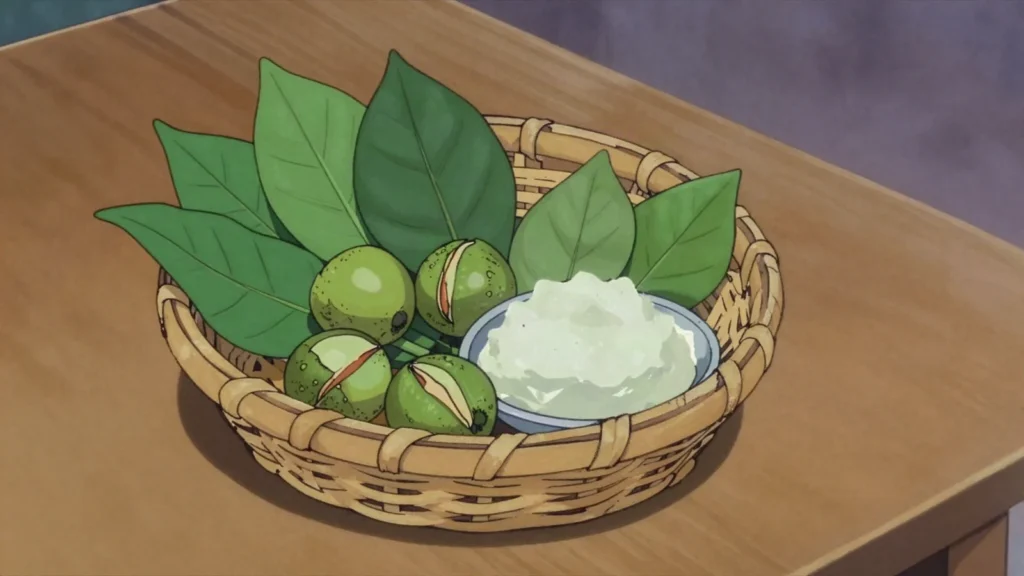
- 1areca nut, fresh or dried
- 1betel pepper leaf
- slaked lime paste, from burnt coral or shell
Sometimes added
- a piece of tobacco
- cloves or other spices
Presentation
- a woven basket or a cloth
- offered with both hands
Directions
- Bua malus is the betel and areca chew of Timor-Leste.
- Bua is the areca nut and malus is the betel leaf.
- It is not a food and it is not swallowed.
- It is chewed and the red juice is spat out.
- This entry records a custom rather than a recipe.
- It is included because it matters enormously in Timorese life.
- It is offered to guests as a basic act of hospitality.
- It is presented at ceremonies and at negotiations.
- It is placed at funerals and at graves.
- Refusing it can be read as a real insult.
- A serious health warning must come first.
- Areca nut is classified as a Group 1 carcinogen.
- That classification comes from the International Agency for Research on Cancer.
- Group 1 means there is sufficient evidence it causes cancer in humans.
- Chewing it causes cancers of the mouth, throat and oesophagus.
- It also causes oral submucous fibrosis, which stiffens the mouth.
- That condition is progressive and cannot be reversed.
- The risk is present without any tobacco added.
- Adding tobacco increases the risk considerably further.
- None of this is disputed in the medical literature.
- This atlas does not recommend chewing it.
- It is recorded here because it is culturally central.
- Understanding the three parts is the useful knowledge.
- The areca nut is the seed of the areca palm.
- It is often called betel nut, which is misleading.
- The nut and the leaf come from two different plants.
- The betel leaf comes from a climbing pepper vine.
- Its botanical name is Piper betle.
- The lime is calcium hydroxide, slaked lime paste.
- It is made by burning coral or shell and slaking it in water.
- That lime is what releases the alkaloids from the nut.
- Without it the chew has very little effect.
- Preparing the chew is done by hand.
- The areca nut is split or sliced into pieces.
- Fresh green nuts and dried nuts are both used.
- A betel leaf is taken and smeared with lime paste.
- Only a small smear of lime is used.
- Too much lime burns the inside of the mouth.
- The nut is placed on the leaf.
- The leaf is folded around it into a small parcel.
- Chewing it produces the characteristic red juice.
- The parcel is chewed slowly rather than swallowed.
- The mixture turns bright red within moments.
- That red comes from a reaction between the components.
- The juice is spat out and never swallowed.
- Red stains on pavements are a common sight in Dili.
- Long-term chewing stains the teeth deep red or black.
- The stimulant effect is mild and comes on quickly.
- Arecoline is the main active alkaloid in the nut.
- Understanding the social role is the important part.
- Bua malus is offered when a guest arrives at a house.
- It is presented with both hands as a mark of respect.
- Woven baskets are made specifically to hold it.
- It appears at marriage negotiations between families.
- It is exchanged as part of formal agreements.
- It is left at graves as an offering to the dead.
- It marks the opening of ceremonies of many kinds.
- Elders in particular chew it throughout the day.
- Declining it politely is possible for visitors.
- A polite refusal is understood from foreigners.
- Accepting the basket and passing it on is one option.
- Explaining that you do not chew is usually accepted.
- The offering itself is the meaningful part.
- A note on where it is found is worth adding.
- The chew is common across South and Southeast Asia.
- It is used in India, Myanmar, Papua New Guinea and Taiwan.
- Hundreds of millions of people chew it worldwide.
- Public health campaigns run against it in several countries.
- Some countries have restricted or banned its sale.
- Those campaigns exist precisely because of the cancer risk.
Technique
- Areca nut is classified by the International Agency for Research on Cancer as a Group 1 carcinogen, causing cancers of the mouth and throat and oral submucous fibrosis, with or without added tobacco.
- The chew is central to Timorese hospitality, ritual and negotiation, and is offered to guests, presented at ceremonies and left at graves.
- The nut comes from the areca palm and the leaf from a climbing pepper vine, so the common name betel nut conflates two different plants.
Substitutions
- There is no substitute, and this entry is a record of a custom rather than a recipe to follow.
- Visitors who do not wish to chew can politely decline, which is generally understood.
Variations
- Some chewers add tobacco to the parcel, which raises the health risk further.
- Cloves and other spices are added in some places.
- The same chew is used across South and Southeast Asia under many different names.
History
Central to Timorese ritual and hospitality, presented at ceremonies, negotiations and funerals; the chew stains the mouth deep red.
Frequently asked questions
What is Bua Malus?
Bua Malus is a snack from Timor-Leste: areca nut with betel leaf and lime, chewed constantly and offered to guests. Central to Timorese ritual and hospitality, presented at ceremonies, negotiations and funerals; the chew stains the mouth deep red.
How long does Bua Malus take to make?
Bua Malus takes 5 minutes of preparation and none of cooking. The recipe makes not a recipe. It is rated easy to make.
What can I substitute in Bua Malus?
Yes, within limits. There is no substitute, and this entry is a record of a custom rather than a recipe to follow. Visitors who do not wish to chew can politely decline, which is generally understood.