
Ingredients
The trout
- 4whole trout of 350 to 400 g each, gutted and scaled, gills removed (farmed Sevan ishkhan or a good river trout)
- 2 tspfine salt
- 1 tspblack pepper
- 3 tbspsunflower oil or clarified butter
Stuffing
- 1large bunch tarragon (tarkhun), the defining Armenian herb here
- 1 bunchflat parsley
- 1small bunch purple basil, if you can get it
- 2lemons, one sliced thin and one for squeezing
- 4garlic cloves, sliced
To serve
- 1pomegranate, seeds only
- 2 tbspmelted butter
- a bowl of coarse salt
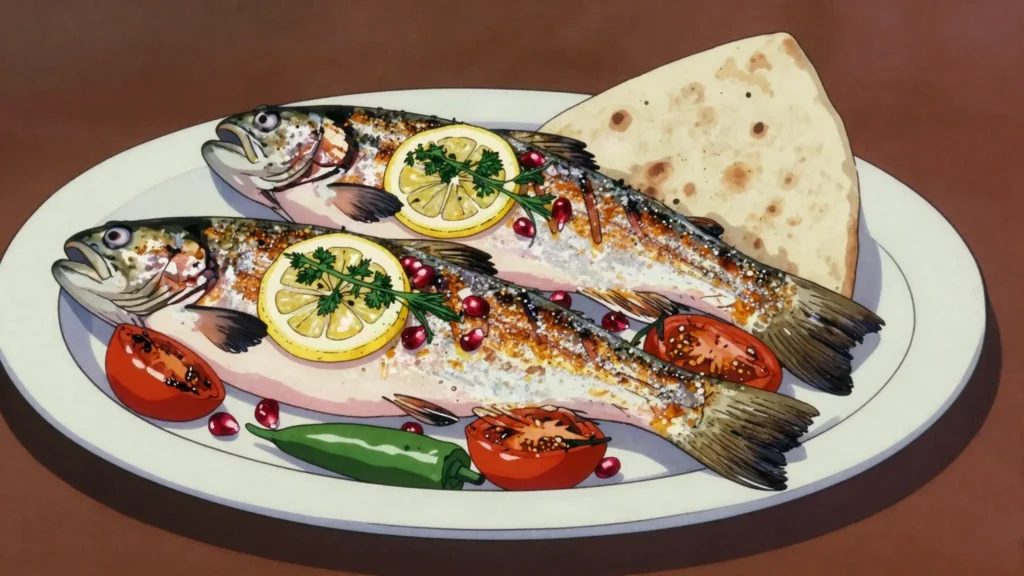
- grilled tomatoes and peppers, and lavash
Directions
- Rinse the trout inside and out and dry them thoroughly, especially the skin; wet skin sticks to the grill and tears.
- Slash each side twice, not quite to the bone, so the heat reaches the thickest part at the same rate as the belly.
- Salt the cavity and the skin generously and leave the trout 15 minutes at room temperature, which firms the surface and draws out surface water.
- Fill each cavity loosely with tarragon, parsley, basil, garlic and two lemon slices. Loosely matters: packed tight, the herbs steam into a wet mass and slow the cooking.
- Oil the skin and set the trout on a grill 12 to 15 cm above grey coals, or in a hinged fish basket, which makes turning far easier.
- Grill 6 to 8 minutes on the first side without moving them, until the skin has crisped and releases from the bars by itself. Forcing it early is what tears the skin.
- Turn once and grill another 5 to 7 minutes. The trout is done when the flesh at the thickest point behind the head is opaque, comes away from the bone when nudged with a knife, and reads 55 to 58°C (135°F) at the spine.
- Slide onto a warm platter, brush with melted butter, squeeze lemon over, scatter pomegranate seeds and serve immediately with grilled vegetables and lavash.
Technique
- Ishkhan means prince, and the name belongs specifically to the Sevan trout, Salmo ischchan, endemic to Lake Sevan. Wild stocks collapsed in the 20th century after the lake was drained for irrigation and the introduction of competing species, and the wild fish is protected. Anything sold today is farmed, and buying farmed is the responsible choice.
- Tarragon is not a substitute for dill here. Armenian cooking uses tarkhun heavily, and it is the herb that makes this taste Armenian rather than generically Caucasian.
- Trout is lean and goes from perfect to dry in about 90 seconds. Pull it while the spine still reads under 58°C (135°F) and let carryover finish it.
- The other classic treatment is poaching in white wine with herbs, served cold; both methods are documented and neither is more authentic than the other.
Substitutions
- No coals: roast the stuffed trout at 200°C (400°F) for 15 to 18 minutes on an oiled tray, or pan-fry in butter 5 minutes a side in a heavy pan.
- No Sevan trout: any whole rainbow or brown trout of similar size behaves identically; Arctic char is the closest in richness.
Variations
- Ishkhan in wine: poached gently in dry white wine with onion, bay and tarragon, then cooled and served with the reduced liquid.
- Some Sevan restaurants stuff the trout with rice, dried apricots and raisins before baking, a festive version.
History
Trout endemic to Lake Sevan; overfishing and falling water levels left the wild fish endangered, so most are farmed.
Frequently asked questions
What is Ishkhan?
Ishkhan is a main from Armenia: lake Sevan trout grilled or poached with herbs. Trout endemic to Lake Sevan; overfishing and falling water levels left the wild fish endangered, so most are farmed.
How long does Ishkhan take to make?
Ishkhan takes 25 min of preparation and 20 min of cooking. The recipe makes 4 servings. It is rated medium to make.
What can I substitute in Ishkhan?
Yes, within limits. No coals: roast the stuffed trout at 200°C (400°F) for 15 to 18 minutes on an oiled tray, or pan-fry in butter 5 minutes a side in a heavy pan. No Sevan trout: any whole rainbow or brown trout of similar size behaves identically; Arctic char is the closest in richness.
What is the most important thing to get right in Ishkhan?
Tarragon is not a substitute for dill here. Armenian cooking uses tarkhun heavily, and it is the herb that makes this taste Armenian rather than generically Caucasian.