
Ingredients
Meat
- 1.4 kgbeef chuck or shin, well trimmed, chilled to near freezing
- 600 glamb fat or beef fat, chilled hard
Cure and spice (percentages of total meat weight)
- 50 gfine sea salt (2.5%)
- 5 gcuring salt no.2, sodium nitrite and nitrate (0.25%)
- 20 gground cumin
- 12 gfenugreek, ground (chaman)
- 10 gsweet paprika
- 6 gground allspice
- 6 gcoarsely ground black pepper
- 20 ggarlic, crushed to a paste
- 10 gsugar to feed the fermentation
- 60 mlice water
Casings
- 3metres beef middle casings, 38 to 40 mm, soaked and rinsed
- butcher’s twine
Directions
- Cut the chilled beef and fat into cubes and grind through a 6 mm plate straight into a bowl set over ice; the fat must stay below 4°C (40°F) or it will smear and the sausage will dry greasy and grey.
- Mix the salt, curing salt, sugar, all the spices and the garlic with the ice water, pour over the mince and knead for 4 to 5 minutes until the mass turns sticky and clings to your hand when you turn it upside down.
- Cover and cure the mixture in the fridge at 3 to 4°C (40°F) for 24 hours, which lets the salt and nitrite penetrate evenly and the spices bloom.
- Stuff the mixture firmly into the beef casings, working out every air pocket, and tie into loops of about 40 cm; prick any visible bubbles with a sterilised needle.
- Ferment the loops at 20 to 22°C (70°F) and 85 to 90 per cent humidity for 48 hours. The surface should darken and the smell should turn pleasantly tangy as the pH falls below 5.3, which is the first food-safety hurdle.
- Press the loops flat between two boards under a light weight for 12 hours in the fridge, then hang and press again the next day; this flattening is the signature shape of sujuk.
- Dry at 12 to 15°C (60°F) and 75 to 80 per cent humidity for 3 to 5 weeks, pressing every few days, until the sticks have lost 35 to 40 per cent of their green weight, weighed on a scale rather than judged by eye.
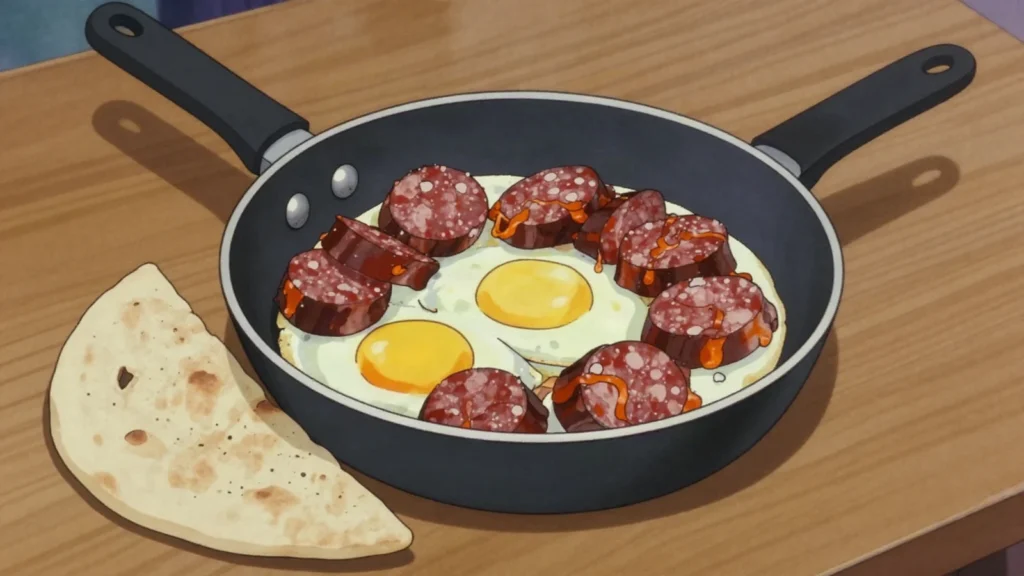
- To eat, slice 5 mm thick and fry in a dry pan over medium heat for 2 minutes a side until the fat runs and the edges curl, then crack eggs into the rendered fat for the classic sujukhov dzvadzegh.
Technique
- The 35 to 40 per cent weight loss and the pH drop are the two things that make this safe. Curing salt no.2 protects against botulism through a long dry cure and is not optional in a home cellar.
- Case hardening is the common failure: too dry an environment sets a shell that traps moisture inside. If the outside is hard and the centre soft, raise the humidity and let it equalise vacuum-sealed in the fridge for a week.
- A white powdery bloom of Penicillium is harmless and desirable. Fuzzy black, green or wet grey growth means discard the batch.
- Fenugreek, or chaman, is the flavour that marks Armenian and Anatolian sujuk out from other dry sausages, and Kayseri-style versions use far more of it.
Substitutions
- No lamb fat: beef fat from the kidney area works and is what most Armenian butchers use.
- Without a curing chamber, a spare fridge with a humidifier and a temperature controller set to 13°C (55°F) gets you there.
- For a same-day approximation, shape the spiced mince into flat patties and pan-fry; you get the flavour but none of the cured texture.
Variations
- Kayseri-style sujuk is heavier on fenugreek and garlic and softer in texture.
- A hot version adds 8 g of Aleppo pepper for warmth without much heat.
- Sujuk is also sliced onto lahmajun or rolled into lavash with tomato and herbs.
History
Cured sausage shared across the Caucasus and Anatolia; Armenian butchers season it hard with cumin, fenugreek and red pepper.
Frequently asked questions
What is Sujuk?
Sujuk is a charcuterie & cured from Armenia: flat spiced cured sausage of beef and lamb, grilled or fried with eggs. Cured sausage shared across the Caucasus and Anatolia; Armenian butchers season it hard with cumin, fenugreek and red pepper.
How long does Sujuk take to make?
Sujuk takes 1 hr plus overnight curing of the meat of preparation and 3 to 5 weeks drying of cooking. The recipe makes about 1.6 kg, four sticks. It is rated hard to make.
What can I substitute in Sujuk?
Yes, within limits. No lamb fat: beef fat from the kidney area works and is what most Armenian butchers use. Without a curing chamber, a spare fridge with a humidifier and a temperature controller set to 13°C (55°F) gets you there. For a same-day approximation, shape the spiced mince into flat patties and pan-fry; you get the flavour but none of the cured texture.
What is the most important thing to get right in Sujuk?
Cut the chilled beef and fat into cubes and grind through a 6 mm plate straight into a bowl set over ice; the fat must stay below 4°C (40°F) or it will smear and the sausage will dry greasy and grey.