The leathery red fruit packed with hundreds of jewel-like seeds — sweet-sour, crunchy, staining — the ancient fruit of Persia and the Mediterranean, and in its cooked-down form, molasses, the sour-sweet backbone of Persian and Levantine cooking.
Where it comes from
The pomegranate was domesticated in Persia and the Caucasus and is one of the oldest cultivated fruits; it appears in Egyptian tombs, in the Old Testament as a symbol of fertility and on the columns of Solomon’s temple, in Greek myth as the fruit that kept Persephone in the underworld, and in Islamic art everywhere. The Moors carried it to Spain — Granada is named for it — and the Spanish to the Americas. Iran, India, Turkey and Afghanistan remain its heartlands.
Fresh, the arils are scattered over salads, rice, yoghurt and desserts for their crunch and colour. Cooked down, the juice becomes pomegranate molasses — rob-e anar in Iran, dibs rumman in the Levant — a thick, tart, dark syrup that is the sourness in Persian fesenjan (with walnuts and chicken), in the Turkish and Levantine muhammara, in fattoush dressing and in marinades for lamb. It does for Persian and Syrian cooking what lemon does elsewhere, with sweetness and depth behind the acid.
Varieties
- Wonderful — The large, deep red Californian and Israeli commercial variety; sweet-tart, dark juicy arils, hard seeds.
- Persian sour and sweet varieties — Iran grows hundreds — some bred sweet for eating, some sour for molasses and cooking.
- Soft-seeded varieties (Mollar de Elche, Hicaz) — Spanish and Turkish types with tender, edible seeds; sweeter and easier to eat.
- White pomegranate — Pale pink or white arils, very sweet, mild; Indian and Middle Eastern.
- Pomegranate molasses — The juice reduced to a dark, tart syrup — sometimes with sugar, better without.
- Anardana — Dried pomegranate seeds, whole or ground; a sour spice in northern Indian and Pakistani cooking.
In the kitchen
To seed: score the skin around the crown, pull the fruit apart into sections along the white membranes, and knock the arils out with the back of a spoon over a bowl, or work them loose under water so the membrane floats. Scatter them raw at the end — over a salad, a pilaf, hummus, roasted aubergine, a dessert. Their crunch is the point; do not cook them.
Pomegranate molasses is used by the spoonful: in a dressing with olive oil for fattoush, in fesenjan with ground walnuts, brushed on lamb or chicken before roasting, in muhammara with red pepper and walnuts, or drizzled over roasted vegetables. To make it, reduce fresh juice slowly with a little lemon until syrupy.
Choosing and keeping
A ripe pomegranate is heavy for its size, with taut, slightly angular skin and a deep colour; a light, round, smooth one is dry inside. Whole fruit keeps two or three weeks at room temperature and two months in the fridge. Seeds keep a few days refrigerated and freeze well.
Pomegranate molasses keeps a year or more in the cupboard once opened. Check the label — some brands are mostly sugar syrup; a good one lists only pomegranate juice and is sharply sour.
Dishes with pomegranate
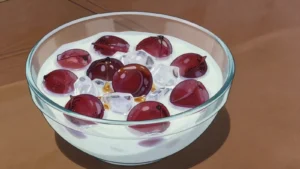 Tub Tim Krob'Crispy rubies' of water chestnut in coconut milk and ice
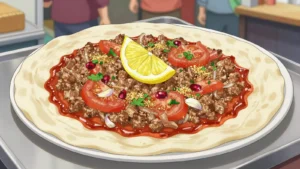 LahmajoPaper-thin round of dough spread with minced meat, rolled up with lemon.
 Chapli KebabFlat minced-beef patty studded with tomato and coriander seed, fried in tallow
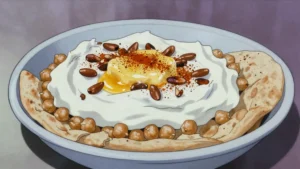 Fattehchickpeas, torn pita and warm yoghurt topped with fried nuts
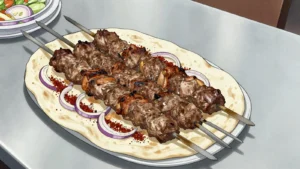 Lula kebabminced lamb kebab molded on flat skewers, served with lavash
 Cig koftespicy kneaded bulgur with pepper paste, served in lettuce with lemon
 Fatayerfolded triangle pies of spinach, cheese or za'atar
 Ma-osh-shaeernon-alcoholic malt drink in fruit flavours, drunk with kabab
Pomegranate is tagged on 50 dishes from 14 countries in the atlas. These notes are written from general knowledge and carry no per-fact citation — see About.