
Ingredients
Dough
- 500 gplain flour
- 200 gcold unsalted butter, cubed
- 150 gmatsun or thick yoghurt
- 1egg
- 1 tspbaking powder
- ½ tspbicarbonate of soda
- ½ tspsalt
- 1 tbspcaster sugar
Khoriz filling
- 200 gplain flour
- 150 gsoft unsalted butter
- 150 gicing sugar
- 1 tspvanilla extract
- ½ tspground cinnamon, optional
- 1 pinchsalt
To finish
- 1egg yolk beaten with 1 tsp milk
- melted butter for brushing between layers
Directions
- Rub the cold butter into the flour, baking powder, bicarbonate, salt and sugar until it looks like breadcrumbs, then work in the matsun and egg to a soft dough. Do not knead it smooth; a little unevenness gives the flaky layers. Chill for 1 hour.
- Make the khoriz by rubbing the soft butter into the flour and icing sugar with your fingertips until it is a crumbly, sandy mass that holds together when squeezed. Add the vanilla and cinnamon. Chill it too.
- Roll the dough on a floured bench into a rectangle about 40 by 30 cm and 3 mm thick, brush it with melted butter, and fold it in three. Turn 90 degrees and repeat twice more, resting 15 minutes in the fridge between folds.
- Roll the rested block into a 35 cm circle about 5 mm thick.
- Spread the khoriz evenly over the whole surface, leaving a 2 cm border, pressing it down lightly so it stays put.
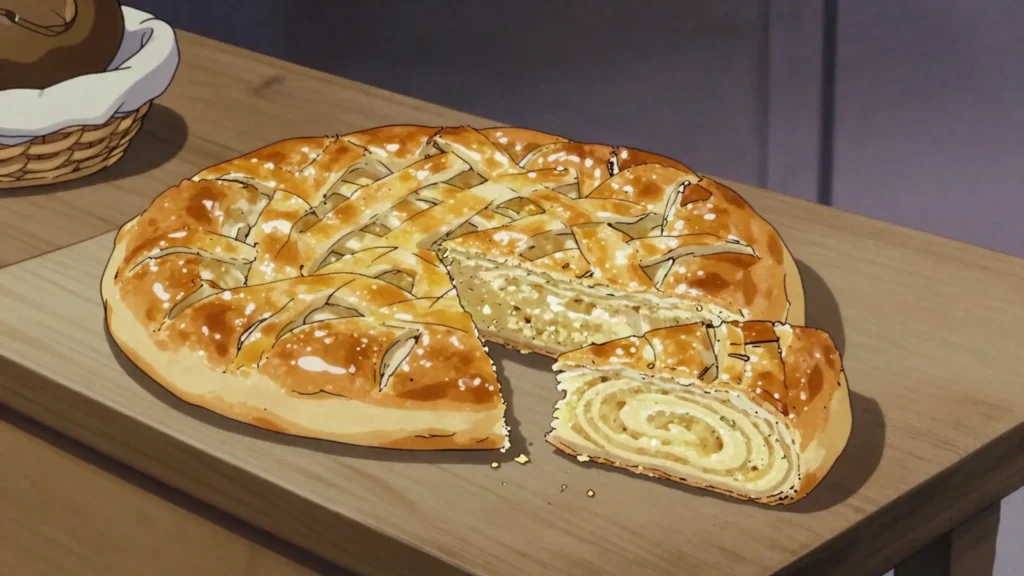
- Roll the circle up into a tight log, then coil the log into a spiral and press it down flat with the palm of your hand into a round about 25 cm across and 3 cm thick.
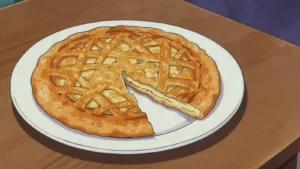
- Transfer to a lined tray, brush all over with egg yolk wash, and score the top with the tines of a fork or a knife in a lattice, sunburst or comb pattern. The pattern is traditional and every household has one.
- Bake at 180°C (350°F) for 35 to 40 minutes, until deep golden brown and firm; the filling should be set and sandy, not liquid. Cool at least 30 minutes before cutting into wedges, and serve with tea or coffee.
Technique
- Khoriz is the whole identity of gata: a dry crumb of flour, butter and sugar rather than a wet filling. Cooked flour in butter is what gives that sandy, shortbread-like interior, and a runny custard filling is simply a different pastry.
- There are as many gatas as there are regions. The Karabakh version is layered and flaky, the Geghard version sold outside the monastery is small and dense, and the Garni version is often round and stamped with a wooden mould.
- Matsun in the dough is not decorative. Its acidity reacts with the bicarbonate for lift and tenderises the gluten, giving the short bite gata should have.
Substitutions
- No matsun: use full-fat plain yoghurt or soured cream, both of which have enough acidity to activate the bicarbonate.
Variations
- Nazook is the log-shaped relative, rolled and cut into diamonds before baking, and is the form most familiar in the diaspora.
- Some bakers work ground walnuts into the khoriz, and a version from Lori adds a spoon of honey to the filling.
History
Sweet layered bread with a buttery khoriz filling; the version sold outside Geghard monastery is bought by pilgrims.
Frequently asked questions
What is Gata?
Gata is a bread & pastry from Armenia: sweet layered pastry with buttery khoriz filling. Sweet layered bread with a buttery khoriz filling; the version sold outside Geghard monastery is bought by pilgrims.
How long does Gata take to make?
Gata takes 50 min plus 1 hr chilling of preparation and 40 min of cooking. The recipe makes one large gata, 12 wedges. It is rated medium to make.
What can I substitute in Gata?
Yes, within limits. No matsun: use full-fat plain yoghurt or soured cream, both of which have enough acidity to activate the bicarbonate.
What is the most important thing to get right in Gata?
Rub the cold butter into the flour, baking powder, bicarbonate, salt and sugar until it looks like breadcrumbs, then work in the matsun and egg to a soft dough. Do not knead it smooth; a little unevenness gives the flaky layers. Chill for 1 hour.