
Ingredients
Dough
- 300 gplain flour
- 50 gglutinous rice flour
- 7 ginstant yeast
- 1 tbspsugar
- ½ tspsalt
- 200 mlwarm milk
- 1 tbspoil
Filling
- 120 gdark brown sugar
- 2 tspground cinnamon
- 60 gwalnuts, chopped
- 1 tbspglutinous rice flour
To fry
- oil
Directions
- Use glutinous rice flour in the dough alongside the plain flour.
- That glutinous rice flour is what gives hotteok its chew. Plain flour alone gives you a bread roll, and the springy, slightly stretchy dough is half the pleasure of the thing.
- Mix the flours, yeast, sugar and salt, add the warm milk and oil, and knead for 8 minutes to a very soft, sticky dough.
- Keep it soft and sticky. It is wetter than most doughs, and oiled hands are how you handle it rather than extra flour.
- Prove for 1 hour 30 minutes, until doubled.
- Mix the brown sugar, cinnamon, walnuts and the spoonful of glutinous rice flour.
- The rice flour in the filling thickens the melting sugar just enough that it flows rather than running out of the first bite, and it is the single most useful trick in the recipe.
- Oil your hands, take a piece of dough, flatten it into a disc, and put a heaped spoonful of filling in the middle.
- Gather the edges up over the filling, pinch them tightly closed, and set it seam side down.
- Seal it completely. Molten sugar finds any gap, burns onto the pan, and burns you as well.
- Heat a thin film of oil in a heavy pan over a medium heat.
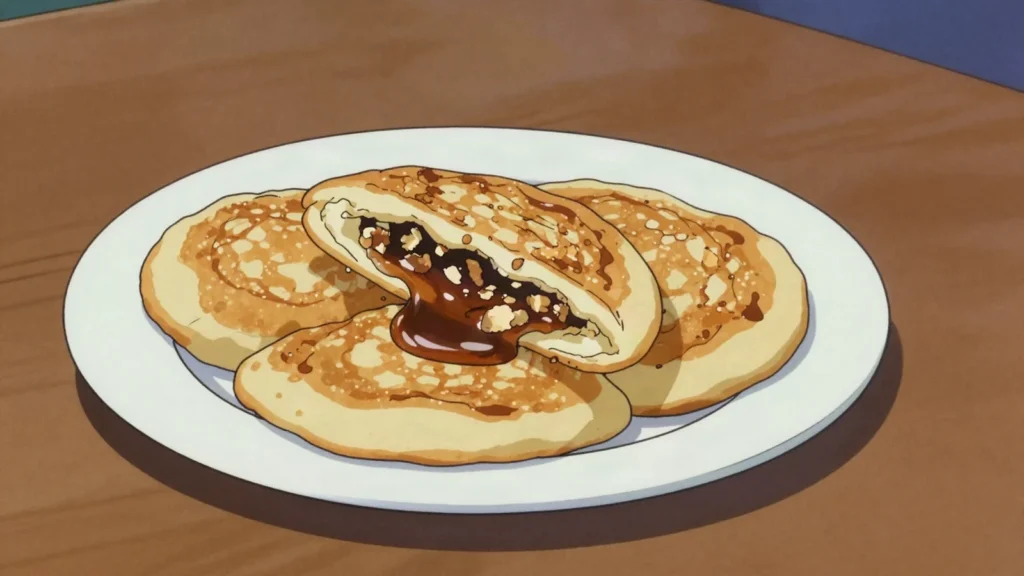
- Put the ball in seam side down, cook it for 30 seconds, then press it flat with a spatula to about 1 cm thick.
- Press it once only, and only after the seam has set. Pressed straight away it bursts.
- Fry for 2 to 3 minutes a side, until deep golden and crisp.
- Serve immediately in a folded paper cup, and warn whoever eats it that the middle is molten.
- The filling is genuinely dangerously hot for the first minute, which every Korean street vendor says and every customer forgets.
- Chinese merchants arriving in the late nineteenth century adapted their filled breads for Korea by packing them with brown sugar.
Technique
- It is winter street food, appearing on carts from about November and gone again by spring.
- The hotteok press is a cheap flat metal disc with a handle, and any flat spatula does the same job.
- Savoury versions exist, filled with japchae, and are sold from the same carts.
Substitutions
- All plain flour, accepting noticeably less chew.
- Sunflower seeds or pine nuts in place of walnuts.
Variations
- Ssiat hotteok, the Busan version split open and packed with seeds after frying.
- Made with green tea powder in the dough.
- Japchae hotteok, the savoury one.
History
Chinese merchants arriving in the late nineteenth century adapted their filled breads for Korea by packing them with brown sugar syrup.
Frequently asked questions
What is Hotteok?
Hotteok is a street food from South Korea: griddled dough pockets oozing brown sugar, cinnamon and nuts, winter treat. Chinese merchants arriving in the late nineteenth century adapted their filled breads for Korea by packing them with brown sugar syrup.
How long does Hotteok take to make?
Hotteok takes 20 min plus 1 hr 30 min rising of preparation and 20 min of cooking. The recipe makes 8 pancakes. It is rated medium to make.
What can I substitute in Hotteok?
Yes, within limits. All plain flour, accepting noticeably less chew. Sunflower seeds or pine nuts in place of walnuts.
What is the most important thing to get right in Hotteok?
Keep it soft and sticky. It is wetter than most doughs, and oiled hands are how you handle it rather than extra flour.