
Ingredients
Base
- 200 gcornflour (cornstarch)
- 1.2 litreswater, divided
- 600 gsugar
- 1 tbsprosewater
- ½ tspsaffron threads, crushed and steeped in 3 tbsp hot water
- 1 tspground cardamom
- ¼ tspsaffron-orange or green food colouring (traditional)
Enriching
- 250 gghee, melted and kept warm
- 1 tbsprosewater (second addition)
Nuts and finish
- 80 gblanched almonds, halved
- 60 gcashews, halved
- 60 gpistachios, whole
- 1 tbspblack or white sesame seeds
Directions
- Whisk the cornflour into 400 ml of cold water until there is not a single lump; this slurry must be perfectly smooth before it meets any heat.
- Bring the remaining 800 ml water and all the sugar to a boil in a wide, heavy pan (traditionally a copper mirjal) and boil 5 minutes until it is a clear thin syrup.
- Lower the heat and pour the cornflour slurry into the syrup in a steady stream while stirring hard with a wooden paddle. It will thicken and turn opaque within a minute.
- Now begin the long cook: stir constantly over low heat for 45–60 minutes. Never stop moving the paddle or it catches and turns bitter.
- As it thickens, start adding the warm ghee a ladleful at a time, waiting until each addition is fully absorbed before the next. The mass will pass through a stiff, dull stage and then loosen and gloss.
- Add the saffron water, cardamom and colouring about halfway through, and the rosewater in the last 5 minutes so its perfume is not driven off.
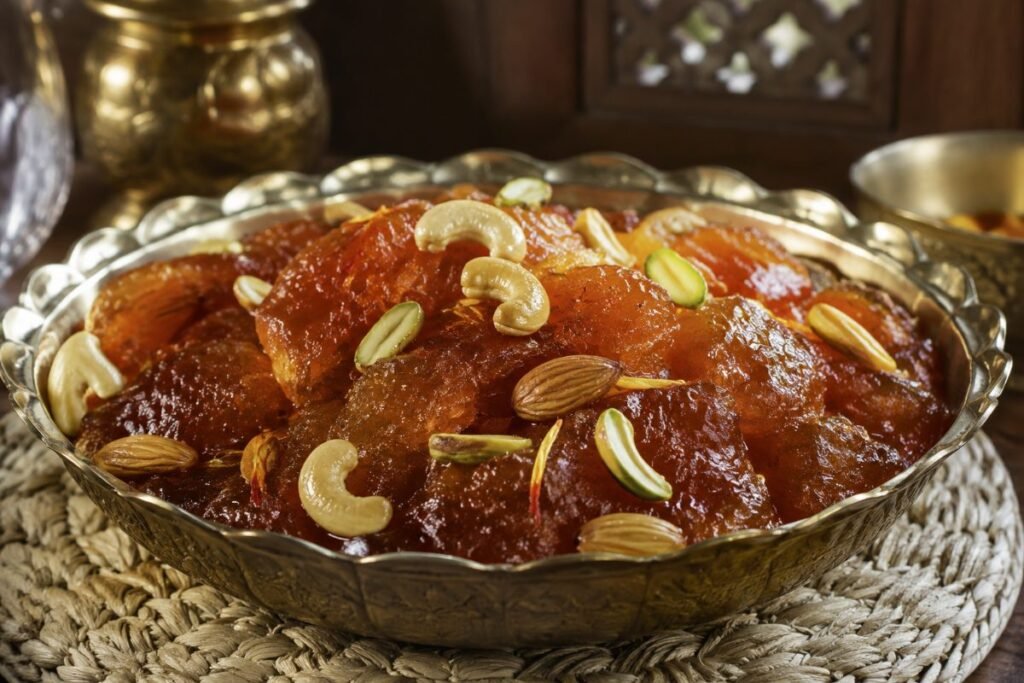
- The halwa is ready when it is translucent, pulls cleanly away from the sides of the pan in a single mass, and a spoon dragged through leaves a track that closes slowly. A little ghee will pool at the edges.
- Stir in half the nuts, pour into an oiled tray or into small brass bowls, level the top with an oiled spatula, and press the remaining nuts and sesame over the surface.
- Leave uncovered at room temperature at least 6 hours, ideally overnight, until set to a firm, springy chew. Cut into diamonds or scoop straight from the bowl.
Technique
- Bahraini halwa has been made commercially in Muharraq since the 1850s, cooked over wood fire in huge copper pots and stirred by hand with a long oar — the arm work is genuinely the recipe.
- It is not a nut-paste halva like the Levantine kind. The texture should be dense, glossy and elastic, closer to Turkish delight than to fudge.
- Underdone halwa never sets and tastes of raw starch; the colour change from milky to translucent is the reliable signal.
- Do not refrigerate. Cold makes it weep ghee and go grainy.
Substitutions
- Ghee is not optional for flavour, but unsalted butter clarified at home works identically; do not use oil, which will not carry the saffron.
- If you cannot find saffron, a pinch of turmeric plus a drop of orange colouring gives the traditional look, though not the aroma.
Variations
- Green cardamom-heavy halwa tinted emerald, the second classic Bahraini colour, served alongside the orange at weddings.
- Some houses fold in a handful of shredded coconut or a spoon of ground mastic in the last minutes.
History
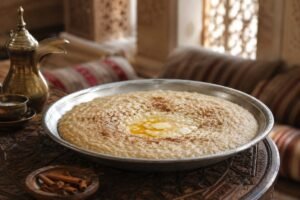
Translucent saffron and rosewater halwa stirred in copper pots; Muharraq families have made it commercially since the nineteenth century.
Frequently asked questions
What is Halwa Bahraini?
Halwa Bahraini is a dessert from Bahrain: gelatinous saffron-cornstarch sweet with nuts, made since the 1850s. Translucent saffron and rosewater halwa stirred in copper pots; Muharraq families have made it commercially since the nineteenth century.
How long does Halwa Bahraini take to make?
Halwa Bahraini takes 20 min of preparation and 1 hr 30 min plus 6 hr setting of cooking. The recipe makes 12 servings (one 25 cm tray). It is rated hard to make.
What can I substitute in Halwa Bahraini?
Yes, within limits. Ghee is not optional for flavour, but unsalted butter clarified at home works identically; do not use oil, which will not carry the saffron. If you cannot find saffron, a pinch of turmeric plus a drop of orange colouring gives the traditional look, though not the aroma.
What is the most important thing to get right in Halwa Bahraini?
Whisk the cornflour into 400 ml of cold water until there is not a single lump; this slurry must be perfectly smooth before it meets any heat.