
Ingredients
Choux
- 250 mlwater
- 100 gbutter
- ½ tspsalt
- 1 tspsugar
- 150 gstrong flour
- 4eggs
Crème pâtissière
- 500 mlmilk
- 6egg yolks
- 120 gsugar
- 45 gcornflour
- 1vanilla pod
- 30 gbutter
Glaze
- 200 gfondant, or 150 g dark chocolate with 100 ml cream
Directions
- Make the pastry cream first so that it has time to chill. Infuse the milk with the split vanilla pod, whisk the yolks with the sugar and cornflour, temper, then cook it out for a full minute past thickening.
- Beat in the butter, strain it, press film onto the surface and refrigerate.
- For the choux, bring the water, butter, salt and sugar to a full rolling boil.
- Tip in all the flour at once and beat over the heat for 2 to 3 minutes, until it forms a ball and a thin film appears on the base of the pan.
- Cool it to lukewarm, then beat in the eggs one at a time. The paste is ready when it falls from the spoon in a slow V and holds a piped ridge.
- Judge by consistency rather than by counting eggs. Eggs vary in size and the fourth one may not all be needed.
- Pipe fingers of about 12 cm using a large fluted nozzle, holding the bag at a low angle and keeping the pressure even.
- Use a fluted nozzle rather than a plain one. The ridges let the éclair expand along set lines instead of splitting at random, which is why professional ones are straight.
- Bake at 200°C (400°F) for 15 minutes, then lower the oven to 170°C (340°F) and bake for a further 20 to 25 minutes.
- Do not open the oven for the first 20 minutes. The rush of cool air collapses them and they never recover.
- Pierce each end and return them to the switched-off oven for 10 minutes to dry the insides out.
- Cool completely, then pipe the pastry cream in through both ends until each one feels heavy in the hand.
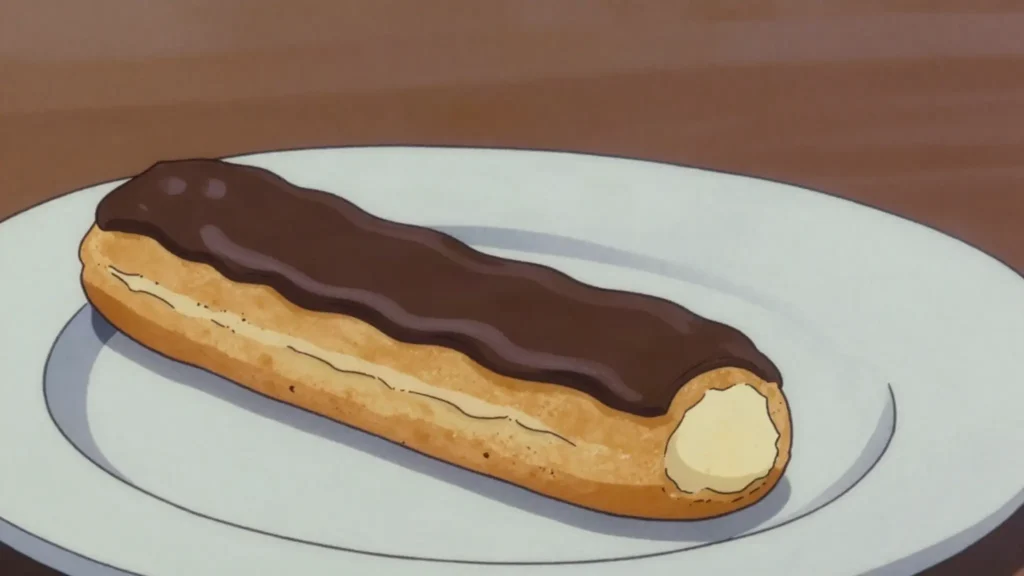
- Warm the fondant to blood heat only, or make a chocolate glaze, and dip the tops, drawing a finger along the edge to leave a clean line.
- Set at room temperature and eat the same day.
- It is attributed to Antonin Carême in early nineteenth-century Paris, and the name, meaning lightning, appears in French and American cookbooks from the 1860s.
Technique
- Fondant must never go above blood heat. Overheated, it loses its shine and dries dull and streaky.
- Fill them heavy. An éclair that feels light has not been filled properly and will be hollow at one end.
- They are at their best within a few hours. Choux goes soft under a wet filling overnight.
Substitutions
- A chocolate ganache glaze, which is far more forgiving than fondant.
- Plain flour if you have no strong flour, though the rise will be a little lower.
Variations
- Filled with coffee or chocolate pastry cream and glazed to match.
- Religieuse, made as two stacked choux buns.
- Filled with lightly sweetened whipped cream, which is the simpler home version.
History
Attributed to Antonin Carême in early nineteenth-century Paris; the name, meaning lightning, appears in French and American cookbooks from the 1860s.
Frequently asked questions
What is Éclair?
Éclair is a bread & pastry from France: choux pastry finger filled with pastry cream, chocolate glaze. Attributed to Antonin Carême in early nineteenth-century Paris; the name, meaning lightning, appears in French and American cookbooks from the 1860s.
How long does Éclair take to make?
Éclair takes 45 min plus chilling of preparation and 45 min of cooking. The recipe makes 12 éclairs. It is rated hard to make.
What can I substitute in Éclair?
Yes, within limits. A chocolate ganache glaze, which is far more forgiving than fondant. Plain flour if you have no strong flour, though the rise will be a little lower.
What is the most important thing to get right in Éclair?
Judge by consistency rather than by counting eggs. Eggs vary in size and the fourth one may not all be needed.