
Ingredients
Filling
- 300 gyellow split peas, soaked 2 hours and drained
- 1 tspground turmeric
- 1 tspwhole cumin seed
- 1 litrewater
- 1.5 tspsalt
Dough
- 500 gplain white flour
- ½ tspground turmeric
- 1 tspsalt
- 3 tbspsunflower oil, plus more for the tawa
- about 300 ml warm water
To serve
- Cari gros pois: 300 g butter beans simmered with onion, garlic, thyme, curry leaf, tomato and 2 tbsp massale
- Rougaille sauce, 400 ml
- Satini coco: 100 g grated coconut ground with 2 chillies, coriander, tamarind and salt
- Mazavaroo (crushed chilli paste), to taste
Directions
- Simmer the drained split peas with the turmeric and half the cumin in the water for 25–30 minutes, until a pea crushes easily but the peas still hold their shape. This is the whole trick: overcooked peas turn to mush and cannot be ground dry.
- Drain them thoroughly and spread on a tray for 15 minutes to steam dry, then grind while still warm in a food processor or a hand mill with the salt to a fine, dry, sandy powder, not a paste. Sieve it and regrind any coarse bits.
- Toast the remaining cumin seed in a dry pan for 30 seconds, grind, and mix through the pea powder.
- Make the dough: rub the turmeric, salt and oil into the flour, then add the warm water gradually to a soft, smooth, slightly sticky dough. Knead 8 minutes, oil the surface and rest 30 minutes covered.
- Divide the dough into 12 balls. Flatten one in the palm into a cup, spoon in a heaped tablespoon of the pea powder, then draw the edges up over it and pinch closed, sealing it completely with no air trapped inside.
- Rest the filled balls seam-down for 10 minutes, then roll each out gently on a lightly floured board into a thin round about 18 cm across. Roll from the centre outwards with light, even pressure; too much force splits the seam and the filling escapes.
- Cook on a hot tawa or heavy flat pan over medium heat for about 45 seconds, until pale blisters appear, then flip.
- Brush the cooked side lightly with oil, flip again after 45 seconds, and press the edges with a cloth so the puri puffs. It should stay soft, pale gold and pliable, with no crisp or brown patches; a dholl puri that crackles has been overcooked.
- Stack the finished puris under a cloth so they steam and stay flexible.
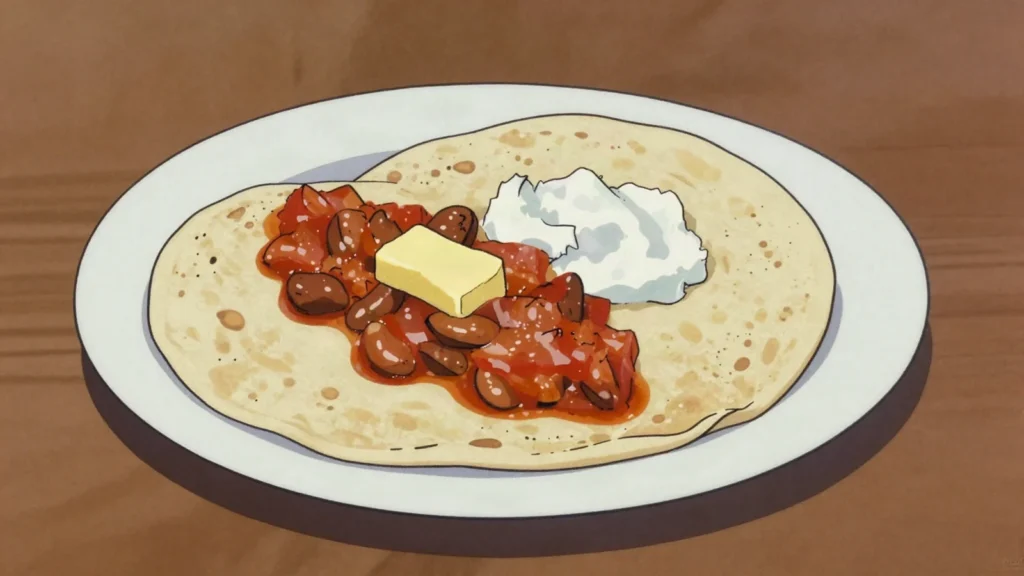
- To eat, lay two puris overlapping on a square of paper, spoon on the butter bean curry, then rougaille, satini coco and a smear of mazavaroo, roll it up tightly and eat with the hands, standing at the stall.
Technique
- The filling must be a dry powder. Mauritian vendors grind the cooked peas in a hand-cranked mill while warm and pass them through a sieve, because any dampness turns to paste and glues the layers together when you roll.
- Two puris are always served together, never one, and always with cari gros pois. That pairing is fixed street-food grammar in Port Louis.
- Turmeric goes into both dough and filling. It is there for the pale gold colour as much as the flavour.
- Do not let them go crisp. The whole point of a dholl puri is that it stays soft enough to roll around the curry without cracking.
Substitutions
- No yellow split peas: chana dal works and is used by some vendors, though the grind is grittier and the flavour nuttier.
- No tawa: a heavy cast-iron frying pan over medium heat is fine, but avoid non-stick, which never gets hot enough to blister the surface.
- Cari gros pois can be replaced with a lima or cannellini bean curry made the same way.
Variations
- Farata is the plain, flaky, unfilled cousin, served with the same curries.
- Roti chaud in the north is served with more rougaille and less bean curry.
- Some stalls now offer a version with a thicker filling and a spoon of achard de legumes rolled inside.
History
A thin, soft flatbread, made by stuffing a dough with ground yellow split peas seasoned with turmeric and cumin before rolling it out thin and cooking it on a griddle, documented across Mauritius with clear roots in Indian indentured laborer culinary tradition, since dholl puri traces directly to Indian roti and dal traditions brought to Mauritius by Indian workers who arrived on the island during the 1800s following the abolition of slavery in the British Empire. Its distinctive technique, incorporating the split pea filling directly into the dough before rolling rather than serving dal separately, reflects a specifically Mauritian adaptation of that Indian culinary lineage, developed over generations on the island. Dholl puri remains one of Mauritius’s most iconic and widely eaten street foods.
Frequently asked questions
What is Dholl puri?
Dholl puri is a street food from Mauritius: soft split-pea flatbreads with curry, rougaille and pickles; island icon. A thin, soft flatbread, made by stuffing a dough with ground yellow split peas seasoned with turmeric and cumin before rolling it out thin and cooking it on a griddle, documented across Mauritius with clear roots in Indian indentured laborer culinary tradition, since dholl puri traces directly to Indian roti and dal traditions brought to Mauritius by Indian workers who arrived on the island during the 1800s following the abolition of slavery in the British Empire. Its distinctive technique, incorporating the split pea filling directly into the dough before rolling rather than serving dal separately, reflects a specifically Mauritian adaptation of that Indian culinary lineage, developed over generations on the island. Dholl puri remains one of Mauritius’s most iconic and widely eaten street foods.
How long does Dholl puri take to make?
Dholl puri takes 45 min of preparation and 2 hr soaking, 40 min cooking of cooking. The recipe makes 12 puri, 4–6 servings. It is rated hard to make.
What can I substitute in Dholl puri?
Yes, within limits. No yellow split peas: chana dal works and is used by some vendors, though the grind is grittier and the flavour nuttier. No tawa: a heavy cast-iron frying pan over medium heat is fine, but avoid non-stick, which never gets hot enough to blister the surface. Cari gros pois can be replaced with a lima or cannellini bean curry made the same way.
What is the most important thing to get right in Dholl puri?
Simmer the drained split peas with the turmeric and half the cumin in the water for 25–30 minutes, until a pea crushes easily but the peas still hold their shape. This is the whole trick: overcooked peas turn to mush and cannot be ground dry.