
Ingredients
Water dough
- 300 gplain flour
- 60 gbutter or lard
- 1 tspsalt
- about 130 ml water
Oil dough
- 180 gplain flour
- 100 glard or shortening
Filling
- 500 gpotatoes, diced small
- 300 gchicken, diced
- 1onion, chopped
- 3 tbspcurry powder
- 1 tspturmeric
- 1 tspsugar
- 150 mlcoconut milk
- 3 tbspoil
- salt
- 4hard-boiled eggs, quartered
To fry
- oil, for deep frying
To serve
- hot, with a cup of tea
Directions
- Rub the fat into the flour and salt, then add water to make a soft pliable dough. Knead it for five minutes until smooth, then rest it for thirty minutes. Rub the fat into the flour until it forms a soft, greasy, cohesive mass. It should be soft but not runny, and it should hold together when pressed.
- Chill it briefly if it is too soft to handle. Both doughs must be of similar softness before they are combined. Adjust with a little more flour or fat until they feel alike. Divide both doughs into equal small portions. Flatten a piece of water dough, place a piece of oil dough in the centre, and wrap it completely. Turn it ninety degrees, roll it out again, and roll it up again.
- Rest the dough for ten minutes between each roll if it resists. Chill it if the fat begins to soften and come through. Stand each coil on its cut end and roll it flat from that position. Now the filling, and the rule about it.
- Cook the onion, curry powder and turmeric in oil, then add the diced potato and chicken. Add the coconut milk and cook until the potato is tender and the mixture is completely dry.
- Cook it until there is no liquid at all, since wet filling makes the pastry soggy and bursts it in the oil. Dice the potato small, about half a centimetre, so it fits neatly into the pocket. Let the filling cool completely before use.
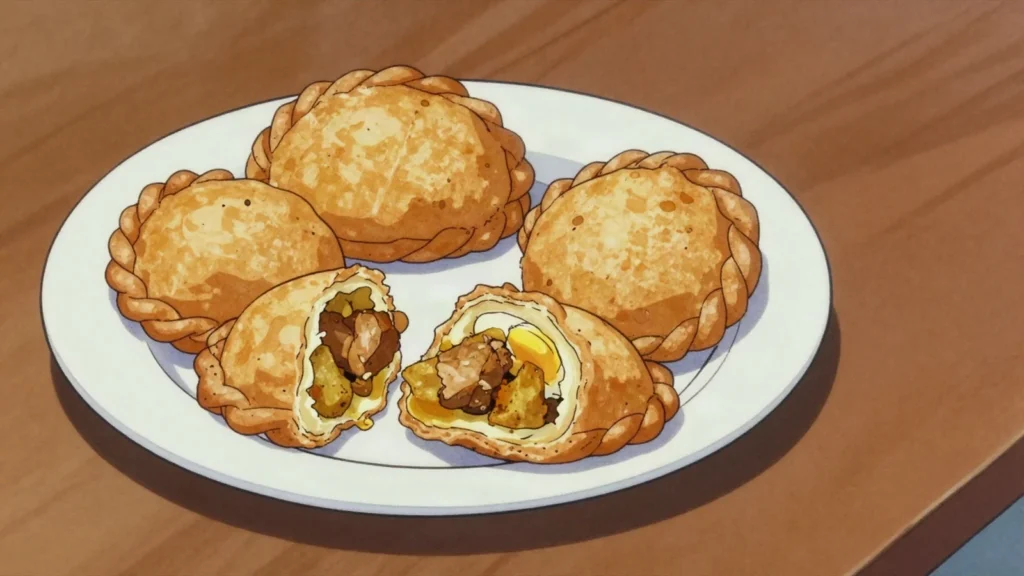
- Put filling and a piece of egg on one half of the rolled circle and fold it over. Do not overfill, since an overfilled puff cannot be sealed and will open in the fryer. Press the edges together firmly, working out any trapped air. Fold the sealed edge over on itself in a rope pattern, working along the curve. It takes practice and a fork crimp works while you learn.
- Heat the oil to about 160°C, which is moderate rather than hot. Fry them at a moderate temperature, since the layers need time to separate and set. Hot oil colours the outside before the pastry has puffed, and the spiral does not open.
- Fry for six to eight minutes, turning once, until golden and the layers have visibly separated. Do not crowd the pan as you fry. Drain them on a rack and serve them hot with tea.
Technique
- It is a colonial-era hybrid with several plausible ancestors rather than one.
- The oil dough contains no water, which is what separates the layers.
- Roll each coil from its cut end, which is what exposes the spiral.
Substitutions
- A single short pastry, for the easier plain version.
- Ready-made puff pastry, which is a considerable compromise.
Variations
- Made with sardine filling, which is common.
- Made vegetarian, with potato and peas alone.
- Baked rather than fried, which is drier.
History
Crimped pastry of curried potato, egg and chicken, a colonial-era hybrid traced to the Cornish pasty, the empanada and the Malay epok-epok.
Frequently asked questions
What is Curry Puff?
Curry Puff is a snack from Singapore: flaky pastry pocket of curried potato, chicken and egg. Crimped pastry of curried potato, egg and chicken, a colonial-era hybrid traced to the Cornish pasty, the empanada and the Malay epok-epok.
How long does Curry Puff take to make?
Curry Puff takes 1 hr plus 1 hr chilling of preparation and 30 min of cooking. The recipe makes about 20. It is rated hard to make.
What can I substitute in Curry Puff?
Yes, within limits. A single short pastry, for the easier plain version. Ready-made puff pastry, which is a considerable compromise.
What is the most important thing to get right in Curry Puff?
Chill it briefly if it is too soft to handle. Both doughs must be of similar softness before they are combined. Adjust with a little more flour or fat until they feel alike. Divide both doughs into equal small portions. Flatten a piece of water dough, place a piece of oil dough in the centre, and wrap it completely. Turn it ninety degrees, roll it out again, and roll it up again.