
Ingredients
Batter
- 500 mlwhole milk
- 50 gbutter
- 1vanilla pod, split
- 100 gplain flour
- 250 gcaster sugar
- 2whole eggs
- 2egg yolks
- 50 mldark rum
- a pinch of salt
Moulds
- 30 gbeeswax
- 30 gclarified butter
- copper canelé moulds
Directions
- Bring the milk to a simmer with the butter and the split vanilla pod, then take it off the heat and leave it to infuse for 30 minutes.
- Whisk the flour and sugar together, then whisk in the whole eggs and the yolks. Work it as little as you can: canelé batter is closer to a crêpe batter than a cake batter, and air beaten into it gives you a hollow that collapses in the oven.
- Pour the warm milk in slowly, whisking gently, then stir in the rum and the salt.
- Strain the batter and refrigerate it for at least 24 hours, and 48 if you can manage it.
- This rest is not optional. It hydrates the flour and, more importantly, lets the gluten relax so the batter does not climb the mould and blow out over the rim.
- Prepare the moulds. Melt the beeswax together with the clarified butter, brush or pour it into each copper mould, and invert them on a rack to drain so only a thin film is left behind.
- The beeswax is what gives a canelé its lacquered, almost brittle shell, and it is exactly why an unwaxed silicone mould produces a soft brown cake instead.
- Chill the coated moulds thoroughly. Stir the cold batter gently without whisking it, and fill each mould to about 1 cm below the rim.
- Bake at 230°C (445°F) for 15 minutes, then lower the oven to 180°C (355°F) and bake for a further 50 minutes to 1 hour.
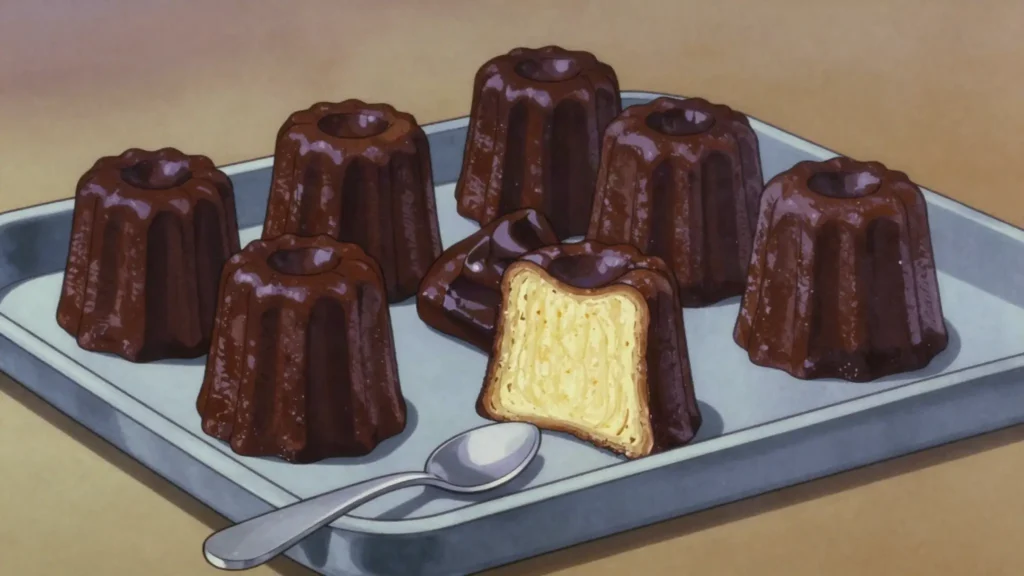
- The finished canelé should be almost black outside. Pale is wrong: the shell is meant to be caramelised to a point that looks burnt to anyone who has not seen one before.
- Turn them out immediately while hot, or the wax sets and holds them fast in the mould.
- Cool on a rack and eat within a few hours. The contrast between the hard shell and the soft custard centre has gone by the following day.
Technique
- Long rest, copper and wax, very dark bake. Those are the three things, and skipping any one of them produces something that is not a canelé.
- The Bordeaux link is to convent bakers who had egg yolks to spare because the whites were used for fining wine.
- Copper moulds are expensive and last a lifetime, and they hold heat in a way nothing else matches.
Substitutions
- Silicone moulds brushed with butter alone, which works and gives a distinctly softer shell.
- Vanilla extract in place of the pod, added with the rum rather than infused.
Variations
- With orange blossom water in place of the rum.
- Made in miniature moulds, baked for around 35 minutes.
- With the vanilla doubled and the rum left out, for children.
History
A Bordeaux speciality linked to convent bakers using egg yolks left over from fining wine.
Frequently asked questions
What is Canelé?
Canelé is a bread & pastry from France: small fluted rum and vanilla custard cake with a dark caramelised shell. A Bordeaux speciality linked to convent bakers using egg yolks left over from fining wine.
How long does Canelé take to make?
Canelé takes 30 min plus 24 hr resting of preparation and 1 hr 15 min of cooking. The recipe makes 16 canelés. It is rated hard to make.
What can I substitute in Canelé?
Yes, within limits. Silicone moulds brushed with butter alone, which works and gives a distinctly softer shell. Vanilla extract in place of the pod, added with the rum rather than infused.
What is the most important thing to get right in Canelé?
Whisk the flour and sugar together, then whisk in the whole eggs and the yolks. Work it as little as you can: canelé batter is closer to a crêpe batter than a cake batter, and air beaten into it gives you a hollow that collapses in the oven.