
Ingredients
Fish
- 4whole tilapia of about 400 g each, scaled and gutted, gills removed
- juice of 3 limes, about 90 ml
- 6garlic cloves, crushed to a paste with 1 tsp salt
- 1 tspcoarsely ground black pepper
- 1 tspfine salt
- 3 tbspred palm oil, melted
Basting oil
- 60 mlred palm oil
- 1onion, very finely chopped
- 2jindungo chillies, minced
- juice of 1 lime
To serve
- 500 gfunge de bombo (cassava porridge), stiff and hot
- 150 ggindungo sauce
- 2onions, sliced into rings and steeped 10 min in lime juice and salt
- 2tomatoes, sliced
Directions
- Score each tilapia three times on each side, cutting on the diagonal down to the bone, so the marinade and the heat reach the thickest muscle.
- Rub the garlic paste, salt and pepper into the cuts and the belly cavity, then pour over the lime juice and turn the fish to coat.
- Marinate 20–30 minutes only, no longer: lime acid begins to cure the flesh and it will go chalky on the grill.
- Light a charcoal fire and let it burn down to grey-ashed embers with no flame; you should be able to hold a hand 15 cm above the grate for four seconds.
- Lift the fish out, wipe off the loose marinade so it does not steam, and brush all over with the melted palm oil. Oil the grill bars well.
- Grill 7–8 minutes on the first side without touching the fish, until the skin has crisped and releases cleanly from the bars.
- Turn once, brush again, and grill 6–7 minutes more, basting with the onion and chilli oil, until the flesh at the backbone is opaque and the dorsal fin lifts out with no resistance.
- Whisk the remaining basting oil with the lime juice, spoon it over the hot fish and let it sit 3 minutes.
- Serve with a mound of funge, the lime-soused onion, sliced tomato, and gindungo on the side for each person to add.
Technique
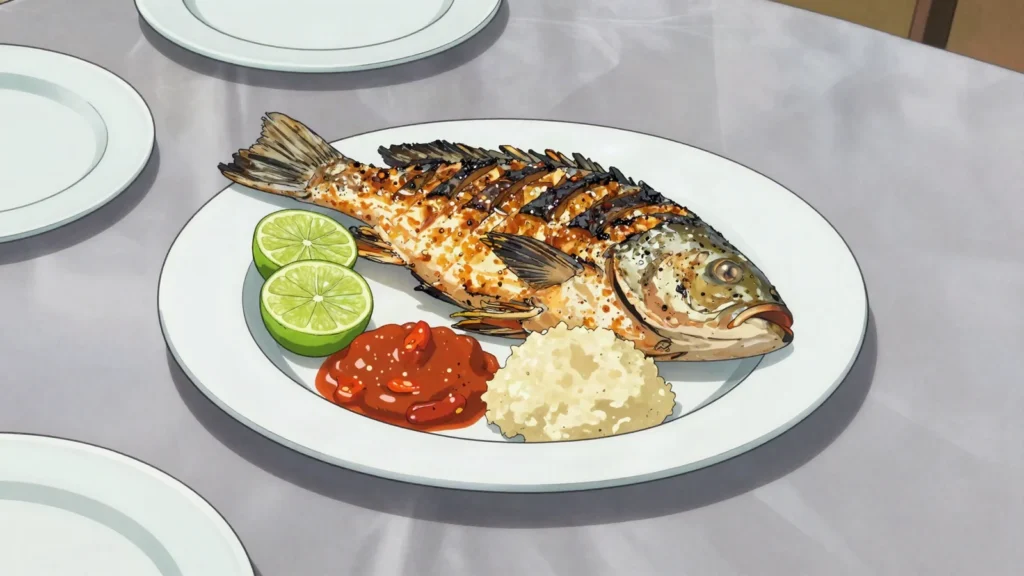
- Cacusso is the Kimbundu name for the tilapia of the Kwanza river and Angola’s lagoons; along the Luanda waterfront it is the default grilled fish and it is always cooked whole, head on, which is what keeps it moist.
- Palm oil is not interchangeable with other fats here. Its carotenoid colour stains the skin orange-red and its flavour is the dish; use unrefined red palm oil, which is thick and solid below about 25°C (75°F).
- The fire must be embers, not flames. Dripping palm oil flares badly, and a flame-cooked tilapia is sooty outside and raw at the bone.
Substitutions
- No tilapia: any firm, mild freshwater fish of similar size works, such as carp, or sea bream at a push; add 2 minutes a side for anything over 500 g.
- Without charcoal, cook the fish in a ridged pan over high heat, or on a rack under a fierce grill, 8 minutes a side, turning once.
Variations
- Cacusso served as part of a mufete, with palm-oil beans, boiled cassava and fried plantain.
- Cacusso grelhado com quiabos, the fish laid over stewed okra.
- Cooked wrapped in banana leaf over the embers, which steams rather than crisps it.
History
Caught in the Kwanza and Angola’s lakes, and the fish Luandans order at riverside grill houses on a Sunday.
Frequently asked questions
What is Cacusso?
Cacusso is a main from Angola: freshwater tilapia grilled whole and served with funge and gindungo. Caught in the Kwanza and Angola’s lakes, and the fish Luandans order at riverside grill houses on a Sunday.
How long does Cacusso take to make?
Cacusso takes 25 min of preparation and 30 min of cooking. The recipe makes 4 servings. It is rated medium to make.
What can I substitute in Cacusso?
Yes, within limits. No tilapia: any firm, mild freshwater fish of similar size works, such as carp, or sea bream at a push; add 2 minutes a side for anything over 500 g. Without charcoal, cook the fish in a ridged pan over high heat, or on a rack under a fierce grill, 8 minutes a side, turning once.
What is the most important thing to get right in Cacusso?
The fire must be embers, not flames. Dripping palm oil flares badly, and a flame-cooked tilapia is sooty outside and raw at the bone.