
Ingredients
Rice
- 1 kgglutinous rice, soaked 8 hours
- 2 tspsalt
Filling
- 400 gsplit mung beans, soaked 4 hours
- 600 gpork belly, in thick strips
- 2 tspsalt
- 2 tspblack pepper
- 2shallots, minced
- 1 tbspfish sauce
To wrap
- 16dong leaves (or banana leaves), wiped and de-ribbed
- bamboo string or kitchen twine
- a wooden square mould, about 16 cm (optional)
Directions
- Drain the soaked rice and toss with the salt. Steam the drained mung beans 25 minutes until soft, then mash them coarsely while warm and season with a little salt.
- Marinate the pork strips with the salt, pepper, shallot and fish sauce for at least 30 minutes. The pepper should be assertive — it is one of the few seasonings in the cake.
- Lay four leaves in a cross inside the mould, shiny side down, overlapping at the centre so there are no gaps.
- Build the layers: a cup of rice spread flat, then half the mung bean, then two strips of pork, then the rest of the bean, then rice to cover completely. The filling must be sealed inside rice on every side, or it will leak during the long boil.
- Fold the leaves over into a tight square parcel and tie with string in both directions, firmly but not so tight the cake cannot expand. Lift the mould away.
- Pack the cakes into a large pot, weigh them down with a plate so they stay submerged, and cover with cold water by a good 5 cm.
- Boil for 8 hours, topping up with boiling water whenever the level drops. This is not negotiable: the long boil is what turns the rice translucent and fuses the layers, and an underboiled bánh chưng has a chalky core.
- Lift out, rinse briefly in cold water, then press under a board with weights for 4–6 hours to compact them and squeeze out excess water.
- Unwrap and cut with a length of the string rather than a knife — the traditional method, and it cuts the sticky rice cleanly into eight. Serve with pickled onion and dưa hành at Tết.
Technique
- Keep them submerged the whole time. Any part above water cooks unevenly and discolours.
- The pressing at the end is what gives the dense sliceable texture; skipping it leaves them soggy.
- Dong leaves give the pale green tint and the particular scent. Banana leaves work but the colour is different.
Substitutions
- A pressure cooker reduces the boil to about 2 hours, though purists dispute the result.
- Foil-lined moulds where leaves are unavailable, with a few leaves inside for scent.
Variations
- Bánh tét, the cylindrical southern version, otherwise the same.
- A vegetarian version with mung bean only, made for Buddhist households.
History
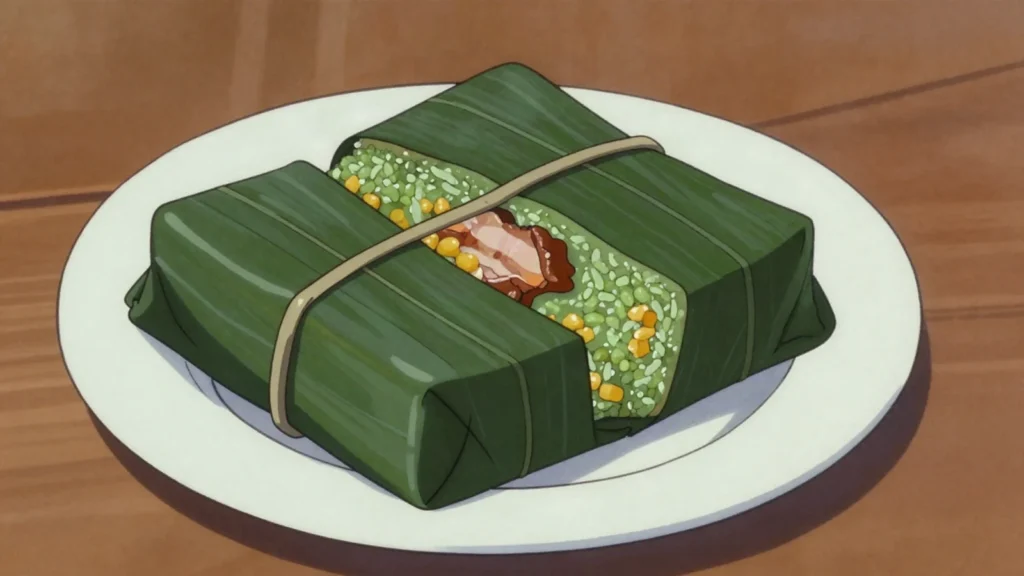
Square glutinous rice cake with pork and mung bean wrapped in dong leaves for Tet; legend credits prince Lang Lieu of the Hung kings.
Frequently asked questions
What is Banh Chung?
Banh Chung is a snack from Vietnam: square Tet cake of sticky rice, mung bean and pork in leaves. Square glutinous rice cake with pork and mung bean wrapped in dong leaves for Tet; legend credits prince Lang Lieu of the Hung kings.
How long does Banh Chung take to make?
Banh Chung takes 1 hr 30 min plus overnight soaking of preparation and 8 hr of cooking. The recipe makes 4 cakes. It is rated hard to make.
What can I substitute in Banh Chung?
Yes, within limits. A pressure cooker reduces the boil to about 2 hours, though purists dispute the result. Foil-lined moulds where leaves are unavailable, with a few leaves inside for scent.
What is the most important thing to get right in Banh Chung?
Build the layers: a cup of rice spread flat, then half the mung bean, then two strips of pork, then the rest of the bean, then rice to cover completely. The filling must be sealed inside rice on every side, or it will leak during the long boil.