
Ingredients
Dough
- 600 gstrong white bread flour
- 10 gfine salt
- 7 ginstant yeast, or 100 g mature wheat sourdough
- 1 tspsugar
- 360 mlwarm water or warm milk for a richer non
- 30 gmelted butter or 2 tbsp sunflower oil
To finish
- 1egg, beaten with 1 tsp water, for glazing
- 2 tbspwhite or black sesame seeds
- 2 tbspnigella seeds (siyoh dona)
- 1chekich, the nail-studded bread stamp, or a fork and a small glass
Directions
- Dissolve the yeast and sugar in the warm water, add the flour, salt and melted butter and knead 12–15 minutes to a firm, smooth, quite tight dough. Obi non dough is stiffer than most bread dough.
- Prove covered at room temperature 1.5–2 hours until doubled, knock back, and prove again 40 minutes. The second rise gives the fine, close crumb of the ring.
- Divide in two and shape each into a tight ball, then rest 15 minutes under cloth so the gluten relaxes.
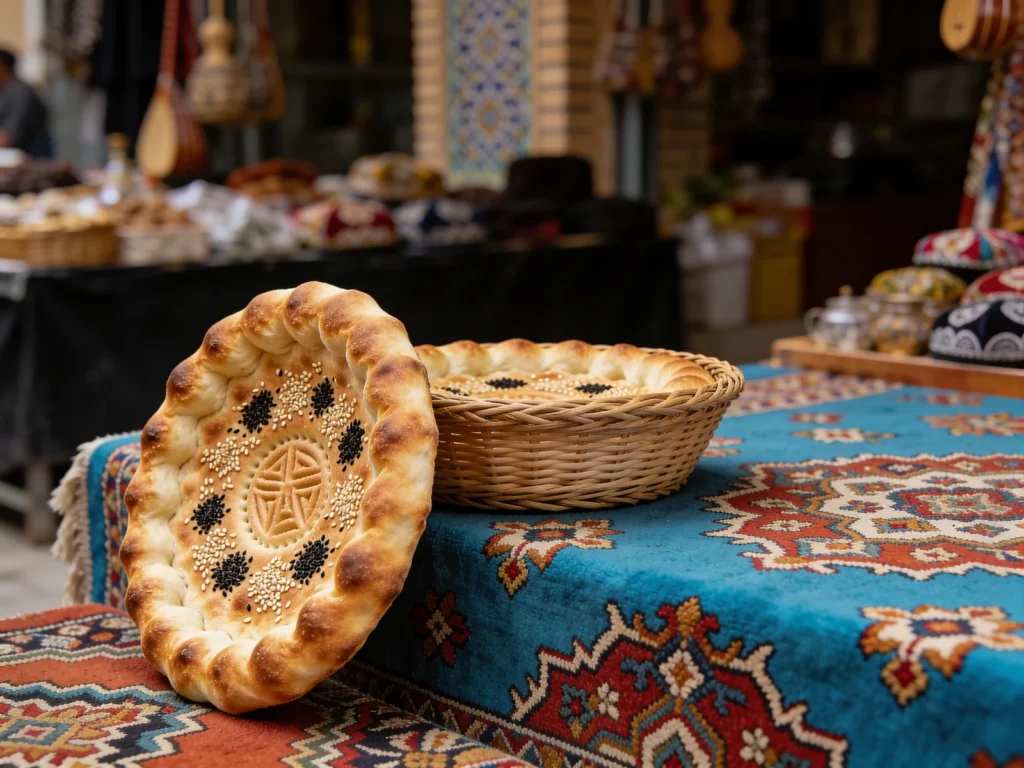
- Press each ball out from the centre with your knuckles and the heel of your hand, thinning the middle to about 5 mm and leaving a raised rim 2–3 cm wide and 2 cm thick. Never use a rolling pin on the rim.
- Prove the shaped rounds 20 minutes, then stamp the thin centre all over with the chekich, pressing right through so the middle cannot rise. This is what creates the sunken patterned base and puffed ring.
- Brush the centre and rim with egg wash and scatter sesame and nigella seeds over the stamped middle.
- Bake in the hottest oven you have, 250°C (475°F) with a preheated stone or heavy tray, for 15–20 minutes until the rim is puffed and deep gold and the base sounds hollow.
- Flick or spray a little water onto the loaf as it comes out and cover it with a cloth for 5 minutes for a softer crust, then cool on a rack, upright, never face down.
Technique
- In a real tandyr the dough round is slapped onto the searing clay wall, which is why the base is flat and blistered and the bread bakes in 8–10 minutes. A pizza stone at maximum heat is the honest home approximation.
- Uzbeks never place obi non upside down. Bread is treated with respect, always set the right way up and torn by hand, never cut with a knife at the table.
- The chekich stamp is functional as well as decorative: docking the centre keeps it flat so the loaf bakes evenly and stacks well.
Substitutions
- No chekich? Dock the centre firmly with a fork in concentric rings and mark the inner edge of the rim by pressing with the rim of a small glass.
- Substituting half the water with milk and adding 2 tbsp of butter or ghee gives the richer patyr non of Samarkand.
Variations
- Samarkand non, famously dense and long-keeping, said to be impossible to reproduce outside the city.
- Patyr, enriched with fat and often layered, baked for celebrations.
- Gijduvan non, thicker and darker, stamped with a wider pattern.
History
A round, flat bread with a distinctive pattern of decorative stamped indentations across its center, baked in a tandoor-style clay oven, documented across Uzbekistan for many generations as an essential daily staple food carrying deep cultural and even ceremonial significance within Uzbek society. Its decorative stamped pattern, applied using a specific tool called a chekich before baking, is both a practical technique, allowing steam to escape evenly during baking, and an aesthetic tradition, with different regions and bakers maintaining their own particular decorative styles. Obi non is treated with genuine reverence within Uzbek culture, traditionally never placed upside down or thrown away carelessly, reflecting bread’s broader sacred status across Central Asian and wider regional culinary tradition.
Frequently asked questions
What is Obi non?
Obi non is a bread & pastry from Uzbekistan: stamped tandyr bread rounds, never placed upside down. A round, flat bread with a distinctive pattern of decorative stamped indentations across its center, baked in a tandoor-style clay oven, documented across Uzbekistan for many generations as an essential daily staple food carrying deep cultural and even ceremonial significance within Uzbek society. Its decorative stamped pattern, applied using a specific tool called a chekich before baking, is both a practical technique, allowing steam to escape evenly during baking, and an aesthetic tradition, with different regions and bakers maintaining their own particular decorative styles. Obi non is treated with genuine reverence within Uzbek culture, traditionally never placed upside down or thrown away carelessly, reflecting bread’s broader sacred status across Central Asian and wider regional culinary tradition.
How long does Obi non take to make?
Obi non takes 30 min of preparation and 3 hr rising, 20 min baking of cooking. The recipe makes 2 large flatbreads. It is rated medium to make.
What can I substitute in Obi non?
Yes, within limits. No chekich? Dock the centre firmly with a fork in concentric rings and mark the inner edge of the rim by pressing with the rim of a small glass. Substituting half the water with milk and adding 2 tbsp of butter or ghee gives the richer patyr non of Samarkand.
What is the most important thing to get right in Obi non?
Press each ball out from the centre with your knuckles and the heel of your hand, thinning the middle to about 5 mm and leaving a raised rim 2–3 cm wide and 2 cm thick. Never use a rolling pin on the rim.