
Ingredients
Base
- 8 sliceswhite bread, crusts removed
- or 200 g rusks or plain sponge
Syrup
- 300 gsugar
- 200 mlwater
- 1 tbsplemon juice
- 1 tbsprose water
- 1 tbsporange blossom water
Ashta cream
- 1 litrewhole milk
- 5 tbspcornflour
- 3 tbspsugar
- 200 mldouble cream
- 1 tsprose water
- 1 tsporange blossom water
To finish
- 80 gpistachios, finely ground
- a little rose water
To serve
- cold, cut into squares, with Arabic coffee
Directions
- Use plain white bread with the crusts cut off, or the dry rusks sold in Middle Eastern shops. Toast the bread in the oven until it is dry and deep golden brown, almost dark. That toasting does two things: it gives the caramelised colour and flavour the base needs, and it dries the bread so it absorbs syrup without turning to paste.
- Let it cool, then crush or blend it into coarse crumbs. Boil the sugar and water together for eight to ten minutes until slightly thickened. Add the lemon juice partway through, which prevents the sugar crystallising as it cools. Do not reduce it too far, since a syrup that sets hard will make the base solid rather than soft.
- Add the rose and orange blossom waters off the heat, since their aroma is destroyed by boiling. Pour the warm syrup over the toasted crumbs and mix until evenly moistened.
- Add the syrup gradually and stop when the crumbs hold together like damp sand. Too much syrup gives a wet base that will not hold the cream, and too little leaves it dry and crumbly. Press it firmly into the base of a dish in an even layer. Press it down properly, since a loose base falls apart when you cut it.
- Let it cool completely before the cream goes on. The everyday method thickens milk with cornflour into a smooth set cream, which is what most home cooks use and what this recipe does.
- Mix the cornflour with a little cold milk into a smooth slurry. Never add dry cornflour to hot milk, which forms lumps that will not disperse. Heat the remaining milk with the sugar, then whisk in the slurry gradually. Now the cooking, which needs constant attention.
- Stir continuously over a medium-low heat until it thickens, which takes five to eight minutes. Stir without stopping and scrape the base and corners of the pan, since milk thickened with starch catches instantly.
- Let it bubble gently for two minutes once thick, which cooks out the raw floury taste. It should be thick enough to hold a shape on a spoon. Take it off the heat and stir in the cream and the flower waters. Adding the cream off the heat keeps it rich and stops it splitting. Pour the hot ashta over the cooled base and smooth it with a wet spatula.
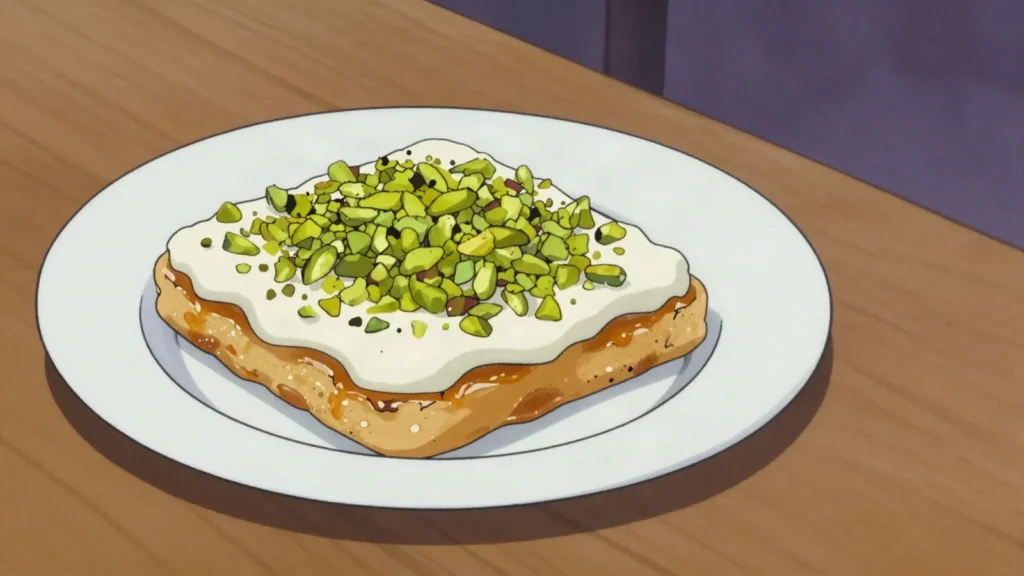
- Pour it while hot so it settles into an even layer, since cooled ashta is too stiff to spread smoothly. Laying film on the surface stops a skin forming as it cools, which would spoil the texture. Scatter finely ground pistachios generously over the top. Add the pistachios only just before serving, since they lose their colour and go soft sitting on damp cream.
- Grind them fresh rather than buying them ground, since the colour and flavour are far better. Cut it into squares or diamonds and serve it cold, with Arabic coffee. It keeps three days refrigerated, though the base gradually softens further.
Technique
- The name means palace bread and the base is toasted bread rather than pastry.
- The bread must be toasted dark or it turns to sludge under the syrup.
- Traditional ashta is skimmed milk skin; the cornflour version is the everyday one.
Substitutions
- Rusks or plain sponge in place of bread.
- Ground almonds in place of pistachios, though the colour differs.
Variations
- Made with traditional skimmed ashta, which is richer.
- With a layer of clotted cream on top.
- Made in individual glasses.
History
Its name means palace bread, a nineteenth-century Ottoman dessert built on toasted bread rather than pastry.
Frequently asked questions
What is Aish el-saraya?
Aish el-saraya is a dessert from Syria: syrup-soaked bread base under thick ashta cream and crushed pistachios. Its name means palace bread, a nineteenth-century Ottoman dessert built on toasted bread rather than pastry.
How long does Aish el-saraya take to make?
Aish el-saraya takes 30 min plus 4 hr chilling of preparation and 25 min of cooking. The recipe makes 8 servings. It is rated medium to make.
What can I substitute in Aish el-saraya?
Yes, within limits. Rusks or plain sponge in place of bread. Ground almonds in place of pistachios, though the colour differs.
What is the most important thing to get right in Aish el-saraya?
Let it cool, then crush or blend it into coarse crumbs. Boil the sugar and water together for eight to ten minutes until slightly thickened. Add the lemon juice partway through, which prevents the sugar crystallising as it cools. Do not reduce it too far, since a syrup that sets hard will make the base solid rather than soft.