
Ingredients
Skin aspic (pi dong)
- 400 gpork skin, scraped clean of fat
- 1pork trotter, split
- 1.5 litreswater
- 3 slicesginger
- 2spring onions
- 2 tbspShaoxing wine
Filling
- 400 gpork shoulder, minced, about 30% fat
- 20 gginger, grated
- 2spring onions, finely chopped
- 1.5 tbsplight soy sauce
- 1 tbspShaoxing wine
- 1 tspsugar
- ½ tspground white pepper
- 1 tspsalt
- 300 gcold set aspic, finely diced
Dough
- 300 gplain flour
- 150–160 mlwater, half boiling and half cold
- ¼ tspsalt
To serve
- Fine julienne of young ginger
- Zhenjiang black vinegar
Directions
- Blanch the pork skin and trotter for 5 minutes, drain, scrape off every trace of fat from the underside of the skin, then simmer with the water, ginger, spring onion and wine for 3 hours until the liquid is sticky between the fingers.
- Strain, chill overnight until it sets to a firm, sliceable jelly, then chop it very finely; this jelly is what melts into soup inside the dumpling.
- Beat the minced pork with the ginger, soy, wine, sugar, pepper and salt, stirring in one direction for 3 minutes until sticky, then fold in the diced aspic and the spring onion and refrigerate 30 minutes.
- Mix the boiling water into the flour first, then the cold water and salt, and knead 10 minutes to a smooth, firm dough. Rest, covered, 30 minutes. This part-scalded dough is strong enough to hold soup but stays tender.
- Roll into ropes, cut 10 g pieces and roll each into a 7–8 cm round with a distinctly thicker centre; the thick centre carries the weight, the thin rim takes the pleats.
- Cradle a wrapper in your palm, spoon in a heaped teaspoon of cold filling and pleat the edge, rotating as you go, aiming for 16–18 even pleats and twisting the top closed into a small knot.
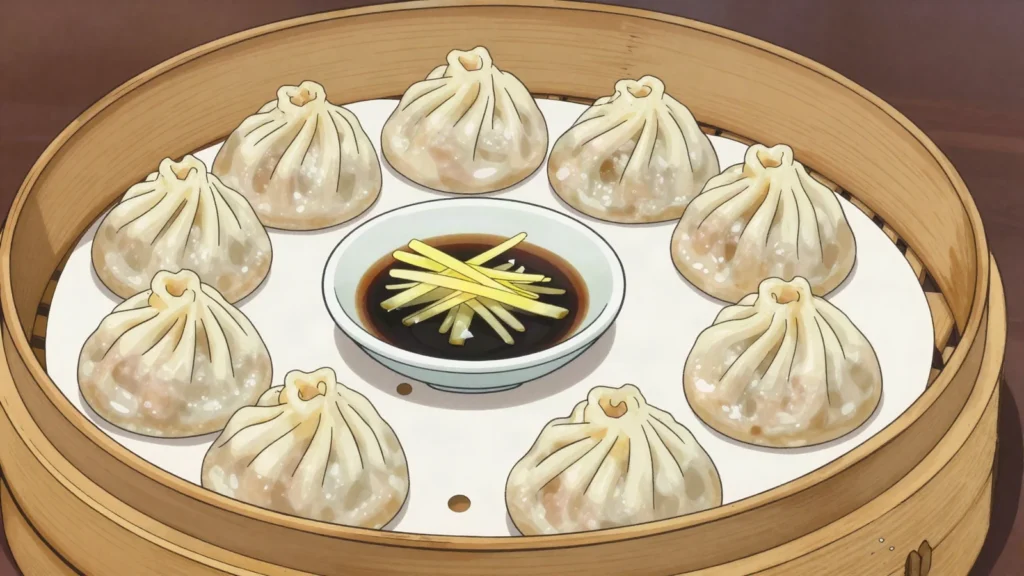
- Set the finished dumplings on squares of baking paper or on carrot slices in a bamboo steamer, well spaced; they swell and will fuse if crowded.
- Steam over vigorously boiling water for 8 minutes with the lid slightly ajar so no condensation drips and softens the tops. The dumplings are done when the skins turn translucent and you can see broth sloshing inside.
- Serve immediately in the steamer with ginger and black vinegar. Eat by lifting a dumpling to a spoon, nipping the side, drinking the soup first, then eating the rest; the broth is hot enough to burn.
Technique
- The soup is not poured in. It is aspic, chopped cold into the filling, which melts during steaming. Adding liquid directly guarantees a burst dumpling.
- Nanxiang xiaolongbao, from the town outside Shanghai, uses a fully unleavened dough; the puffier versions found elsewhere use a slightly leavened one. Both are defended fiercely.
- Keep everything cold, work in small batches and steam as soon as they are folded. Warm filling melts early and leaks through the base.
- Freeze uncooked on a tray, then bag; steam from frozen with 3 extra minutes.
Substitutions
- No pork skin? Use 2 split trotters, or set a strong stock with 8 g gelatine leaf per 500 ml, which works but has less body.
- Crab roe and crab meat added to the filling makes xiefen xiaolongbao, the luxury Shanghai version.
Variations
- Tangbao are the large, straw-sipped soup dumplings of Huaiyang cuisine, a related but distinct thing.
- Shengjianbao use a leavened dough, are pan-fried and also contain soup.
History
Soup dumplings whose broth-filled center comes from a specific technique: aspic, a jellied stock made by simmering pork skin and bones until they set into a gel when cooled, is chopped and mixed directly into the raw filling, then melts back into liquid soup once the dumpling steams. The dish is generally credited to Nanxiang, a town now part of Shanghai, where a restaurant called Nanxiang Mantun Dian began selling a soup-filled dumpling in the 1870s or 1880s, refining an earlier, larger steamed bun into the smaller, thinner-skinned, individually portioned form now standard. Eating xiaolongbao correctly, without losing the hot soup inside, is itself a small skill: most guidance recommends lifting it gently by the top knot, biting a small hole first to sip the broth, rather than biting into it whole.
Frequently asked questions
What is Xiaolongbao?
Xiaolongbao is a snack from China: shanghai-style steamed soup dumplings releasing hot pork broth with each bite. Soup dumplings whose broth-filled center comes from a specific technique: aspic, a jellied stock made by simmering pork skin and bones until they set into a gel when cooled, is chopped and mixed directly into the raw filling, then melts back into liquid soup once the dumpling steams. The dish is generally credited to Nanxiang, a town now part of Shanghai, where a restaurant called Nanxiang Mantun Dian began selling a soup-filled dumpling in the 1870s or 1880s, refining an earlier, larger steamed bun into the smaller, thinner-skinned, individually portioned form now standard. Eating xiaolongbao correctly, without losing the hot soup inside, is itself a small skill: most guidance recommends lifting it gently by the top knot, biting a small hole first to sip the broth, rather than biting into it whole.
How long does Xiaolongbao take to make?
Xiaolongbao takes 1 hr 30 min of preparation and 3 hr for the aspic plus 8 min steaming of cooking. The recipe makes about 32 dumplings, 4 servings. It is rated hard to make.
What can I substitute in Xiaolongbao?
Yes, within limits. No pork skin? Use 2 split trotters, or set a strong stock with 8 g gelatine leaf per 500 ml, which works but has less body. Crab roe and crab meat added to the filling makes xiefen xiaolongbao, the luxury Shanghai version.