
Ingredients
The corn
- 10 earsfresh sweet corn
- elote, young and milky
- kernels cut off
- husks kept for wrapping
The rest
- 150 gsugar
- or to taste
- 100 gbutter, melted
- or lard
- 100 mlcream
- or milk
- 1 teaspoonsalt
- 2 tablespoonsrice flour
- if needed
Sometimes added
- 100 ggrated cheese
- queso duro
- half a teaspoon cinnamon
- 1 teaspoonvanilla
To serve
- warm from the steamer
- with crema
- or soured cream
- and coffee
Directions
- Press a kernel and it should squirt milk. Old corn is starchy and gives a dry tamale. Salt is added to balance rather than season. Wash the husks thoroughly before using them. Rinse them through several changes of water. Check each one as you wash it. Never let the steamer boil dry at all.
- Check the water level regularly. Top the steamer up with boiling water. Strip the husks from the cobs carefully. Peel them off whole rather than tearing them. Work down from the top of the cob. Keep the large outer husks for wrapping. The small inner ones tear too easily. Use those for tying or discard them. Wash the husks thoroughly in cold water.
- Rinse them through several changes of water. Rub each one to remove dirt and silk. Check for insects as you wash them. Cut the kernels off the cobs with a knife. Stand the cob upright in a large bowl. Cut downward close to the core.
- Turn it and work all the way round. Do not waste any of it at all. Hold it firmly at the top of the cob. Cut into a bowl to catch everything. Take real care with that step. Blend the kernels to a rough pulp. Blend them with the cream or milk. Leave some texture rather than making it smooth. A completely smooth purée gives a dense tamale.
- Stir the sugar, butter and salt into the pulp. Let the melted butter cool slightly first. Stir everything through thoroughly. The mixture should be thick but loose. Add rice flour if it is very loose. Add a little milk if it is too stiff. Very young corn may need binding.
- Taste the mixture before adding all the sugar. Very sweet corn needs less than the recipe gives. Salt is essential even in a sweet tamale. Spoon the mixture into the husks.
- Lay a husk flat with the wide end toward you. Spoon mixture into the centre of it. Use about two heaped tablespoons. Leave a good border all the way round. Do not overfill the husks at all. Fold the husk over the mixture from both sides. Bring the two long sides together over it.
- Fold the wide end down over that. Use two if the husks are small. Tie each packet with a strip of husk. Tear thin strips from the spare husks.
- Tie one around the middle of each packet. Steam the tamales for about an hour. Stand them upright in a steamer if you can. Fold side up so nothing leaks out. Cover the steamer tightly with a lid. Keep the water boiling steadily throughout. Check the water level every twenty minutes.
- Top it up with boiling water as needed. A dry steamer burns and ruins them. Return them to steam if it sticks. Let the tamales rest before unwrapping. Give them about fifteen minutes off the heat.
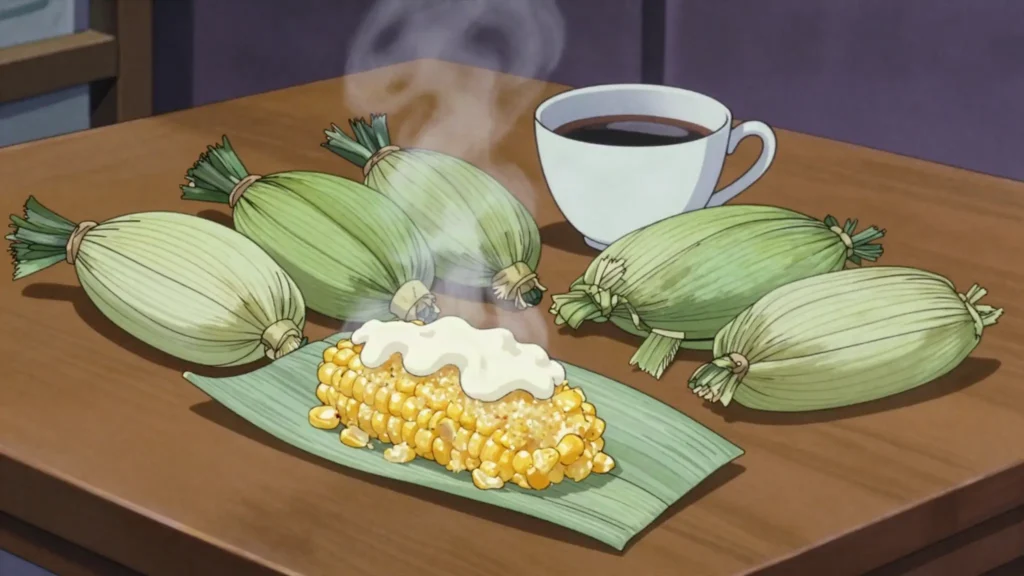
- Serve the tamales warm in their husks. It also keeps it warm on the plate. Spoon crema over each opened tamale. Salvadoran crema is thick and slightly soured. Serve them with strong black coffee. They keep three days refrigerated in their husks. Steam them again to reheat them.
Technique
- The corn must be young and milky — press a kernel and it should squirt milk. Old starchy corn gives a dry tamale, and that milkiness is genuinely essential here.
- Wash the husks thoroughly through several changes of water, rubbing each to remove dirt and silk and checking for insects. Keep the large outer husks for wrapping, since the small inner ones tear too easily.
- Check the steamer water every twenty minutes and top it up with boiling water — a dry steamer burns and ruins them. Rest them fifteen minutes off the heat before unwrapping, since they fall apart if opened immediately.
Substitutions
- Lard replaces the butter and milk replaces the cream. Rice flour binds the mixture if the corn is very young and loose, thickening without adding flavour — judge that by the corn you actually have.
- Some Salvadoran households add grated queso duro to the mixture for a sweet and salty combination that surprises people at first and is genuinely traditional; both plain sweet and sweet-savoury versions are made and neither is more correct. Cinnamon and vanilla are also added by some.
Variations
- These use fresh corn ground to a pulp rather than masa from dried nixtamalised maize, so they are a genuinely different preparation from ordinary savoury tamales — sharing a name and a wrapping only. The atlas records them as separate dishes.
- Blend the kernels to a rough pulp rather than a smooth purée, pulsing rather than running continuously and stopping while pieces are still visible: smooth purée gives a dense tamale where some texture gives a lighter better one. Scrape each cob with the knife back afterward for the remaining milk.
- Salt is essential even in a sweet tamale — a full teaspoon is a real amount that sharpens the sweetness and brings out the corn. Taste the mixture before adding all the sugar, since very sweet corn needs less. Do not overfill the husks, since the mixture expands and overfilled tamales burst.
History
Fresh sweet corn tamales steamed in husks and eaten with cream, made when the young maize is harvested.
Frequently asked questions
What is Tamales de elote?
Tamales de elote is a snack from El Salvador: sweet young-corn tamales served with crema. Fresh sweet corn tamales steamed in husks and eaten with cream, made when the young maize is harvested.
How long does Tamales de elote take to make?
Tamales de elote takes 45 minutes of preparation and 1 hour of cooking. The recipe makes makes about 15. It is rated medium to make.
What can I substitute in Tamales de elote?
Yes, within limits. Lard replaces the butter and milk replaces the cream. Rice flour binds the mixture if the corn is very young and loose, thickening without adding flavour — judge that by the corn you actually have. Some Salvadoran households add grated queso duro to the mixture for a sweet and salty combination that surprises people at first and is genuinely traditional; both plain sweet and sweet-savoury versions are made and neither is more correct. Cinnamon and vanilla are also added by some.
What is the most important thing to get right in Tamales de elote?
Press a kernel and it should squirt milk. Old corn is starchy and gives a dry tamale. Salt is added to balance rather than season. Wash the husks thoroughly before using them. Rinse them through several changes of water. Check each one as you wash it. Never let the steamer boil dry at all.