
Ingredients
Batter
- 500 gunsalted butter, very soft
- 500 gcaster sugar
- 20eggs, separated
- 500 gplain flour, sifted
- 200 mlsour cream
- 1 tspfine salt
- 1 tbspvanilla extract or the seeds of 1 pod
- 2 tbspbrandy or rum, optional
Equipment
- 1rotating spit over an open fire, or a rotisserie motor and a foil-wrapped wooden roller
- 1wide dripping tray
To finish
- 50 gicing sugar, for dusting
- 50 gdark chocolate, melted, optional
Directions
- Beat the soft butter with half the sugar for 10 minutes until very pale and aerated, then beat in the egg yolks one at a time, keeping the mixture emulsified.
- Fold in the sour cream, vanilla, salt and brandy, then the sifted flour in three additions, mixing only until smooth.
- Whisk the egg whites with the remaining sugar to soft, glossy peaks and fold them into the batter in three parts. The finished batter should fall from a ladle in a thick, unbroken ribbon.
- Set up the spit: a wooden or metal roller, wrapped in baking parchment or foil and lightly greased, turning steadily about 20 cm above glowing coals or in front of a strong heat source. It must turn continuously and slowly, roughly 20 revolutions per minute.
- Ladle a thin stream of batter along the length of the turning roller. As it rotates, the batter runs downward and sets, throwing off the drips that become the spikes.
- Let each layer set to pale gold, about 2–3 minutes, before ladling on the next. Do not rush: pouring onto a wet layer collapses the spikes and gives a smooth, dense cake.
- Repeat for 18–25 layers over 60–90 minutes, catching the drips in the tray below and returning them to the bowl. The cake grows outward and the spikes lengthen with each pass.
- Stop when the cake is 15–18 cm across and deep gold all over, with dry, brittle spikes that snap when tapped. The internal layers should be set and springy, not raw.
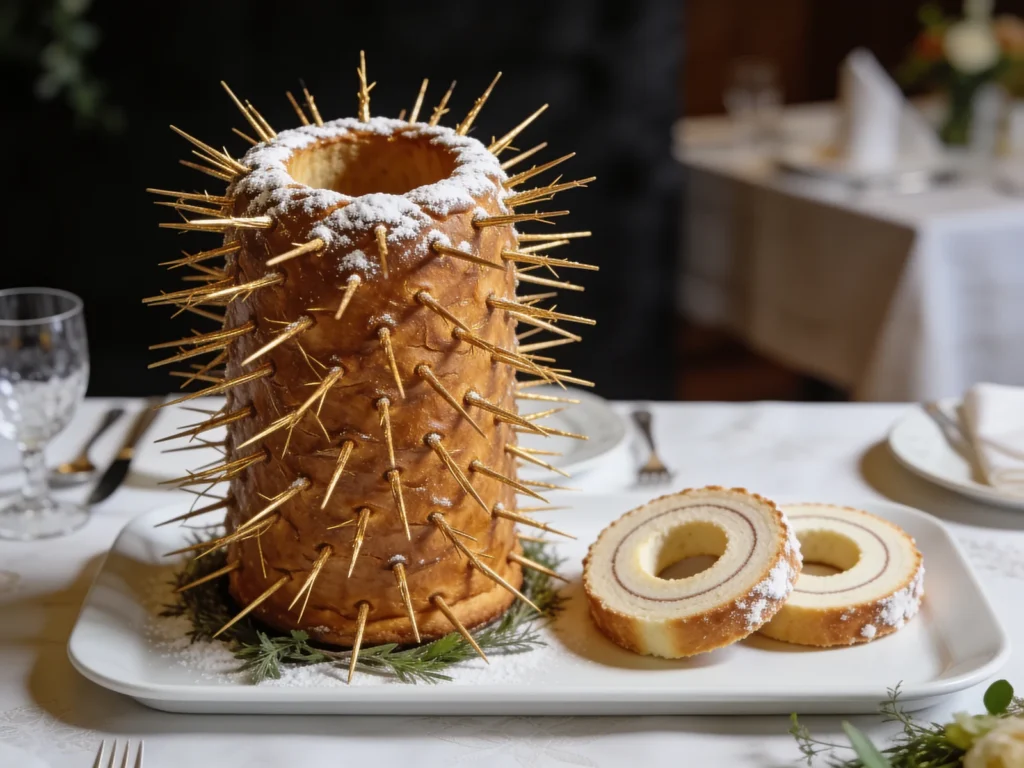
- Let it cool completely on the roller before easing it off, upright and hollow like a spiky tree trunk. Dust with icing sugar, or drizzle with melted chocolate, and cut across into rings to serve.
Technique
- The spikes are the whole point and they come from gravity, not from a mould: batter dripping off a slowly turning roller sets in mid-fall. Anything that turns too fast throws the drips off; too slow and they run into a sheet.
- Šakotis is a wedding and Christening cake in Lithuania, made professionally on gas-fired machines and ordered by the metre. Home versions are genuinely difficult and this is honest to acknowledge.
- The very high egg content is what allows the cake to keep for weeks, dry and crisp, with no preservative.
- The name means branched, and the related sękacz of Poland and Baumkuchen of Germany share the technique with different fat and sugar ratios.
Substitutions
- No spit: an electric rotisserie in an oven at 190°C (375°F) with a foil-wrapped wooden dowel is the workable home rig. Bake with the door ajar so steam escapes and the spikes crisp.
- Failing that, pour the batter into a bundt tin and bake at 170°C (350°F) for 55 minutes for the flavour without the shape, and say plainly that it is not šakotis.
Variations
- Raguolis, the same cake under its other Lithuanian name, meaning horned.
- Sękacz, the Polish Podlasie version, usually made with more butter and a darker bake.
- A modern version with the interior brushed in dark chocolate between layers.
History
Spit cake made by dripping batter onto a turning spit over fire, giving its spikes; it is the traditional Lithuanian wedding cake.
Frequently asked questions
What is Šakotis?
Šakotis is a dessert from Lithuania: spiky spit-baked ‘tree cake’ for weddings and celebrations. Spit cake made by dripping batter onto a turning spit over fire, giving its spikes; it is the traditional Lithuanian wedding cake.
How long does Šakotis take to make?
Šakotis takes 40 min of preparation and 1 hr 30 min of cooking. The recipe makes 1 cake, about 1.4 kg, 20 servings. It is rated hard to make.
What can I substitute in Šakotis?
Yes, within limits. No spit: an electric rotisserie in an oven at 190°C (375°F) with a foil-wrapped wooden dowel is the workable home rig. Bake with the door ajar so steam escapes and the spikes crisp. Failing that, pour the batter into a bundt tin and bake at 170°C (350°F) for 55 minutes for the flavour without the shape, and say plainly that it is not šakotis.
What is the most important thing to get right in Šakotis?
Set up the spit: a wooden or metal roller, wrapped in baking parchment or foil and lightly greased, turning steadily about 20 cm above glowing coals or in front of a strong heat source. It must turn continuously and slowly, roughly 20 revolutions per minute.