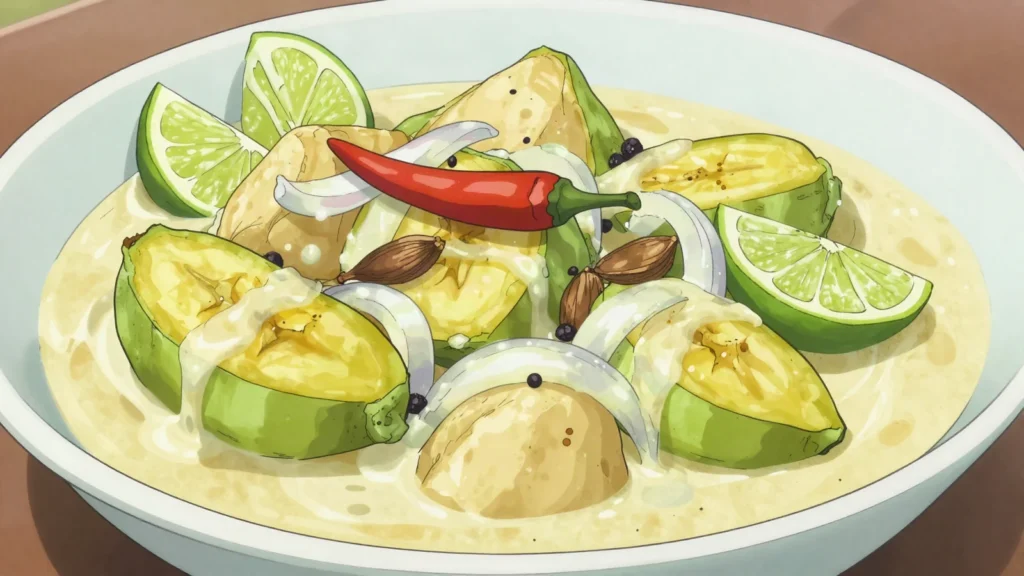

Ingredients
The bananas
- 8green cooking bananas
- firm and completely unripe
- or 6 green plantains
- peeled and cut into chunks
The coconut milk
- 2fresh coconuts
- grated and pressed
- for about 800 ml thick milk
- or 2 tins coconut milk
- full fat, not light
- plus 200 ml water
The seasoning
- 1onion, finely chopped
- 3 clovesgarlic, crushed
- a thumb of ginger, grated
- 1 teaspoonsalt
- or to taste
- black pepper
Sometimes added
- 1tomato, chopped
- a pinch of ground turmeric
- 2cardamom pods, bruised
- a little chopped coriander
- 1hot chilli, whole
To serve
- on its own, as a full meal
- or with grilled fish
- or with a meat stew
- lime wedges
Directions
- Oil your hands and your knife first. Oil dissolves the sap where water does not. Gloves are worth wearing if you have them. Cut the ends off each green banana. Score the skin lengthways in two or three lines. Cut through the skin but not the flesh. Use your thumb or the back of a knife.
- Drop the peeled flesh into salted water. That stops it browning while you work. Cut them into chunks of about four centimetres. Crack a mature coconut over a bowl. Never chop at a coconut on a board. Grate the flesh out with a scraper.
- Put the grated coconut in a clean cloth. Add a little warm water to it. Squeeze the cloth hard over a bowl. The thick first pressing is the cream. Add more water and squeeze again. Keep the two separate if you can. The thin milk cooks the bananas. Use full fat, never light coconut milk. Light versions give a thin watery sauce.
- Shake the tin hard before opening it. Put the thin coconut milk in a wide pan. Add the chopped onion and the garlic. Add the grated ginger and the salt. Add the tomato if you are using it. Add the whole chilli, left unbroken.
- Bring the pan to a gentle simmer. They should be just covered by the liquid. Add a little water if they are not. Simmer them gently, partly covered. Do not boil coconut milk hard at any point.
- Keep it at a bare simmer throughout. Simmer for about twenty-five minutes. Stir gently from time to time. Some pieces should collapse into the sauce. Add it in the last five minutes only. Long cooking splits the thick cream. Stir the cream through gently. Let it warm through without boiling. Taste and adjust the salt now.
- Add plenty of ground black pepper. The dish should be creamy and thick. Scatter chopped coriander over the top. Remove the whole chilli before serving. Serve it hot in bowls with a spoon. It takes the place of rice in a meal.
Technique
- The bananas must be completely green. Any yellowing means sugars have developed and the dish turns into sweet mush; green cooking bananas behave like a potato, which is the point.
- Green bananas leak a sticky sap that stains hands and clothes brown and does not wash off with water. Oil your hands and knife first, or wear gloves. Score the skin lengthways and prise it off in strips rather than trying to peel it like a ripe banana.
- Never let coconut milk boil hard. It splits and goes grainy with the oil separating out. Keep it at a bare simmer, and add the thick cream only in the last five minutes.
- Use full-fat coconut milk, not light. The sauce is most of the dish and a light version gives something thin and watery.
- The two-stage pressing — thin milk to cook in, thick cream at the end — is the traditional Indian Ocean method and it is worth following even with tinned milk by holding back the thick top of the tin.
- Some pieces should collapse and others stay whole. The starch from the collapsing pieces is what thickens the sauce; if it is too thin, mash a few more against the side of the pan.
- Leave the chilli whole. Unbroken it perfumes the pot; burst it makes everything fiercely hot.
- Bananas and coconut are the two crops that grow everywhere on the Comoros, which are among the world’s poorest countries with expensive and unreliable food imports. This is what people eat most days, not a festive dish.
Substitutions
- Green plantains replace green cooking bananas directly and are easier to find in many places.
- Tinned full-fat coconut milk replaces freshly pressed; hold back the thick cream from the top of the tin for the end.
- Cassava or breadfruit can be cooked the same way, giving a related but distinct dish.
- A pinch of turmeric or a couple of bruised cardamom pods reflect the islands’ spice trade and are common additions.
- The tomato is optional; the plainest version has none.
- Vegetable stock replaces some of the water for a more savoury dish, though it is not traditional.
Variations
- A version with salted or smoked fish cooked in the pot is common and turns it into a fuller meal.
- Mataba, cassava leaves pounded and cooked with coconut milk, is the classic Comorian partner dish.
- Some households add a little chopped meat, which makes it a Sunday rather than everyday dish.
- Related green banana and coconut dishes are made across the Swahili coast, in Zanzibar and coastal Tanzania and Kenya.
- A drier version, with less liquid and the bananas left in whole chunks, is served as a side rather than a main.
- Mayotte makes the same dish with its own local variations.
History
Bananas and coconut are the two crops that grow everywhere on the islands; the dish is the everyday Comorian starch.
Frequently asked questions
What is Trovi ya nadzi?
Trovi ya nadzi is a main from Comoros: green bananas simmered in thick coconut milk until they collapse. Bananas and coconut are the two crops that grow everywhere on the islands; the dish is the everyday Comorian starch.
How long does Trovi ya nadzi take to make?
Trovi ya nadzi takes 20 minutes of preparation and 40 minutes of cooking. The recipe makes serves 4. It is rated easy to make.
What can I substitute in Trovi ya nadzi?
Yes, within limits. Green plantains replace green cooking bananas directly and are easier to find in many places. Tinned full-fat coconut milk replaces freshly pressed; hold back the thick cream from the top of the tin for the end. Cassava or breadfruit can be cooked the same way, giving a related but distinct dish. A pinch of turmeric or a couple of bruised cardamom pods reflect the islands’ spice trade and are common additions. The tomato is optional; the plainest version has none. Vegetable stock replaces some of the water for a more savoury dish, though it is not traditional.
What is the most important thing to get right in Trovi ya nadzi?
Drop the peeled flesh into salted water. That stops it browning while you work. Cut them into chunks of about four centimetres. Crack a mature coconut over a bowl. Never chop at a coconut on a board. Grate the flesh out with a scraper.