
Ingredients
Meringue
- 6egg whites (about 210 g), at room temperature, from eggs at least 3 days old
- 330 gcaster sugar
- 2 tspcornflour, sieved
- 1 tspwhite vinegar
- 1 tspvanilla extract
- Pinch of fine salt
Topping
- 500 mldouble cream, cold
- 1 tbspicing sugar
- 1 tspvanilla extract
Fruit
- 4ripe kiwifruit, peeled and sliced into rounds
- 4passionfruit, pulp scooped
- 200 gstrawberries, hulled and halved (optional)
Equipment
- 1 sheetof baking paper marked with a 22 cm circle
- 1stand mixer or hand whisk
- 1oven thermometer, if you have one
Directions
- Heat the oven to 150°C (300°F). Wipe the bowl and whisk with a little vinegar on kitchen paper to strip any trace of grease; a speck of fat or yolk will stop the whites whipping.
- Whisk the whites with the salt on medium speed until they hold soft, floppy peaks, about 3 minutes. Do not race to stiff peaks at this stage.
- Add the caster sugar one tablespoon at a time, waiting 15–20 seconds between additions, and keep whisking for 8–10 minutes in total until the meringue is very stiff, bright white and glossy.
- Test it: rub a little between finger and thumb. If you can feel sugar grains, keep whisking. Undissolved sugar is what makes a pavlova weep amber beads.
- Fold in the sieved cornflour, vinegar and vanilla with a spatula in a few decisive strokes. The cornflour and acid are what give the marshmallow centre rather than a dry meringue all the way through.
- Draw the marked paper onto a tray, pencil side down. Pile the meringue in the middle and spread it to the circle with a palette knife, building the sides slightly higher than the centre so there is a hollow for the cream.
- Put it in the oven and immediately drop the temperature to 120°C (250°F). Bake for 1 hour 15 minutes to 1 hour 30 minutes, without opening the door.
- It is ready when the outside is dry, faintly cream-coloured rather than white, and the whole thing lifts off the paper cleanly and sounds hollow when tapped underneath.
- Turn the oven off, wedge the door slightly ajar with a wooden spoon and leave the pavlova inside until completely cold, at least 3 hours or overnight. Sudden cooling is what cracks it.
- Whip the cream with the icing sugar and vanilla to soft, slightly floppy peaks, not stiff. Pile it into the hollow no more than an hour before serving.
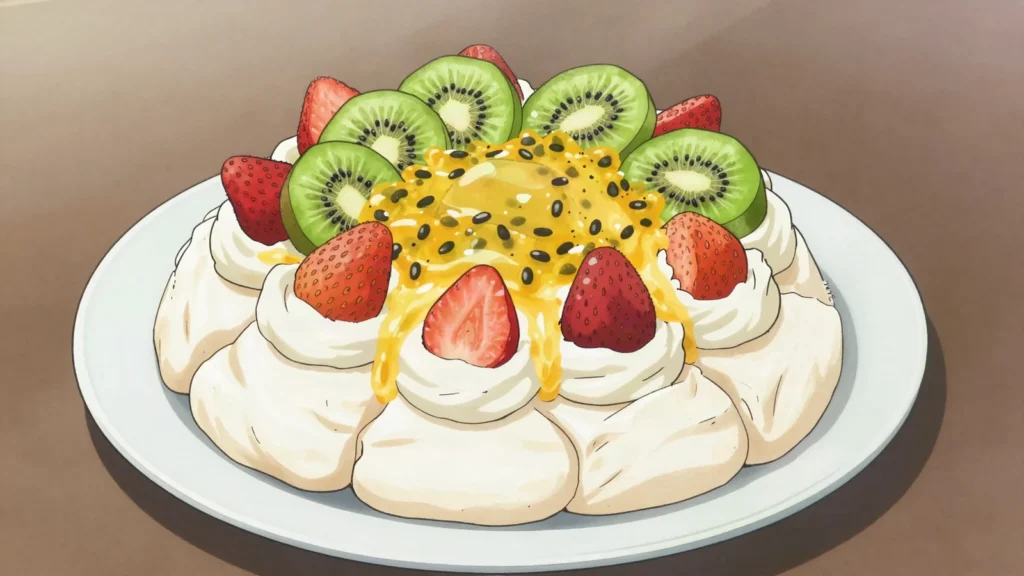
- Cover with kiwifruit and strawberries and spoon the passionfruit pulp over the top so it runs down the sides. Cut with a hot wet knife and expect the crust to shatter, which is exactly right.
Technique
- The texture is the test: crisp shell, and a centre with the give of marshmallow. Cornflour holds moisture in the middle and vinegar stabilises the foam, and leaving either out gives a dry meringue shell.
- Humidity is the enemy. Sugar draws in water from the air, so on a wet day a pavlova will weep and go sticky no matter how carefully it is made; bake on a dry day if you can.
- Cracks are normal and traditional. A pavlova collapses slightly as it cools and the cream and fruit go on top; a perfectly smooth one usually means it was underbaked or overloaded with cornflour.
- The origin is genuinely disputed. New Zealand’s earliest known recipe under the name appeared in a 1929 Rangiora publication and researchers have traced the modern form to New Zealand kitchens of the late 1920s, while Australia claims a Perth creation in 1935; both countries claim Anna Pavlova’s tours as the inspiration and the argument is unresolved.
Substitutions
- Out-of-season kiwifruit: use tamarillo, feijoa, berries or sliced peaches. Passionfruit is worth keeping whatever else changes.
- Caster sugar can be half replaced with soft brown sugar for a caramel-toned pavlova, but expect a beige shell.
- No white vinegar: use lemon juice or cream of tartar, ½ tsp, for the same stabilising effect.
Variations
- Individual pavlovas, 8 small nests baked at 120°C (250°F) for 50 minutes.
- Pavlova roulade, the same mixture baked flat in a tray, rolled around cream and fruit.
- Christmas pavlova topped with cherries, berries and mint, the New Zealand summer festive table.
History
A meringue-based dessert with a crisp exterior and a soft, marshmallow-like center, topped with whipped cream and fresh fruit, named after Anna Pavlova, a celebrated Russian ballerina who toured Australia and New Zealand in the 1920s, with both countries claiming to have invented the dessert in her honor and maintaining a long-running, genuinely serious rivalry over which can rightfully claim it as their own national dish. Food historians have not conclusively settled the dispute, and early meringue-based dessert recipes resembling pavlova appear in period cookbooks from both countries around a similar time, making a definitive single point of origin difficult to establish. It remains closely associated with Christmas and summer celebrations in both Australia and New Zealand, given the Southern Hemisphere’s warm December climate.
Frequently asked questions
What is Pavlova?
Pavlova is a dessert from Australia: crisp-shelled marshmallow meringue with cream and passionfruit, Christmas centrepiece. A meringue-based dessert with a crisp exterior and a soft, marshmallow-like center, topped with whipped cream and fresh fruit, named after Anna Pavlova, a celebrated Russian ballerina who toured Australia and New Zealand in the 1920s, with both countries claiming to have invented the dessert in her honor and maintaining a long-running, genuinely serious rivalry over which can rightfully claim it as their own national dish. Food historians have not conclusively settled the dispute, and early meringue-based dessert recipes resembling pavlova appear in period cookbooks from both countries around a similar time, making a definitive single point of origin difficult to establish. It remains closely associated with Christmas and summer celebrations in both Australia and New Zealand, given the Southern Hemisphere’s warm December climate.
How long does Pavlova take to make?
Pavlova takes 25 min of preparation and 1 hr 30 min plus cooling in the oven of cooking. The recipe makes 8 servings. It is rated medium to make.
What can I substitute in Pavlova?
Yes, within limits. Out-of-season kiwifruit: use tamarillo, feijoa, berries or sliced peaches. Passionfruit is worth keeping whatever else changes. Caster sugar can be half replaced with soft brown sugar for a caramel-toned pavlova, but expect a beige shell. No white vinegar: use lemon juice or cream of tartar, ½ tsp, for the same stabilising effect.
What is the most important thing to get right in Pavlova?
Whisk the whites with the salt on medium speed until they hold soft, floppy peaks, about 3 minutes. Do not race to stiff peaks at this stage.