
Ingredients
Dough
- 300 gplain flour
- 3eggs
- 1 tspbaking powder
- a pinch of salt
- a little water, if needed
To fry
- oil, for deep frying
- cornflour, for dusting
Syrup
- 200 gsugar
- 150 gmaltose or golden syrup
- 80 mlwater
- 20 gbutter
- 1 tbsphoney
Optional
- 60 graisins
- 40 gsesame seeds
- 40 gdried cranberries
- 1 tsposmanthus, optional
Equipment
- a sugar thermometer
- a lined square tin
Directions
- Mix the flour, eggs, baking powder and salt into a firm dough, adding water only if it will not come together. Use eggs rather than water for the liquid. Knead it 10 minutes until smooth, then wrap it and rest it 30 minutes. Roll the dough out very thin, about 2 mm, dusting generously with cornflour.
- Use cornflour rather than plain flour for dusting, because it does not absorb into the dough and keeps the strands separate. Fold the sheet loosely over itself several times and cut it into fine strands, about 3 mm wide. Cut them thin and evenly. Thick strands stay doughy in the middle and give a heavy slab.
- Toss the cut strands in more cornflour and shake them apart thoroughly. Separate them completely before frying, because strands stuck together fry into clumps. Shake off the excess cornflour in a sieve, or it burns in the oil. Heat the oil to 170°C (340°F).
- Fry the strands in small batches for 30 to 60 seconds only. They puff up almost immediately and should stay pale golden rather than browning. Fry them briefly and pale. Lift them out as soon as they puff and drain them on a rack.
- Boil the sugar, maltose, water, butter and honey together. Maltose is the traditional binder and it gives the characteristic soft chew. Boil it to 115 to 118°C (240 to 245°F), the soft ball stage.
- Use a thermometer and be exact. Below this the slab never sets and stays sticky; above it, the sugar goes hard and the sachima shatters instead of yielding. Take the syrup off the heat the moment it reaches temperature. Fold it together quickly with an oiled spatula until every strand is coated.
- Work quickly, because the syrup begins setting within a minute and once it does you cannot combine it evenly. Tip the mixture into a lined tin and press it down firmly with an oiled spatula or a second tin.
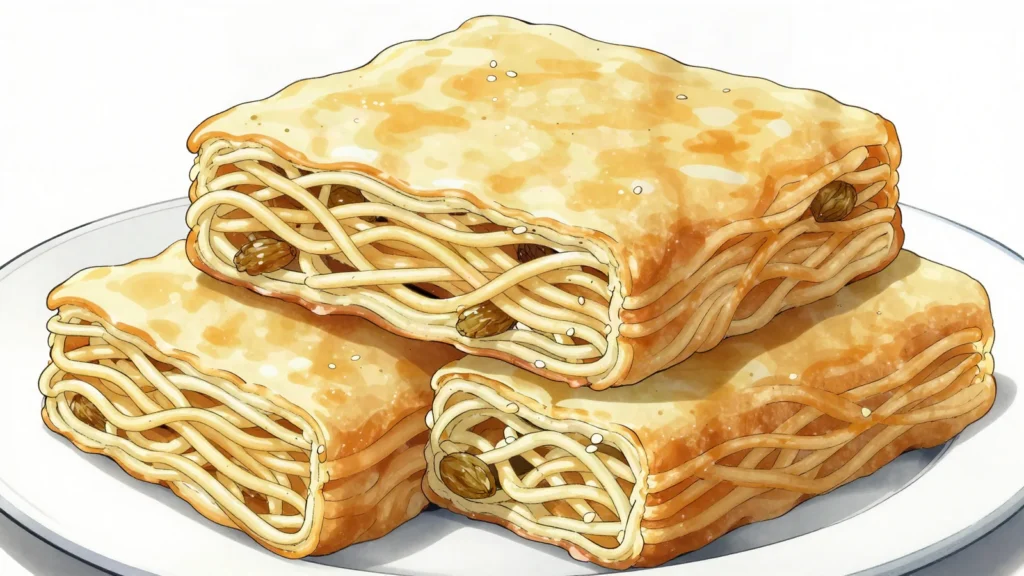
- Press it firmly and evenly. Level the top and let it cool for 20 minutes. Cut it warm, because a fully cooled slab shatters under the knife rather than cutting cleanly. Let the pieces cool completely, then store them in an airtight tin. It should be soft and chewy with a faint crunch, and it keeps about a week sealed away from damp.
Technique
- Maltose is sold in Chinese shops in tubs and is very thick and sticky.
- Osmanthus flowers are a traditional flavouring and give a distinctive floral note.
- It goes hard in humid air, so keep it sealed.
Substitutions
- Golden syrup or corn syrup in place of maltose.
- Ready-fried noodle strands, sold for exactly this purpose in some Chinese shops.
Variations
- With osmanthus for a floral version.
- With dried cranberries and nuts, which is common now.
- Made plain, without any fruit.
History
A Manchu confection brought to Beijing with the Qing court, its name from a Manchu word for the pastry.
Frequently asked questions
What is Sachima?
Sachima is a bread & pastry from China: fried dough strands bound with sugar syrup into a soft, chewy slab. A Manchu confection brought to Beijing with the Qing court, its name from a Manchu word for the pastry.
How long does Sachima take to make?
Sachima takes 40 min plus 30 min resting of preparation and 30 min of cooking. The recipe makes about 20 pieces. It is rated hard to make.
What can I substitute in Sachima?
Yes, within limits. Golden syrup or corn syrup in place of maltose. Ready-fried noodle strands, sold for exactly this purpose in some Chinese shops.
What is the most important thing to get right in Sachima?
Mix the flour, eggs, baking powder and salt into a firm dough, adding water only if it will not come together. Use eggs rather than water for the liquid. Knead it 10 minutes until smooth, then wrap it and rest it 30 minutes. Roll the dough out very thin, about 2 mm, dusting generously with cornflour.