
Ingredients
Bread dough
- 250 gstrong white flour
- 40 gsugar
- 5 ginstant yeast
- ½ tspsalt
- 1egg
- 100 mlwarm milk
- 40 gbutter, softened
Cookie dough
- 60 gbutter, softened
- 80 gsugar
- 1egg
- 200 gplain flour
- ½ tspbaking powder
- 1 tspvanilla
To finish
- caster sugar, for rolling
Optional
- melon essence, or melon cream for filling
Directions
- Make the bread dough first: mix the flour, sugar, yeast and salt, then work in the egg and warm milk. Knead 10 minutes until smooth, then work in the softened butter piece by piece.
- Add the butter after the dough has developed, not at the start, or it coats the flour and the dough never builds strength. Prove for 1 hour 30 minutes until doubled. Do not overwork the cookie dough. Wrap the cookie dough and chill it 30 minutes, until firm enough to roll but still pliable.
- Divide both doughs into 8 equal pieces each. Roll each piece of bread dough into a tight ball with a smooth surface. Roll each piece of cookie dough between two sheets of cling film into a thin round, wider than the bread ball.
- Roll the cookie dough between plastic. It is soft and sticky and it tears on a floured board every time. Leave the base uncovered. Roll each covered bun in caster sugar until the whole cookie surface is coated.
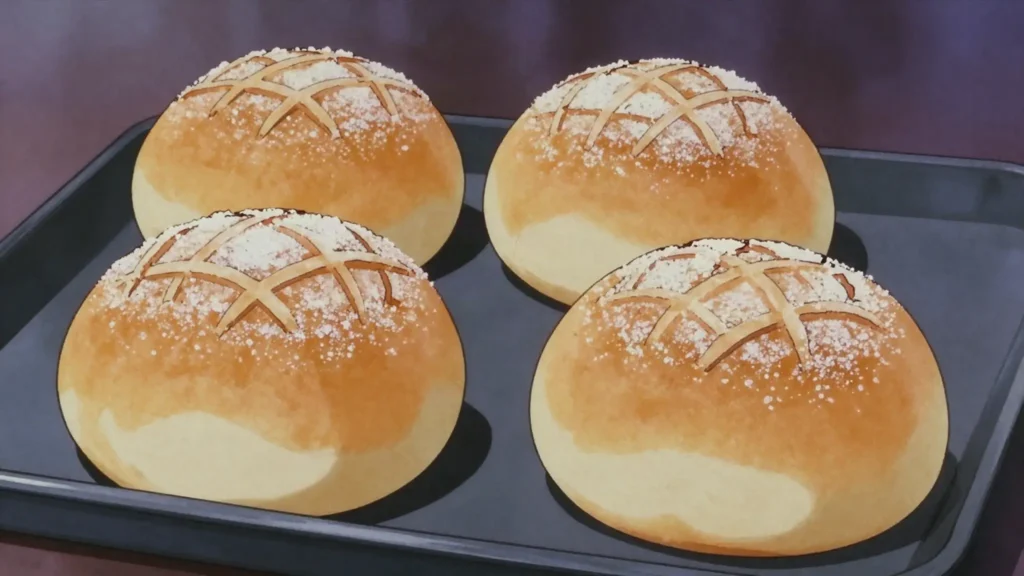
- Score a criss-cross pattern into the cookie layer with the back of a knife or a scraper, cutting into the cookie dough but not through it. Score it now, before the second prove.
- Set them well apart on lined trays and prove 40 minutes, until noticeably puffed. Do not over-prove them at this stage, because the cookie layer cracks apart into islands rather than a net.
- Bake at 180°C (355°F) for 13 to 15 minutes, until the cookie crust is pale gold. Take them out while the crust is still pale. Cool them on a rack, where the crust crisps as it cools. They are best a few hours after baking, when the top is crisp and the bun beneath is still soft.
Technique
- The contrast is the entire point: a crisp sugary shell over a soft enriched bun.
- They go soft overnight and are refreshed for a few minutes in a hot oven.
- Some bakeries add a little melon essence to the cookie dough, which is a modern touch.
Substitutions
- Ready-made sugar cookie dough, rolled thin.
- Whole milk in place of the egg in the cookie layer, for a plainer crust.
Variations
- Filled with custard cream or chocolate chips.
- The Kobe version, filled with melon cream.
- With cocoa in the cookie layer, as chocolate melonpan.
History
A Taisho-era Japanese bakery creation named for its appearance, not its flavour; Kobe versions hide melon cream inside.
Frequently asked questions
What is Melonpan?
Melonpan is a bread & pastry from Japan: soft bun under a crisp cookie crust scored into a melon pattern. A Taisho-era Japanese bakery creation named for its appearance, not its flavour; Kobe versions hide melon cream inside.
How long does Melonpan take to make?
Melonpan takes 45 min plus 2 hr rising of preparation and 15 min of cooking. The recipe makes 8 buns. It is rated hard to make.
What can I substitute in Melonpan?
Yes, within limits. Ready-made sugar cookie dough, rolled thin. Whole milk in place of the egg in the cookie layer, for a plainer crust.
What is the most important thing to get right in Melonpan?
Add the butter after the dough has developed, not at the start, or it coats the flour and the dough never builds strength. Prove for 1 hour 30 minutes until doubled. Do not overwork the cookie dough. Wrap the cookie dough and chill it 30 minutes, until firm enough to roll but still pliable.