
Ingredients
The cake
- 500 gglutinous rice
- soaked 4 hours and drained
- 500 mlfresh pig’s blood
- from a licensed butcher
- read the safety note
- 1 teaspoonsalt
- about 200 ml water or stock
For the broth to dip in
- 1 litrepork stock
- or water
- 2 slicesginger
- 1spring onion
- 1 teaspoonsalt
- 2 tablespoonssoy sauce
The coating
- 150 groasted peanuts
- ground to a coarse powder
- 2 tablespoonssugar
- mixed into the peanut powder
- a large handful of coriander
- chopped
To serve
- sweet chilli sauce
- or soy paste
- wooden sticks or skewers
Directions
- Keep it refrigerated at all times. Use it the day you buy it. Do not let it stand at room temperature. Wash everything thoroughly afterwards. It should smell metallic and clean. Steam it until it is completely firm.
- Strain it before use to remove any clots. Blood is nutritious and it is otherwise wasted. Use glutinous rice, also called sticky rice. Rinse the rice several times. Cover it with cold water.
- Soak it for at least four hours. Glutinous rice needs soaking to cook evenly. Drain the soaked rice thoroughly. Put it in a bowl. Strain the blood through a sieve. Pour it over the rice. Add the salt and the water. Stir it thoroughly. It should be a loose wet mixture. Line a shallow tin or dish. Pour the mixture in.
- Make it about three centimetres deep. Thicker than that and the centre stays soft. Set the dish in a steamer over boiling water. Cover it tightly. Lay a cloth under the lid. Steam it for about an hour. Check the water level halfway. Top it up with boiling water. A steamer that boils dry is a fire risk.
- Steam it longer if in doubt. Steam scalds badly. Lift the lid away from your face. Lift the far edge first. Let it cool completely in the dish. Then refrigerate it for several hours.
- Warm cake cannot be cut or skewered. Cold cake cuts into clean blocks. Cut it into rectangles. About the size of a small bar of soap. Bring the seasoned stock to a simmer. Leave it for two or three minutes. Lift it out and let it drip briefly. It should be wet on the surface.
- Grind roasted peanuts to a coarse powder. It should be gritty rather than smooth. Mix sugar into the peanut powder. Roll the wet cake in the peanut powder.
- Press it on so it adheres thickly. Use a generous coating. A thin dusting is not enough. Press chopped coriander onto the coated cake. Or with a thick sweet soy paste. Serve it hot on the stick. The steamed cake keeps four days refrigerated. Cut it into portions before freezing. Coat it only when you serve it. A coated cake goes soggy within minutes.
Technique
- Buy blood only from a licensed butcher, and ask whether it is legal to sell where you are — rules vary by country and it is restricted or unavailable in some places. It is highly perishable, spoiling faster than most meat: keep it refrigerated, use it the day you buy it, handle it with clean hands and a separate board, and wash everything afterwards.
- Fresh blood is deep red and liquid and smells metallic and clean. Any sour or off smell, or a greenish tint, means discard it. Strain it before use, since it clots quickly once collected.
- Steam it until completely firm with a skewer coming out clean — an hour. Undercooked blood cake is soft, unpleasant and not safe; steam it longer if in any doubt.
- Chill it several hours or overnight before cutting. It firms considerably as it cools, and warm cake cannot be cut or skewered.
- Use glutinous rice, soaked at least four hours. Its starch makes it sticky and chewy, which is what binds the cake — ordinary rice will not hold together, and unsoaked grains stay hard in the centre.
- Glutinous rice contains no gluten. The name refers to its glue-like texture and it is safe for anyone avoiding gluten.
- Make the layer about three centimetres deep. Thicker and the centre stays soft; thinner and the cake is too fragile to skewer.
- The broth dip is not just reheating — the wet surface is what the peanut powder sticks to. A dry cake takes no coating at all.
- Grind the peanuts coarse and gritty, pulsing rather than running the machine. Ground too far it turns to peanut butter.
- Sugar in the peanut powder is deliberate. The sweetness against the savoury blood is a Taiwanese habit across many dishes.
- Coriander is not optional. It cuts through the peanut and the blood and is what makes the whole thing work.
- Coat it only at the moment of serving. A coated cake goes soggy within minutes.
- This contains peanuts heavily and peanut allergy can cause anaphylaxis. The coating cannot simply be left out, since it is most of the flavour — ground sesame is a workable substitute.
- Frozen pig’s blood cake from a Chinese grocer skips the whole preparation and is what most people outside Taiwan use. The atlas records that without disapproval.
- Blood is eaten across a great many cultures — black pudding, morcilla, boudin noir, czernina, sundae, dinuguan. It is nutritious and otherwise wasted, and in a system where an animal is fully used it is food. Many people are uncomfortable with it, which is a common reaction and not a wrong one; the atlas records the dish and urges no one to eat it.
Substitutions
- Frozen ready-made pig’s blood cake replaces the whole steaming stage.
- Ground sesame replaces peanut powder for anyone avoiding peanuts.
- Duck blood is used in some versions and behaves the same way.
- Thick sweet soy paste replaces sweet chilli sauce.
- Steaming replaces the broth dip for reheating, though the surface must then be brushed with sauce to hold the coating.
- Pork stock replaces water in the dipping broth and gives more flavour.
Variations
- Duck blood cake is made the same way and is common in hotpot.
- Duck blood in mala hotpot is the other great Taiwanese blood dish.
- Sundae in Korea stuffs blood and noodles into intestine casing.
- Dinuguan in the Philippines is a blood stew with pork.
- Black pudding, morcilla and boudin noir are the European relatives.
- A version served in a bowl of broth rather than on a stick is also sold.
History
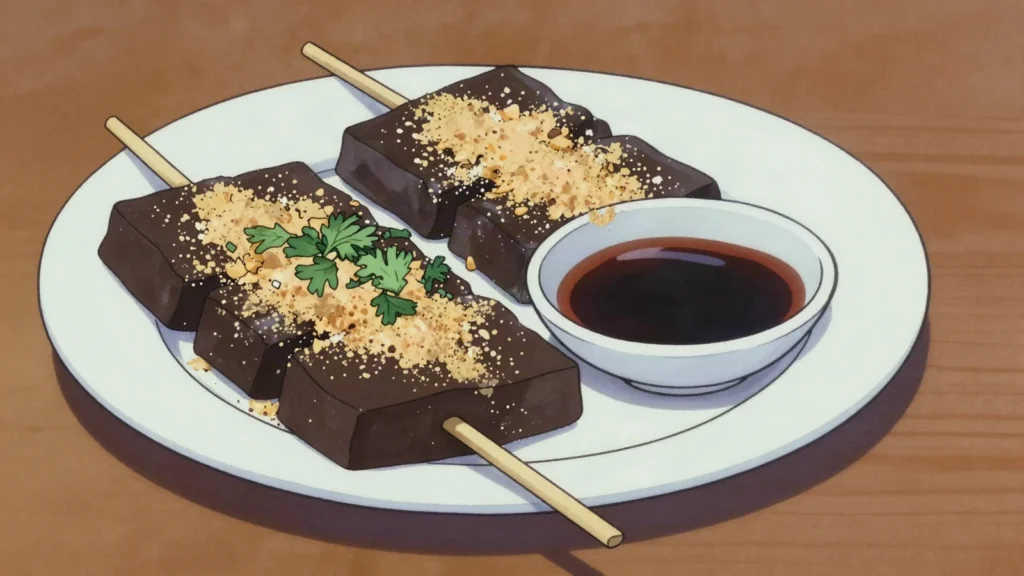
A dense cake made from glutinous rice and pig’s blood, steamed until firm, then typically skewered, coated in peanut powder and coriander, and eaten like a savory popsicle, documented across Taiwan as one of the country’s most distinctive night market foods, reflecting a broader Chinese and Taiwanese culinary tradition of using the whole animal, including blood, rather than discarding it. Its firm, slightly chewy texture, achieved by steaming the rice-and-blood mixture until it sets into a solid cake, distinguishes pig’s blood cake as a genuinely unique textural experience within Taiwanese street food. Pig’s blood cake remains a well-known, if occasionally polarizing among first-time visitors, staple of Taiwan’s night market food culture.
Frequently asked questions
What is Pig’s Blood Cake?
Pig’s Blood Cake is a street food from Taiwan: steamed pork-blood rice cake on a stick, rolled in peanut powder and coriander. A dense cake made from glutinous rice and pig’s blood, steamed until firm, then typically skewered, coated in peanut powder and coriander, and eaten like a savory popsicle, documented across Taiwan as one of the country’s most distinctive night market foods, reflecting a broader Chinese and Taiwanese culinary tradition of using the whole animal, including blood, rather than discarding it. Its firm, slightly chewy texture, achieved by steaming the rice-and-blood mixture until it sets into a solid cake, distinguishes pig’s blood cake as a genuinely unique textural experience within Taiwanese street food. Pig’s blood cake remains a well-known, if occasionally polarizing among first-time visitors, staple of Taiwan’s night market food culture.
How long does Pig’s Blood Cake take to make?
Pig’s Blood Cake takes 30 minutes of preparation and 1 hour, plus setting of cooking. The recipe makes makes about 8 sticks. It is rated medium to make.
What can I substitute in Pig’s Blood Cake?
Yes, within limits. Frozen ready-made pig’s blood cake replaces the whole steaming stage. Ground sesame replaces peanut powder for anyone avoiding peanuts. Duck blood is used in some versions and behaves the same way. Thick sweet soy paste replaces sweet chilli sauce. Steaming replaces the broth dip for reheating, though the surface must then be brushed with sauce to hold the coating. Pork stock replaces water in the dipping broth and gives more flavour.
What is the most important thing to get right in Pig’s Blood Cake?
Keep it refrigerated at all times. Use it the day you buy it. Do not let it stand at room temperature. Wash everything thoroughly afterwards. It should smell metallic and clean. Steam it until it is completely firm.