
Ingredients
Dough
- 500 gplain flour
- 7 gdried yeast
- 80 gsugar
- 1 tspsalt
- 50 gbutter or margarine, melted
- 1egg
- about 220 ml warm milk or water
- 1 tspgrated nutmeg, optional
To fry
- oil, for deep frying
To finish
- caster sugar, for rolling
- or a simple sugar glaze
To serve
- warm, from a market tray, wrapped in paper
Directions
- Grate the nutmeg fresh if you can. Dissolve the yeast with a spoonful of the sugar in warm liquid and leave it for five minutes until it froths. Use liquid at body temperature, since anything above about fifty degrees kills the yeast outright. If it does not froth, the yeast is dead and the donat will not rise.
- Mix everything into a soft dough and knead for eight to ten minutes until smooth and elastic. It should be soft and slightly tacky rather than firm. Cover it and let it rise until doubled, which takes about an hour in a warm kitchen. In the tropics this happens quickly, and in a cold kitchen it takes considerably longer.
- Roll the dough out to about a centimetre and a half and cut rings, or roll balls by hand. Rings cook more evenly, since a ball has a thick centre that stays raw.
- Let the shaped donat prove on a floured tray for twenty to thirty minutes until visibly puffy. Press one gently: the dent should spring back slowly. Heat the frying oil to about 175°C. Test with a scrap of dough, which should rise immediately and colour over two minutes.
- Use enough oil for them to float freely and turn themselves. Do not crowd the pan, which drops the temperature sharply. Fry for about two minutes a side until deep golden. Break one open before frying the rest: it should be light and cooked through with no raw dough at the centre. If the middle is raw, lower the heat for the next batch.
- Drain them on a rack rather than paper. Roll them in caster sugar while they are still warm. Sugar sticks to a warm donat and slides off a cold one, so do it straight away.
- Let them cool slightly first so the glaze sets rather than soaking in. Now serving them out while warm. Serve them warm, which is when they are at their best. They go dense within a few hours and stale by the next day, which is why they are fried fresh each morning.
Technique
- The name is a Pijin borrowing of doughnut, from colonial and mission baking.
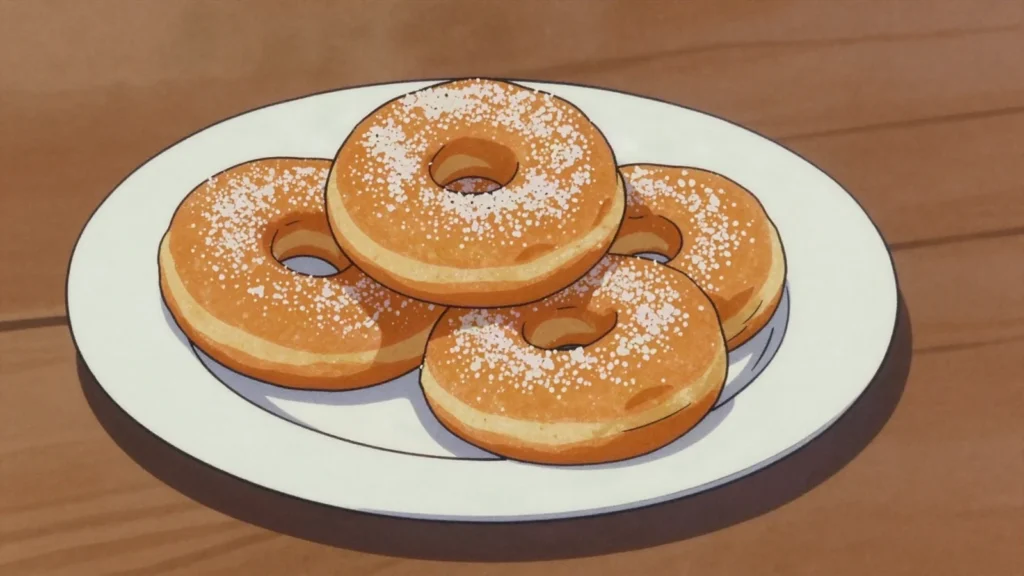
- The pale band around the middle shows correct proving and oil temperature.
- Roll them in sugar while warm, since it slides off a cold one.
Substitutions
- Margarine in place of butter, which is common.
- Water in place of milk, which gives a plainer donat.
Variations
- Made as balls rather than rings.
- Glazed rather than sugared.
- Made with coconut milk in the dough.
History
A Pijin borrowing of the doughnut, adopted from colonial and mission baking and now standard Honiara market fare.
Frequently asked questions
What is Donat?
Donat is a street food from Solomon Islands: rings of fried sweet dough sold warm from market trays. A Pijin borrowing of the doughnut, adopted from colonial and mission baking and now standard Honiara market fare.
How long does Donat take to make?
Donat takes 25 min plus 1 hr 30 min rising of preparation and 25 min of cooking. The recipe makes about 16. It is rated easy to make.
What can I substitute in Donat?
Yes, within limits. Margarine in place of butter, which is common. Water in place of milk, which gives a plainer donat.
What is the most important thing to get right in Donat?
Mix everything into a soft dough and knead for eight to ten minutes until smooth and elastic. It should be soft and slightly tacky rather than firm. Cover it and let it rise until doubled, which takes about an hour in a warm kitchen. In the tropics this happens quickly, and in a cold kitchen it takes considerably longer.