
Ingredients
The sausage
- 8Taiwanese pork sausages
- xiang chang
- bought, not made
- see the note
To glaze, optional
- 2 tablespoonsrice wine
- or mirin
- 1 tablespoonhoney
- or maltose
To serve
- raw garlic cloves
- peeled, whole
- sliced spring onion
- sliced cucumber
- sticky rice, optional
- wooden skewers
For the fire
- charcoal
- burned down to embers
- or a griddle pan indoors
Directions
- Check the packet. Raw cured sausage must be cooked through. Cook it until it is firm and hot throughout. It makes no recommendation about anyone’s diet.
- Take a small bite of garlic rather than the whole clove. Never use a charcoal grill indoors at all. Grill outdoors in open air only. Let the charcoal burn down to embers. Use moderate heat, not fierce.
- Cook over the cooler part. Move the sausages if they darken too fast. Lay them on the grill. Turn them every two or three minutes. Give them ten to fifteen minutes. Turn them often.
- Brush them with rice wine and honey near the end. So brush it on in the last three minutes only.
- Cut one open to check. There should be no raw pink centre. Cook over medium heat. Turn them often. Give them about twelve minutes.
- Pour it off as it collects. Otherwise they fry rather than grill. Roast them at two hundred degrees. Give them about fifteen minutes.
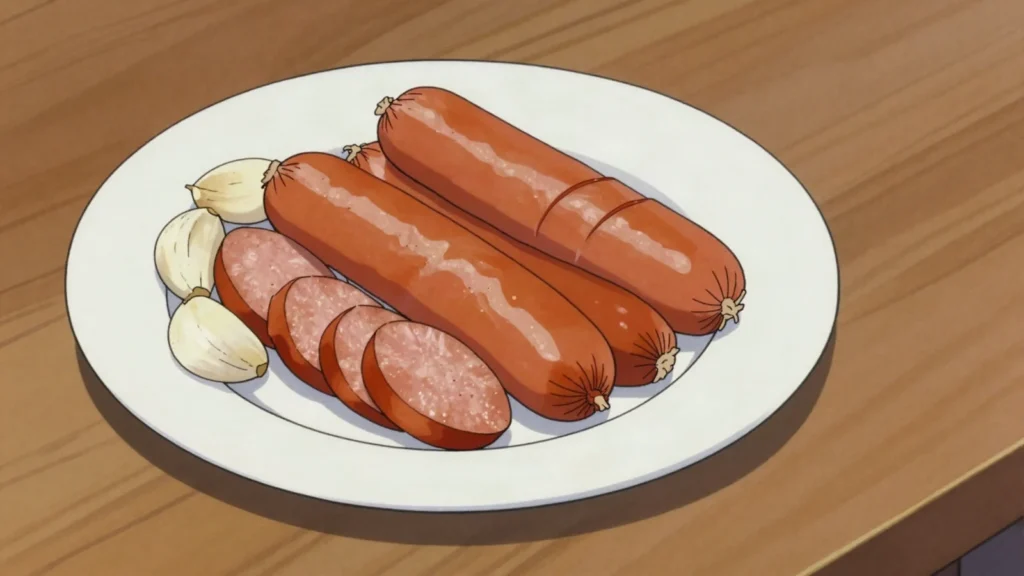
- Turn them once. Serve them hot on a skewer. Or cut into thick diagonal slices. Serve peeled raw cloves alongside. It is grilled until crisp outside. Check the packet. Cooked sausage keeps two days refrigerated.
Technique
- The atlas gives no method for making the sausage. Cured sausage involves nitrite curing salts used in small, carefully measured quantities to prevent botulism, and it needs accurate scales, correct ratios and controlled temperature and humidity. Getting it wrong carries real risk, so the omission is deliberate — buy them from a Taiwanese or Chinese grocer, which is what almost everyone does.
- Raw cured sausage must be cooked through. Curing does not make it ready to eat, unlike a dry-cured salami.
- Cured sausage stays pink when fully cooked — that is the nitrite, not undercooking. Judge by firmness and heat throughout rather than by colour, and cut one open to check.
- Use moderate heat and bank the coals to one side. These sausages are full of sugar and fat, sugar burns fast and dripping fat causes flare-ups, so over high heat the outside blackens before the inside cooks — the commonest failure here.
- Do not prick them. Pricking lets the fat out, which causes flare-ups and dries the sausage. A shallow diagonal score helps them cook evenly without releasing much.
- Brush any honey glaze on in the last three minutes only. It burns quickly.
- Turn them every two or three minutes. They colour fast on one side.
- Pour the rendered fat off a griddle pan as it collects, or they fry rather than grill.
- Charcoal produces carbon monoxide, which has no colour, smell or taste and kills in enclosed spaces. Grill outdoors only, never in a garage, tent or shed, and never bring a used grill inside.
- The sweetness is what the sausage is rather than a variation. Taiwanese xiang chang carries a lot of sugar and tastes clearly sweet as well as savoury — Chinese lap cheong is drier, harder and usually steamed or cooked into rice.
- The raw garlic is deliberate and it works: the sausage is sweet, fatty and rich, and sharp raw garlic cuts through it and resets the palate. A whole clove is a lot for many people, so take a small bite of one, use milder young garlic, or use spring onion instead.
- Cured meats contain nitrites and processed meat has documented health associations, with public health bodies advising moderation. The atlas records that as fact and makes no recommendation about anyone’s diet.
Substitutions
- Chinese lap cheong substitutes but is drier and harder and better steamed than grilled.
- A ridged griddle pan replaces charcoal indoors; an oven at 200 degrees works at the cost of the char.
- Maltose replaces honey in the glaze and is more traditional.
- Spring onion or young garlic replace whole raw garlic cloves for a milder accompaniment.
- A ready-made sticky rice sausage turns it into the big-sausage-wraps-small-sausage version.
- The glaze can be left out entirely; the sausage is already sweet.
Variations
- Da chang bao xiao chang wraps the sausage inside a grilled sticky rice sausage.
- Lap cheong in Chinese cooking is steamed or cooked into clay pot rice.
- Pig’s blood cake is the other great Taiwanese night market skewer.
- Sausage grilled with basil leaves is sold at some stalls.
- A version brushed with a spiced or chilli glaze is common.
- Sausage sliced into fried rice is the everyday home use.
History
A slightly sweet pork sausage, seasoned with rice wine and often grilled and served alongside raw garlic or pickled vegetables, documented across Taiwan as one of the country’s most iconic night market foods, its distinctly sweet flavour setting it apart clearly from the saltier, less sweet sausages found in mainland Chinese and many other regional cuisines. Its sweetness, achieved through a notable quantity of sugar mixed directly into the meat before curing and cooking, reflects a broader Taiwanese culinary preference for balancing savory dishes with a touch of sweetness, a pattern found across several other iconic Taiwanese foods. Taiwanese sausage remains one of the most commonly eaten grilled street foods across Taiwan’s night markets.
Frequently asked questions
What is Taiwanese Sausage?
Taiwanese Sausage is a street food from Taiwan: sweet grilled pork sausage, often eaten with raw garlic cloves. A slightly sweet pork sausage, seasoned with rice wine and often grilled and served alongside raw garlic or pickled vegetables, documented across Taiwan as one of the country’s most iconic night market foods, its distinctly sweet flavour setting it apart clearly from the saltier, less sweet sausages found in mainland Chinese and many other regional cuisines. Its sweetness, achieved through a notable quantity of sugar mixed directly into the meat before curing and cooking, reflects a broader Taiwanese culinary preference for balancing savory dishes with a touch of sweetness, a pattern found across several other iconic Taiwanese foods. Taiwanese sausage remains one of the most commonly eaten grilled street foods across Taiwan’s night markets.
How long does Taiwanese Sausage take to make?
Taiwanese Sausage takes 10 minutes of preparation and 15 minutes of cooking. The recipe makes serves 4. It is rated easy to make.
What can I substitute in Taiwanese Sausage?
Yes, within limits. Chinese lap cheong substitutes but is drier and harder and better steamed than grilled. A ridged griddle pan replaces charcoal indoors; an oven at 200 degrees works at the cost of the char. Maltose replaces honey in the glaze and is more traditional. Spring onion or young garlic replace whole raw garlic cloves for a milder accompaniment. A ready-made sticky rice sausage turns it into the big-sausage-wraps-small-sausage version. The glaze can be left out entirely; the sausage is already sweet.
What is the most important thing to get right in Taiwanese Sausage?
Check the packet. Raw cured sausage must be cooked through. Cook it until it is firm and hot throughout. It makes no recommendation about anyone’s diet.