
Ingredients
The rice
- 500 grice flour
- or pounded rice
- about 150 ml water
- a pinch of salt
The baobab liquid
- 200 gbaobab fruit pulp
- bouye, with its seeds
- 1 litrewater
- 200 gsugar
- or to taste
Sometimes added
- a little evaporated milk
- 1 teaspoonvanilla
- grated nutmeg
- raisins
- desiccated coconut
To serve
- chilled in cups
- sliced banana, at the last moment
- at Good Friday
Directions
- Rub the moistened flour between your palms. It takes patience rather than skill. Add the water very sparingly indeed. Too much gives a dough rather than granules. Sprinkle it rather than pouring it. Put the rice flour in a wide shallow bowl.
- Add the pinch of salt to the flour. Sprinkle a little water over it. Rub the flour between your palms. Work in steady circular movements. Building them up takes real time. Sprinkle more water as you work. Add more dry flour as they grow.
- Keep rubbing and rolling throughout. This takes a good half hour to do properly. Work steadily rather than hurrying. Judging the size takes a look. Shake them through a coarse sieve. Put water in the bottom of a pot. Set a steamer basket above it.
- Line it with a cloth if the holes are large. Steaming them takes about thirty minutes. Spread the granules in the basket. Cover it and bring the water to a boil.
- Let them steam for about thirty minutes. That keeps them separate and dry. Take the basket off halfway through. Break up any clumps with a fork. Return it all to the steam again. Breaking them up keeps them separate. Spread them out on a wide tray. Let them cool right down completely.
- Warm granules stick together in a mass. Spread out they cool and stay separate. Break up any clumps as they cool. Put the baobab pulp in a bowl. Add all of the measured water to it. Let it soak for about twenty minutes.
- Work it with your hands to help it. Pour it all through a fine sieve. Press the pulp against the mesh. The seeds are hard and must come out. Discard both of them entirely. Stir the sugar into the strained liquid. Stir until it dissolves completely. It needs real sweetening to balance.
- Taste it and adjust it as needed. It should be clearly sweet to taste. Stir in vanilla or grated nutmeg. Add a little evaporated milk if you like. Give it at least two full hours.
- Chill both of the parts properly. Combining it is done at serving. Put the steamed granules in cups. Pour the cold baobab liquid over them. Combine them shortly before serving. Adding banana is done last of all. Slice the banana into the cups. Add it at the moment of serving. Never add it in at all in advance. Serve it in cups with a spoon. It is sold cold at Gambian markets.
Technique
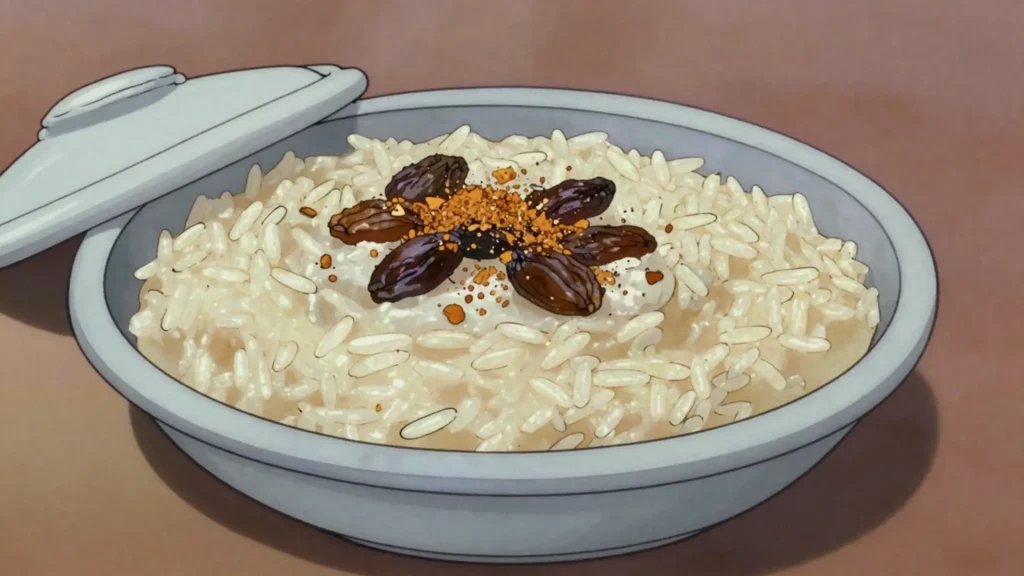
- The atlas calls it a rice pudding, but nothing is simmered in milk: rice flour is hand-rolled into small granules and steamed dry, then dressed with a cold liquid — structurally closer to a chilled couscous dish than a boiled pudding. The atlas also gives sweetened milk as the liquid, where the sources give strained baobab infusion with sugar; milk appears only as an optional addition.
- The baobab pulp is soaked and strained, so what goes into the dish is the water extract — the seeds and fibre are discarded rather than going in. Baobab is intensely tart and needs real sweetening, but it should still taste tart behind the sugar.
- It is a Good Friday dish made by Gambian Christian households and deliberately shared with Muslim neighbours and colleagues; the sources lead with that sharing rather than treating it as incidental.
Substitutions
- Pounded rice stands in for rice flour, which is the traditional starting point.
- Line the steamer basket with damp muslin if the holes are large, since the small granules fall through a coarse basket.
Variations
- Senegalese ngalakh is a close relative, also a baobab and grain dish shared at Easter; whether either descends from the other is unrecorded, so the atlas notes the resemblance without claiming descent.
- Combine the granules and liquid shortly before serving, since long standing turns the granules to mush.
- Slice banana in at the moment of serving, since it darkens quickly once cut.
History
Made with the tart pulp of the baobab fruit, sold cold in cups at Gambian markets.
Frequently asked questions
What is Nan mburu?
Nan mburu is a dessert from Gambia: chilled rice pudding mixed with baobab juice and sweetened milk. Made with the tart pulp of the baobab fruit, sold cold in cups at Gambian markets.
How long does Nan mburu take to make?
Nan mburu takes 40 minutes plus chilling of preparation and 40 minutes of cooking. The recipe makes serves 8. It is rated medium to make.
What can I substitute in Nan mburu?
Yes, within limits. Pounded rice stands in for rice flour, which is the traditional starting point. Line the steamer basket with damp muslin if the holes are large, since the small granules fall through a coarse basket.
What is the most important thing to get right in Nan mburu?
Rub the moistened flour between your palms. It takes patience rather than skill. Add the water very sparingly indeed. Too much gives a dough rather than granules. Sprinkle it rather than pouring it. Put the rice flour in a wide shallow bowl.