
Ingredients
Kaya (coconut jam)
- 4large eggs plus 2 extra yolks
- 200 gcaster sugar
- 300 mlthick coconut milk
- 4pandan leaves, knotted and bruised
- 1 pinchfine salt
- 30 gpalm sugar (gula melaka), shaved, for colour
Toast
- 8thin slices of white sandwich bread, crusts on
- 80 gcold salted butter, cut into 3 mm slabs
Soft-boiled eggs
- 4large eggs, at room temperature
- 1 tspdark soy sauce
- white pepper, to taste
Kopi
- 4 tbspdark-roast coffee grounds (butter-roasted, if you can get it)
- 500 mlboiling water
- 4 tbspsweetened condensed milk
Directions
- Whisk the eggs, yolks and caster sugar in a bowl until just combined but not aerated; froth makes a bubbly, spongy kaya.
- Warm the coconut milk with the pandan and salt to a bare steam, then pour it into the eggs in a slow stream, whisking.
- Strain into a heatproof bowl set over barely simmering water. Stir constantly with a spatula for 40–50 minutes, scraping the base, until the kaya coats the back of the spoon thickly and holds a line drawn through it.
- Melt the palm sugar in a small pan to a dark caramel and stir it in for the traditional bronze colour. Cool, then chill; it thickens further.
- Bring a pan of water to the boil, kill the heat, lower in the whole eggs, cover and steep 6–7 minutes for a set white and a still-liquid yolk. Crack into a saucer and season with dark soy and plenty of white pepper.
- Toast the bread over charcoal or in a very hot dry pan until dark-edged and crisp on both sides but still soft in the middle, about 90 seconds a side.
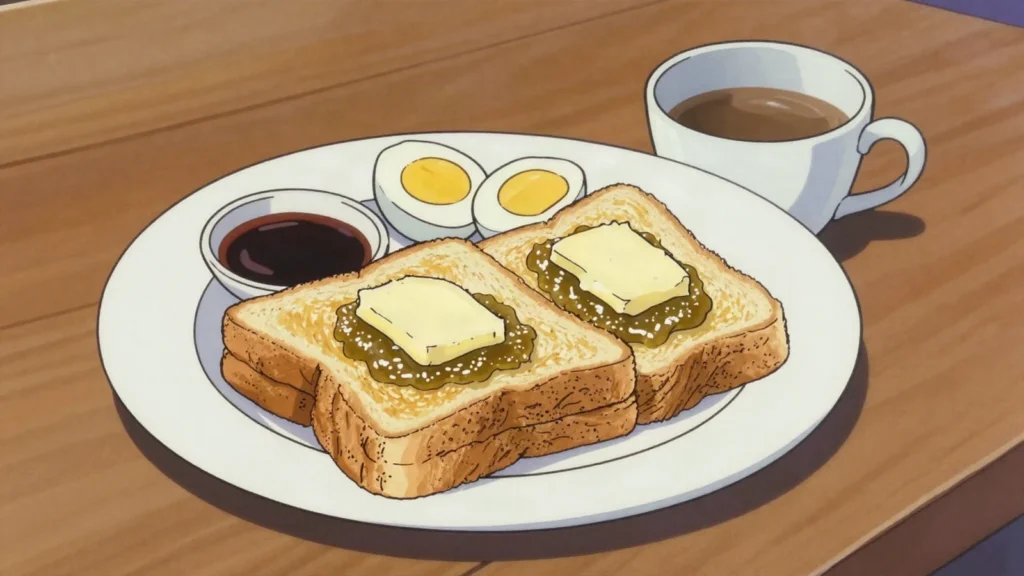
- Spread one slice thickly with cold kaya, lay two cold butter slabs on the other, sandwich and cut into three fingers. The butter should be barely softening, not melted.
- Brew the coffee strong through a cloth sock bag, pour condensed milk into the cup first and top with coffee. Serve the toast for dipping into the eggs, with the kopi alongside.
Technique
- Kaya is a custard, not a jam. Direct heat scrambles it in seconds, which is why every kopitiam cooks it over a double boiler and stirs without stopping.
- The butter must go on cold and in slabs, not spread. The contrast of cold fat against hot charcoal toast is the whole point of the dish.
- Old-style kopitiam bread is steamed-and-toasted or sliced very thin; thick artisan sourdough will not give the right shatter.
Substitutions
- No pandan leaves: use 1 tsp pandan extract stirred in at the end, though the perfume is flatter.
- For a quicker kaya, cook it in a heavy pan over the lowest possible heat, whisking constantly, in about 15 minutes; the risk of graininess is much higher.
Variations
- Hainanese-style green kaya, made with more pandan and no caramel, is pale jade rather than brown.
- Steamed bread (roti bakar kukus) served warm and pillowy instead of toasted.
History
Toasted bread spread with kaya, a sweet coconut-and-egg jam, served alongside soft-boiled eggs and a cup of coffee or tea, developed by Hainanese immigrants in Singapore during the early 1900s, who worked extensively as cooks and staff for British colonial households and later adapted Western breakfast customs, including toast and eggs, into this distinctly Singaporean and Malaysian breakfast combination. Kaya itself, the coconut jam, reflects Southeast Asian ingredients layered onto a fundamentally British-influenced breakfast format, and traditional kaya toast is specifically made using charcoal-toasted bread, considered by many longtime kopitiam, or coffee shop, operators essential to achieving the proper flavour and texture compared to modern electric toasting. It remains one of Singapore’s most iconic and widely eaten breakfast dishes.
Frequently asked questions
What is Kaya Toast?
Kaya Toast is a breakfast from Singapore: charcoal toast with coconut jam and butter, soft-boiled eggs, kopi. Toasted bread spread with kaya, a sweet coconut-and-egg jam, served alongside soft-boiled eggs and a cup of coffee or tea, developed by Hainanese immigrants in Singapore during the early 1900s, who worked extensively as cooks and staff for British colonial households and later adapted Western breakfast customs, including toast and eggs, into this distinctly Singaporean and Malaysian breakfast combination. Kaya itself, the coconut jam, reflects Southeast Asian ingredients layered onto a fundamentally British-influenced breakfast format, and traditional kaya toast is specifically made using charcoal-toasted bread, considered by many longtime kopitiam, or coffee shop, operators essential to achieving the proper flavour and texture compared to modern electric toasting. It remains one of Singapore’s most iconic and widely eaten breakfast dishes.
How long does Kaya Toast take to make?
Kaya Toast takes 20 min of preparation and 50 min of cooking. The recipe makes 4 servings (makes about 400 g kaya). It is rated medium to make.
What can I substitute in Kaya Toast?
Yes, within limits. No pandan leaves: use 1 tsp pandan extract stirred in at the end, though the perfume is flatter. For a quicker kaya, cook it in a heavy pan over the lowest possible heat, whisking constantly, in about 15 minutes; the risk of graininess is much higher.
What is the most important thing to get right in Kaya Toast?
Bring a pan of water to the boil, kill the heat, lower in the whole eggs, cover and steep 6–7 minutes for a set white and a still-liquid yolk. Crack into a saucer and season with dark soy and plenty of white pepper.