
Ingredients
Pastry
- 500 gplain flour
- 200 gcold butter
- 150 mlsour cream
- 1egg
- 1 tspsalt
- 1 tspvinegar
Filling
- 500 gmutton or lamb, hand-chopped
- 3onions, finely chopped
- 1 tspsalt
- 1 tspblack pepper
- 100 mllamb stock or water
- 50 gmutton fat, diced
To finish
- 1egg, beaten
To serve
- clear broth
Directions
- Rub the cold butter into the flour and salt, then bind with the sour cream, egg and vinegar into a soft dough.
- Chill it for at least an hour.
- Chop the meat by hand into small pieces rather than mincing it.
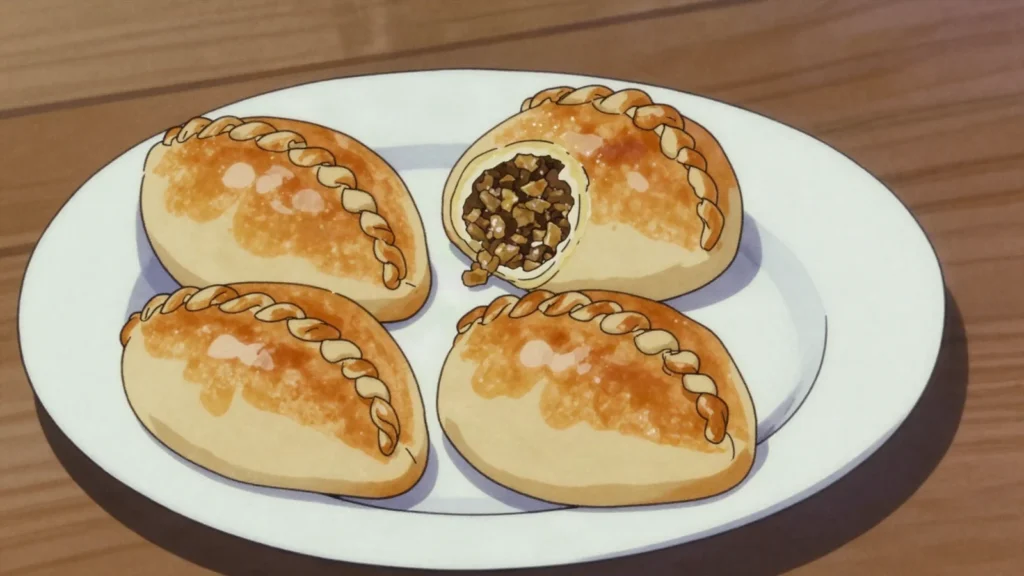
- Hand-chopped meat is the mark of a real kibinas. Mince packs into a dense paste, while chopped pieces stay separate and the juices run between them.
- Mix the meat with the onion, salt, pepper and the diced fat, and stir in the stock.
- Use as much onion as looks excessive, close to the weight of the meat.
- The onion is not a background note. It cooks down into the meat juices and is most of what makes the filling wet and sweet.
- The added fat and stock are what create the broth inside, which is the whole reason kibinai are eaten carefully.
- Roll the pastry out to about 3 mm and cut rounds of about 14 cm.
- Put a generous spoonful of filling on one half of each round.
- Fold the pastry over into a half-moon and press the edge closed firmly.
- Now the crimp. Fold the sealed edge over on itself in small overlapping pleats along the whole curve, pinching as you go.
- That rope crimp is structural as much as decorative. It is what holds the seam shut against the pressure of the broth building inside.
- Set them on a lined tray and brush with beaten egg.
- Bake at 200°C (390°F) for 15 minutes, then drop to 180°C (355°F) for a further 20 minutes.
- Hot first to set the pastry, then lower so the meat cooks through without the crust burning.
- Let them stand 5 minutes before eating.
- Bite a small hole in the end first and drink the broth, or it runs down your arm. This is standard advice and it is offered seriously.
- Serve hot, traditionally with a cup of clear meat broth alongside.
- They are the food of the Lithuanian Karaim, a Turkic community brought to Trakai in the fourteenth century, and Trakai is still where people go to eat them.
Technique
- Mutton is traditional and gives a much stronger flavour than lamb.
- The Karaim community in Lithuania is very small, and kibinai are its best-known contribution to the country’s food.
- They are sold from a row of cafés along the lake at Trakai, opposite the castle.
Substitutions
- Beef, or a beef and lamb mix.
- Shortcrust or even puff pastry, which is a real compromise.
Variations
- With chicken, which is common now.
- Vegetarian, with mushroom and onion.
- Made small, as an appetiser.
History
Baked meat pastries brought by the Karaim, a Turkic community settled at Trakai by Grand Duke Vytautas around 1397, who still run cafés there.
Frequently asked questions
What is Kibinai?
Kibinai is a snack from Lithuania: karaite crescent pies of mutton and onion, from Trakai. Baked meat pastries brought by the Karaim, a Turkic community settled at Trakai by Grand Duke Vytautas around 1397, who still run cafés there.
How long does Kibinai take to make?
Kibinai takes 45 min plus 1 hr chilling of preparation and 35 min of cooking. The recipe makes about 12. It is rated medium to make.
What can I substitute in Kibinai?
Yes, within limits. Beef, or a beef and lamb mix. Shortcrust or even puff pastry, which is a real compromise.
What is the most important thing to get right in Kibinai?
Chop the meat by hand into small pieces rather than mincing it.