
Ingredients
The oven
- about 40 volcanic or river stones, fist-sized, none of them porous or river-smooth (see notes)
- dry hardwood and coconut husk, enough for a 40 minute fire
- banana leaves and banana trunk sections, a large armful
- clean wet sacking or more leaves, to cover
Lu (taro leaf parcels)
- 40young taro leaves, thick stalks cut out
- 600 gpork belly, cut into 3 cm pieces
- 400 mlcoconut cream
- 2onions, finely chopped
- 2 tspsalt
The rest of the oven
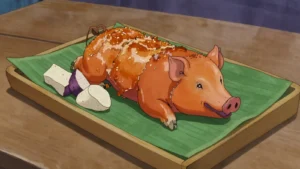
- 2 kgpork shoulder on the bone, scored
- 3 kgtaro corms, peeled and halved
- 6green plantains or breadfruit, halved
- 2 tspsalt
Directions
- Build the fire in a shallow pit and lay the stones over it. Burn it hard for about 40 minutes, until the stones glow and settle into the embers. This is the whole oven: everything after it is retained heat, and stones that are not properly hot will not cook the food through.
- Meanwhile make the lu. Stack four taro leaves in your palm, put in a piece of pork belly, a spoonful of onion, a pinch of salt, and 2 tablespoons of coconut cream. Fold the leaves over into a parcel and wrap the lot in a fifth leaf, then in a strip of banana leaf, and tie it. Repeat for eight parcels.
- Rake the fire out, leaving a bed of hot stones. Level them with a green stick and lay banana trunk sections and leaves over the hottest part so nothing sits on bare stone.
- Put the pork shoulder in the centre where the heat is strongest, the taro and plantain around it, and the lu parcels on top, where they are furthest from the stones and will steam rather than scorch. Salt the taro and plantain.
- Cover the whole mound with a thick layer of banana leaves, then wet sacking, then earth or more leaves banked around the edge until no steam escapes. Any gap is heat leaving the oven.
- Leave it for 3 hours without opening it. Lifting the cover to check drops the temperature and the food will not recover.
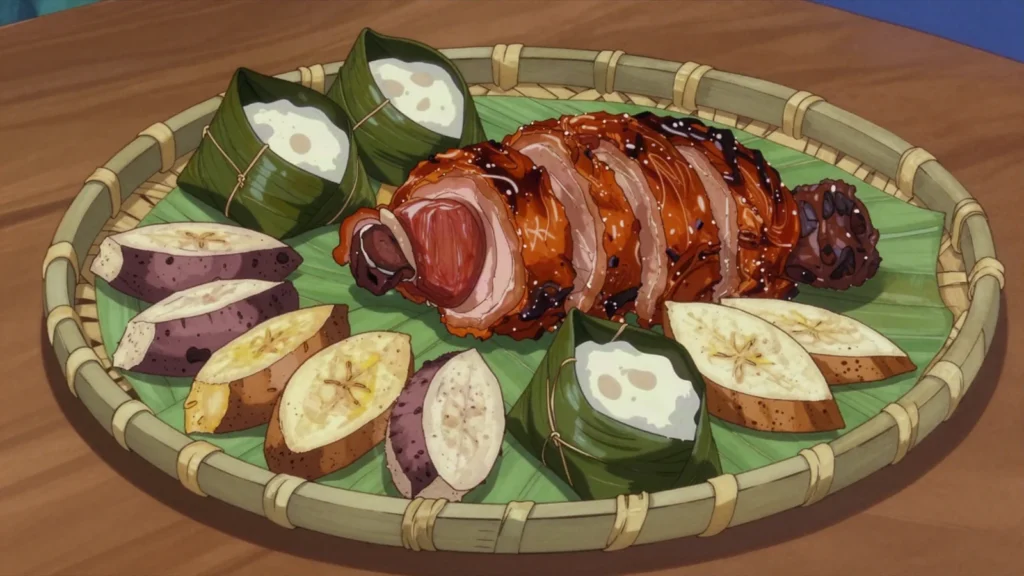
- Unearth it from the edges inward and lift everything onto a pola tray. Serve the pork carved, the taro and plantain in pieces, and one lu parcel per person, opened at the table.
Technique
- Stone choice is the safety step, not a detail. Porous stones and smooth river stones hold water inside them and can burst in a fire; dense volcanic rock is what is used and what you should use. Stand well back while the fire burns.
- The order in the pit is the temperature control. There is no dial — distance from the stones is the only thing setting how hard each item cooks.
- An ‘umu is a whole-day, several-people job by design. It is the centre of Sunday and of feasts because it feeds a crowd from one fire.
Substitutions
- Spinach or chard can stand in for taro leaves, but they are milder and much quicker, so cut the parcels down to two layers.
- Sweet potato or yam replaces taro corms without changing the method.
Variations
- The same oven, under different names, runs across the Pacific — umu in Samoa, imu in Hawaii, hāngī in Aotearoa, lovo in Fiji.
- Chicken and whole fish wrapped in leaves go in alongside the pork, on the upper layer with the lu.
History
The centre of Tongan Sunday and feast cooking, unearthed after several hours and laid out on a pola tray.
Frequently asked questions
What is ‘Umu?
‘Umu is a main from Tonga: earth oven of hot stones baking pork, taro and lu parcels underground. The centre of Tongan Sunday and feast cooking, unearthed after several hours and laid out on a pola tray.
How long does ‘Umu take to make?
‘Umu takes 1 hr 30 min of preparation and 3 hr of cooking. The recipe makes serves 10–12. It is rated hard to make.
What can I substitute in ‘Umu?
Yes, within limits. Spinach or chard can stand in for taro leaves, but they are milder and much quicker, so cut the parcels down to two layers. Sweet potato or yam replaces taro corms without changing the method.
What is the most important thing to get right in ‘Umu?
Build the fire in a shallow pit and lay the stones over it. Burn it hard for about 40 minutes, until the stones glow and settle into the embers. This is the whole oven: everything after it is retained heat, and stones that are not properly hot will not cook the food through.