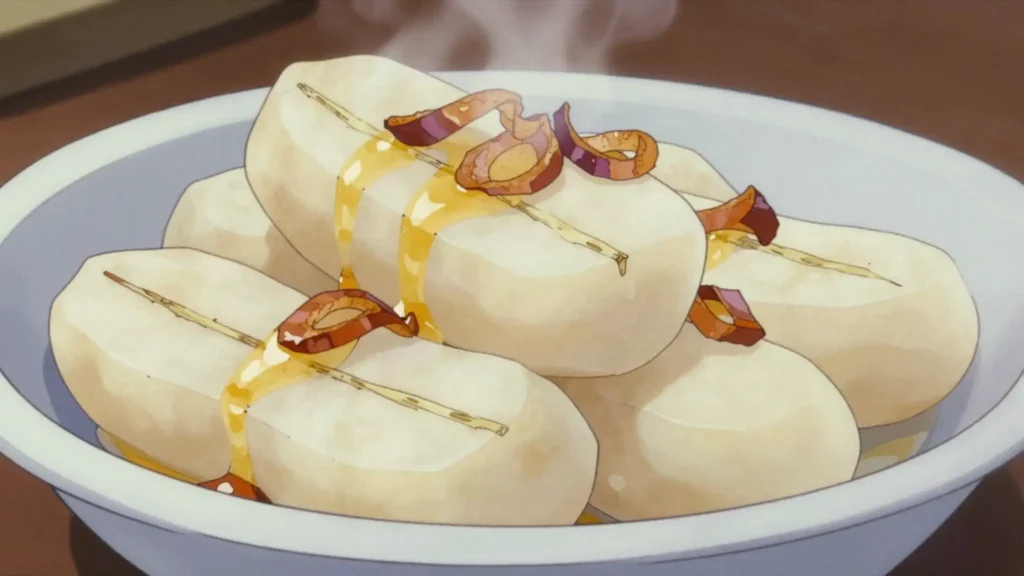

Ingredients
The cassava
- 1.5 kgcassava root
- a sweet variety
- peeled thickly
- see the safety note
- or 1.2 kg frozen cassava
The cooking water
- plenty of water, to cover
- 2 teaspoonssalt
- 1 clovegarlic, optional
- a bay leaf, optional
To finish, optional
- 2 tablespoonspalm oil
- or red palm oil
- or butter
- or olive oil
- 1onion, sliced and fried
- salt and pepper
To serve
- alongside a fish or meat stew
- or grilled fish
- with a chilli sauce
- or a groundnut sauce
Directions
- Peel away the brown skin and the pink layer beneath it. Both come off together in one thick strip. Discard the cooking water afterwards. Never eat cassava raw at any point.
- Discard any root that tastes strongly bitter after cooking. It stores in the ground until it is needed.
- Cut one open and look at the flesh. It should be pure white and clean throughout. Discard any root showing those signs. This takes more effort than peeling a potato.
- Cut the root into lengths of about eight centimetres. Stand each piece upright on the board. Cut down through the thick skin with a knife. The skin comes off in thick strips. Check that the pink layer has come away too. That is worth the extra minute.
- Put the cassava in a large pot. Cover it with plenty of cold water. Add the salt and any aromatics. Bring it to a boil.
- Boil it uncovered or only partly covered. Give it about twenty to twenty-five minutes. Start testing at twenty minutes. Lift out the tender ones as they are ready.
- Drain it thoroughly and discard the water. Never keep that water for a sauce or a stock. Butter or olive oil are also used. Season it with salt and pepper. A hot chilli sauce is usually on the table.
Technique
- Cassava contains cyanogenic glycosides, which release cyanide when the tissue is damaged. Use sweet cassava, peel away both the brown skin and the pink layer beneath, boil it thoroughly in plenty of water in an open pot, and discard the cooking water. Never eat it raw and never keep that water for a sauce or stock.
- Cut a root open before cooking. The flesh must be pure white throughout; grey or blue streaks, black specks or dark rings mean it has started to spoil. Discard those roots — the deterioration raises the harmful compounds, so this is a safety check and not just a quality one.
- Cook it until a knife slides in with no resistance at all. Undercooked cassava is not merely unpleasant, and it matters more here than it would with a potato.
- Discard any piece that tastes strongly bitter after cooking. Bitterness is the warning signal, and bitter varieties need the long grating, soaking, fermenting and drying that African communities developed over centuries.
- Chronic cyanide exposure from poorly processed cassava causes konzo, a permanent paralysis of the legs, and it appears in drought and food shortage when processing is shortened out of hunger. It is a disease of poverty rather than of cassava, which properly processed feeds hundreds of millions because it grows in poor soil, tolerates drought and stores in the ground until needed. Both facts belong together.
- Pull out the tough fibrous cord running down the centre of each piece. It never softens and leaves an unpleasant stringy centre.
- Watch the timing. Cassava goes from firm to falling apart faster than potato does, so start testing at twenty minutes and lift out pieces as they become tender.
- Frozen cassava, peeled and frozen fresh, is often better than what is sold fresh abroad, where the root can deteriorate within days of harvest. It goes into the pot straight from frozen.
- Peel it with a knife, not a peeler. Cut the root into lengths, stand each upright, cut down through the thick skin and lever it off in strips.
- Boiled then fried cassava is genuinely good — crisp outside, soft within — and it is how leftovers are usually used.
- Yuca with one c is cassava; yucca with two is an unrelated ornamental plant. The two are constantly confused in writing.
- Cassava is native to South America and was carried to Africa by Portuguese traders in the sixteenth century, spreading rapidly afterwards. Some of the processing knowledge travelled with it and some was developed independently in Africa.
Substitutions
- Frozen peeled cassava replaces fresh entirely and is often the better buy abroad.
- Yam, plantain or sweet potato replace cassava as the starch alongside a stew.
- Red palm oil, butter or olive oil all serve as the finishing fat; plain is also normal.
- The garlic and bay leaf in the water are optional flavourings and not traditional everywhere.
- Boiled cassava can be fried afterwards for a crisper result.
- Steaming replaces boiling, though boiling in an open pot is what lets the volatile compounds escape.
Variations
- Yuca frita, boiled then deep-fried, is eaten across Latin America and in Equatorial Guinea.
- Yuca con mojo dresses the boiled root in garlic, citrus and oil.
- Attiéké in Côte d’Ivoire is fermented grated cassava, steamed to a couscous-like grain.
- Fufu is cassava pounded to a smooth elastic dough, eaten with soups.
- Gari, dried and toasted grated cassava, is the same root processed for long storage.
- Bankye krakro in Ghana grates the raw root and fries it into spiced balls.
Frequently asked questions
What is Boiled cassava?
Boiled cassava is a salad & side from Equatorial Guinea: boiled cassava root accompanying sauces and grills.
How long does Boiled cassava take to make?
Boiled cassava takes 15 minutes of preparation and 25 minutes of cooking. The recipe makes serves 6 as a side. It is rated easy to make.
What can I substitute in Boiled cassava?
Yes, within limits. Frozen peeled cassava replaces fresh entirely and is often the better buy abroad. Yam, plantain or sweet potato replace cassava as the starch alongside a stew. Red palm oil, butter or olive oil all serve as the finishing fat; plain is also normal. The garlic and bay leaf in the water are optional flavourings and not traditional everywhere. Boiled cassava can be fried afterwards for a crisper result. Steaming replaces boiling, though boiling in an open pot is what lets the volatile compounds escape.
What is the most important thing to get right in Boiled cassava?
Peel away the brown skin and the pink layer beneath it. Both come off together in one thick strip. Discard the cooking water afterwards. Never eat cassava raw at any point.