
Ingredients
Beef
- 1.2 kgcentre-cut beef fillet, trimmed and tied
- 2 tbspoil
- 1 tbspEnglish mustard
- salt and coarse black pepper
Duxelles
- 800 gchestnut mushrooms
- 2shallots, finely chopped
- 2 clovesgarlic
- 40 gbutter
- 2 sprigsthyme, leaves only
- 3 tbspMadeira or dry sherry
- salt and pepper
To wrap
- 12thin slices prosciutto
- 8crêpes, or 12 more slices prosciutto
- 500 gall-butter puff pastry
- 2egg yolks beaten with 1 tbsp milk
- flaky salt
Directions
- Tie the fillet at 3 cm intervals so it holds a even cylinder. Season heavily and sear in very hot oil for 60 seconds on every surface including the ends, until browned all over. Cool, then brush all over with mustard and chill.
- Blitz the mushrooms to a fine rubble. Cook them with the shallot, garlic and butter in a wide dry pan over medium-high heat for 20–25 minutes, stirring, until every drop of moisture has gone and the mass is dark and dry enough to hold its shape on a spoon.
- Add the Madeira and cook it away completely. Season and cool. Wet duxelles is the single most common cause of a soggy Wellington, and it must be genuinely dry.
- Lay overlapping prosciutto on cling film into a rectangle large enough to wrap the fillet. If using crêpes, lay those under the prosciutto — they are an extra moisture barrier and worth the trouble.
- Spread the cold duxelles evenly over the prosciutto, set the beef on top and use the cling film to roll it into a tight cylinder, twisting the ends like a cracker. Chill 1 hour until firm.
- Roll the pastry to about 4 mm. Unwrap the beef parcel, set it on the pastry, brush the borders with egg wash and wrap, trimming the seam so there is no double thickness underneath.
- Turn seam side down, chill 30 minutes, then glaze with egg wash, score the top lightly in a diagonal pattern and sprinkle with flaky salt.
- Bake at 200°C (400°F) for 35–40 minutes for medium rare. Use a thermometer: 52°C (125°F) in the centre for rare, 55°C (130°F) for medium rare. Timing alone will not do it — fillets vary in thickness and there is no visual cue through pastry.
- Rest 15 minutes before carving in thick slices. The temperature climbs 3–4 degrees during the rest, so pull it early.
Technique
- Every stage is chilled before the next. Warm beef melts the duxelles, warm duxelles softens the pastry, warm pastry collapses.
- Sear hard and fast. You want colour without cooking more than a couple of millimetres in.
- Trim the pastry seam rather than folding it. A double layer underneath never cooks through.
Substitutions
- Pancetta or thinly sliced Parma ham in place of prosciutto.
- A mushroom and chestnut Wellington, made the same way, for a vegetarian centrepiece.
Variations
- Individual Wellingtons from 200 g tournedos, baked 20 minutes.
- A version with a layer of pâté or foie gras under the duxelles, which is the older French form.
History
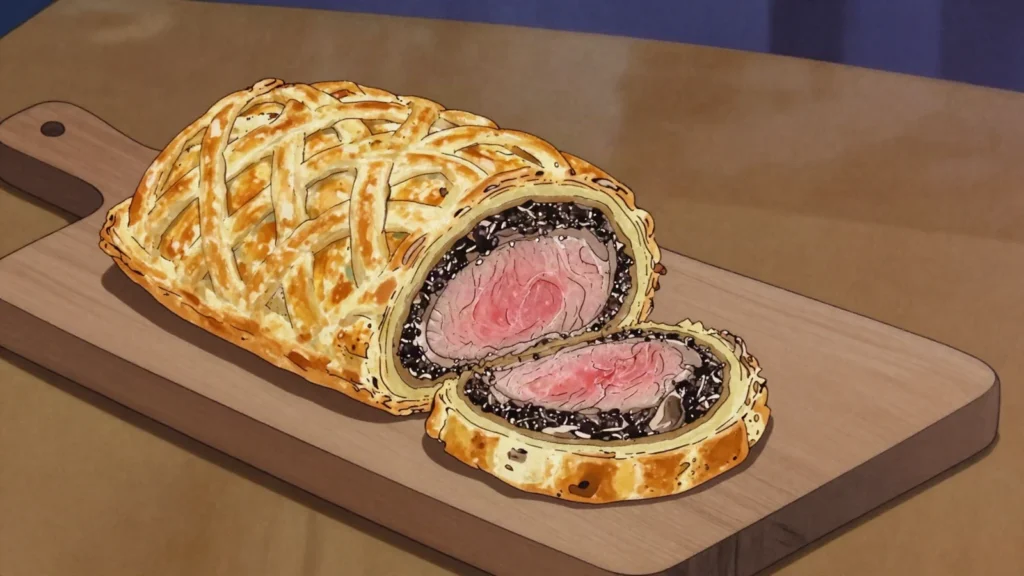
A beef fillet, coated in a mushroom paste called duxelles and wrapped in puff pastry before being baked, documented across the United Kingdom, its specific name and origin genuinely debated among food historians, with one popular though unverified account connecting the dish to Arthur Wellesley, the first Duke of Wellington, who defeated Napoleon at the Battle of Waterloo in 1815, though no strong contemporary evidence directly confirms that connection. Its elaborate, multi-step preparation, requiring the beef, mushroom paste and pastry to each be prepared separately before careful assembly and precise baking to avoid a soggy crust, has made beef Wellington a dish specifically associated with formal, celebratory dining. Beef Wellington remains one of the most iconic and technically demanding dishes within British culinary tradition.
Frequently asked questions
What is Beef Wellington?
Beef Wellington is a main from United Kingdom: beef fillet with mushroom duxelles baked in puff pastry. A beef fillet, coated in a mushroom paste called duxelles and wrapped in puff pastry before being baked, documented across the United Kingdom, its specific name and origin genuinely debated among food historians, with one popular though unverified account connecting the dish to Arthur Wellesley, the first Duke of Wellington, who defeated Napoleon at the Battle of Waterloo in 1815, though no strong contemporary evidence directly confirms that connection. Its elaborate, multi-step preparation, requiring the beef, mushroom paste and pastry to each be prepared separately before careful assembly and precise baking to avoid a soggy crust, has made beef Wellington a dish specifically associated with formal, celebratory dining. Beef Wellington remains one of the most iconic and technically demanding dishes within British culinary tradition.
How long does Beef Wellington take to make?
Beef Wellington takes 1 hr plus 2 hr chilling of preparation and 45 min of cooking. The recipe makes 6 servings. It is rated hard to make.
What can I substitute in Beef Wellington?
Yes, within limits. Pancetta or thinly sliced Parma ham in place of prosciutto. A mushroom and chestnut Wellington, made the same way, for a vegetarian centrepiece.
What is the most important thing to get right in Beef Wellington?
Add the Madeira and cook it away completely. Season and cool. Wet duxelles is the single most common cause of a soggy Wellington, and it must be genuinely dry.