Ingredients
Cassava
- 3 kgsweet cassava roots, peeled and washed
- 200 gmagnan (a starter of cassava fermented several days earlier with red palm oil, kept from the previous batch)
- 3 tbspred palm oil
- 1 tspsalt
Equipment
- A grater or hand mill
- A clean cloth sack and a press, or heavy weights
- A wide sieve or a calabash for granulating
- A couscoussier or a steamer lined with cloth
To serve
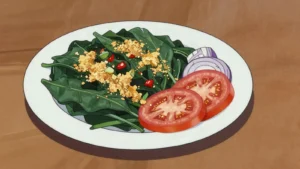
- 2tomatoes and 1 onion, diced, dressed with lemon, oil and chilli
- 1fresh chilli, pounded with a little salt and stock cube, as pepper relish
- Sliced avocado and cucumber
Directions
- Peel the cassava thoroughly, removing the pink inner skin, wash it well and grate it, or pass it through a hand mill, to a wet mash.
- Work the magnan starter and the palm oil through the mash until it is evenly coloured a pale orange; the starter carries the lactic bacteria and yeasts that will sour the cassava and, with them, do the detoxifying work.
- Pack the mash into a cloth sack, tie it and leave it to ferment in a warm place, 28–32°C (80–90°F), for 12–24 hours. It should smell sharply sour and yeasty, like sourdough starter, not putrid.
- Press the sack under heavy weights or in a screw press for 3–4 hours to expel the liquid; the residual moisture is where the remaining cyanogenic compounds go, so pressing is a safety step as well as a texture one.
- Break up the pressed cake and rub it through a wide sieve, or roll it in a calabash, so it granulates into loose, even couscous-sized grains. Discard the fibrous strands that will not pass.
- Spread the granules on a cloth and dry them in the air for an hour so they separate cleanly.
- Steam over boiling water in a cloth-lined couscoussier for 20–25 minutes, until the grains are translucent at the edges, springy and no longer taste raw or chalky. Fluff halfway through with a fork.
- Sprinkle with salt and a few spoonfuls of hot water, fluff again and let it stand covered for 5 minutes to even out the moisture.
- Serve warm or at room temperature, mounded on a plate with the tomato and onion salad, pepper relish, avocado and cucumber, so each mouthful mixes grain, acid and heat.
Technique
- Attiéké is a protected Ivorian speciality, made by Ébrié, Adjoukrou and Alladian women along the lagoons; the granting of a geographical indication to attiéké des lagunes in 2023 was national news.
- The magnan starter is the heart of the process and is passed on from batch to batch, like a sourdough mother. Without it you get bland, unfermented cassava couscous.
- Cassava must be fermented, pressed and cooked. Skipping stages leaves cyanogenic glycosides in the food; use sweet cassava varieties and never eat the mash raw.
- Most Ivorian households now buy fresh attiéké by weight from the market and simply steam it for 10 minutes before serving.
Substitutions
- Ready-made attiéké is sold vacuum-packed or dried in African groceries; rehydrate dried attiéké with an equal volume of hot salted water, then steam 10 minutes.
- Couscous is sometimes suggested as a substitute. It is wheat, has no sourness and is not the same food, though it will carry the same accompaniments.
Variations
- Attiéké comes in recognised grades: agbodjama has large, coarse grains, while the fine-grained attiéké garba is what street vendors use.
- Attiéké-placali blends the fermented mash with cassava starch dough for a stickier texture.
- A yellow version, coloured and enriched with extra red palm oil, is common at celebrations.
History
A Tchaman and Ébrié lagoon craft of southern Côte d’Ivoire; UNESCO inscribed the practices around attiéké production on its intangible heritage list in 2024.
Frequently asked questions
What is Attiéké?
Attiéké is a salad & side from Côte d’Ivoire: tangy fermented cassava couscous served with grilled fish and pepper relish. A Tchaman and Ébrié lagoon craft of southern Côte d’Ivoire; UNESCO inscribed the practices around attiéké production on its intangible heritage list in 2024.
How long does Attiéké take to make?
Attiéké takes 1 hr over two days of preparation and 12–24 hr fermenting plus 20 min steaming of cooking. The recipe makes 6 servings (about 1.2 kg). It is rated hard to make.
What can I substitute in Attiéké?
Yes, within limits. Ready-made attiéké is sold vacuum-packed or dried in African groceries; rehydrate dried attiéké with an equal volume of hot salted water, then steam 10 minutes. Couscous is sometimes suggested as a substitute. It is wheat, has no sourness and is not the same food, though it will carry the same accompaniments.
What is the most important thing to get right in Attiéké?
Cassava must be fermented, pressed and cooked. Skipping stages leaves cyanogenic glycosides in the food; use sweet cassava varieties and never eat the mash raw.