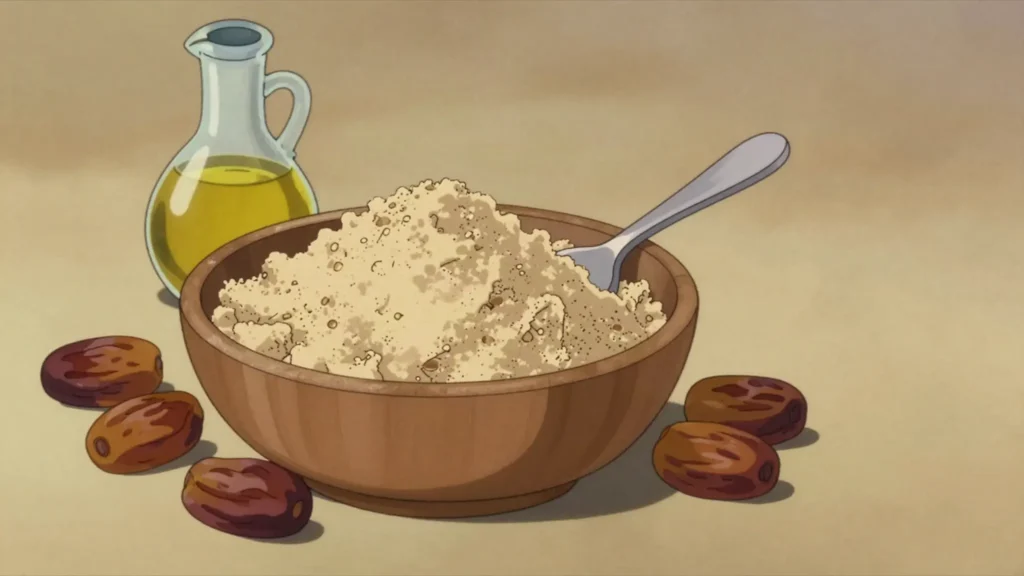

Ingredients
The grain
- 500 gbarley
- whole grain
- or 500 g ready-roasted barley flour
- sold as zummeta or bsissa base
The flavourings
- 1 teaspoonsalt
- or to taste
- 1 teaspoonground fennel seed
- optional
- half a teaspoon ground coriander seed
- optional
- a pinch of ground cumin
- optional
To eat it with
- olive oil
- a good Libyan or Tunisian oil
- or water
- or milk
- dates, to eat alongside
- or honey, or sugar
Equipment
- a wide heavy dry pan
- a spice grinder or a hand mill
- a fine sieve
- an airtight jar
Directions
- Add any liquid and it is food immediately. It also keeps for months without spoiling. Rinse the grain and drain it well. Then dry it thoroughly on a cloth. Use a medium heat, not a high one. Add the barley in a single layer.
- Work in batches if you have a lot. Do not walk away at any point. Keep it moving the entire time. They turn golden brown gradually. Tip them out of the pan immediately. Do not leave them in the hot pan.
- Spread them on a cold tray. Let them cool completely. That takes real time and effort. Work in small batches in a grinder. Do not overload it at any point.
- Grind it to a fine flour. Zummeta should be genuinely fine. Return those to the grinder. Grind them again and sieve again. Repeat until almost nothing remains. Add the salt and stir it through. Add ground fennel if you are using it. Add coriander and cumin if you like.
- Put it in an airtight jar immediately. Flour absorbs moisture from the air. Keep the jar cool and dark. It keeps six months to a year.
- Take small amounts at a time. Never give dry flour to a child. Add liquid gradually to the flour. Start with much less than you expect. It should form a thick paste.
- Adjust it to your own preference. Dates keep as well as the flour does. Take a bite of date and a little paste. Do not keep it at all. Mix only what you will eat now. Once mixed with liquid it does not keep.
Technique
- Never eat the flour dry. It absorbs saliva instantly and causes coughing and choking, and it must be mixed with liquid first. That is how the food is designed to work, not a stylistic preference. Take small amounts, keep water to hand, and never give dry flour to a child.
- Add liquid gradually and start with far less than you expect. The flour absorbs a great deal, and you want a thick paste that holds together in the hand rather than a runny liquid.
- Grain burns in seconds. Stir constantly, take it off when it smells strongly nutty, and tip it straight onto a cold tray — the pan’s residual heat keeps toasting it. Burnt grain is bitter and the batch is lost.
- Grind it genuinely fine and sieve it, returning the coarse bits to be reground. Coarse zummeta is gritty in the mouth, and fineness matters for how it is eaten.
- Store the flour airtight, cool and dark. It draws moisture from the air, and damp flour clumps and then spoils. Kept dry it lasts six months to a year, which is the entire point of it.
- Do not keep the mixed paste. Once liquid is added the oil goes rancid and the water spoils it. Store the dry flour and mix to order — that is the design of the food.
- Zummeta exists because roasted ground grain needs no fire, no pot, no time and no preparation. Add liquid and it is food. It is light, energy dense and keeps for months, which is exactly what a traveller or a herder away from home needs.
- Roasted grain flour is one of the oldest ways of eating grain and predates bread as a technology — bread requires an oven and time, and this requires neither. Related preparations run right across the world: Tunisian and Libyan bsissa, Central Asian talkan, Tibetan tsampa, Ethiopian besso. The atlas records the family and adjudicates no origin claim.
- Ready-roasted barley flour is sold by North African grocers as zummeta or bsissa, and skips the roasting and grinding entirely.
Substitutions
- Ready-roasted barley flour from a North African grocer replaces the whole home process.
- Roasted wheat or a mixture of grains replaces barley in some versions.
- Bsissa, the closely related Tunisian and Libyan preparation, usually contains added fenugreek, chickpeas and spices.
- Water, milk or olive oil are all used to mix it; oil is the classic choice and gives the richest result.
- Honey or sugar turn it into a sweet version rather than a plain one.
- Fennel, coriander and cumin are common additions; the plainest and most common version has salt alone.
Variations
- Bsissa in Tunisia and Libya is the close relative, usually enriched with fenugreek, chickpeas and spices.
- A sweetened version with honey or sugar is eaten as a treat rather than as travelling food.
- Some households mix it into a loose drink with milk rather than a paste.
- Tsampa in Tibet is roasted barley flour eaten with salted butter tea, the same principle in another climate.
- Talkan across Central Asia is the same roasted ground grain, pressed into cakes as zhent in Kazakhstan.
- Besso in Ethiopia and Eritrea is roasted barley flour eaten mixed with water or with butter.
History
Herders and travellers carried roasted barley flour because it needs no cooking; a handful mixed with water or oil in the palm makes an instant meal.
Frequently asked questions
What is Zummeta?
Zummeta is a snack from Libya: roasted barley flour eaten by the handful with dates, oil or water. Herders and travellers carried roasted barley flour because it needs no cooking; a handful mixed with water or oil in the palm makes an instant meal.
How long does Zummeta take to make?
Zummeta takes 10 minutes of preparation and 20 minutes of cooking. The recipe makes serves 4. It is rated easy to make.
What can I substitute in Zummeta?
Yes, within limits. Ready-roasted barley flour from a North African grocer replaces the whole home process. Roasted wheat or a mixture of grains replaces barley in some versions. Bsissa, the closely related Tunisian and Libyan preparation, usually contains added fenugreek, chickpeas and spices. Water, milk or olive oil are all used to mix it; oil is the classic choice and gives the richest result. Honey or sugar turn it into a sweet version rather than a plain one. Fennel, coriander and cumin are common additions; the plainest and most common version has salt alone.
What is the most important thing to get right in Zummeta?
Work in batches if you have a lot. Do not walk away at any point. Keep it moving the entire time. They turn golden brown gradually. Tip them out of the pan immediately. Do not leave them in the hot pan.