
Ingredients
The dough
- 500 gplain flour
- 200 gbutter, cold and cubed
- or 200 g lard
- 100 gcaster sugar
- 2egg yolks
- 7 gsachet dried yeast
- or 20 g fresh yeast
- 100 mlwarm milk
- a pinch of salt
- grated zest of 1 lemon
The filling
- 400 gwalnuts
- ground fairly coarsely
- 150 gcaster sugar
- 1 teaspoonground cinnamon
- optional
- 400 gapricot jam
- thick, not runny
- warmed slightly to spread
The glaze
- 200 gdark chocolate
- 60 gbutter
- or 2 tablespoons oil
- 1 tablespoongolden syrup
- optional, for shine
Equipment
- a 30 by 20 cm tin
- lined with baking paper
- a rolling pin
- a long sharp knife
- a palette knife
Directions
- Grind them fairly coarsely for this. Use short pulses in a processor. Do not over-process them into butter. Simmer it briefly and let it cool. Sieve it if it has large fruit pieces. Warm it slightly to spread it more easily. Do not spread it hot onto raw dough.
- Warm the milk gently. It should feel warm, never hot. Stir the yeast into the warm milk. Add a pinch of the sugar to it. Let it stand ten minutes until frothy. Work quickly with cool fingertips. Rub until it looks like coarse breadcrumbs. Add the sugar, salt and lemon zest. Make a well in the centre.
- Add the egg yolks and the yeast mixture. Mix it until it comes together. Knead it very briefly, just to smooth it. Do not knead it hard at all. Wrap each piece separately. Chill them for at least an hour. Cold dough rolls far more easily.
- Roll one piece on a floured surface. Roll it to the size of your tin. Roll it thin, about three millimetres. Roll each layer on baking paper. Thin yeasted dough tears when lifted bare.
- Chill each rolled layer briefly if it softens. Line the tin with baking paper. Lay the first dough layer in the base. Press it gently into the corners. Spread it thinly and right to the edges. Scatter half the walnut and sugar mixture. Spread it evenly across the whole layer.
- Press it down lightly with your hand. Use the paper to lift and position it. Peel the paper off once it is in place. Scatter the rest of the walnut mixture. Lay the third dough layer on top. Press it down gently and evenly.
- Cover it and leave it thirty minutes. Heat the oven to one hundred and eighty degrees. Bake it for about thirty-five minutes. The top should be pale golden. Chop the chocolate and melt it gently.
- Use a bowl over barely simmering water. Do not let the bowl touch the water. Stir in the butter until smooth. Add the syrup if you want extra shine. Let it cool until it thickens slightly. Pouring it too hot makes it run off. Spread it with a palette knife. Work quickly before it sets.
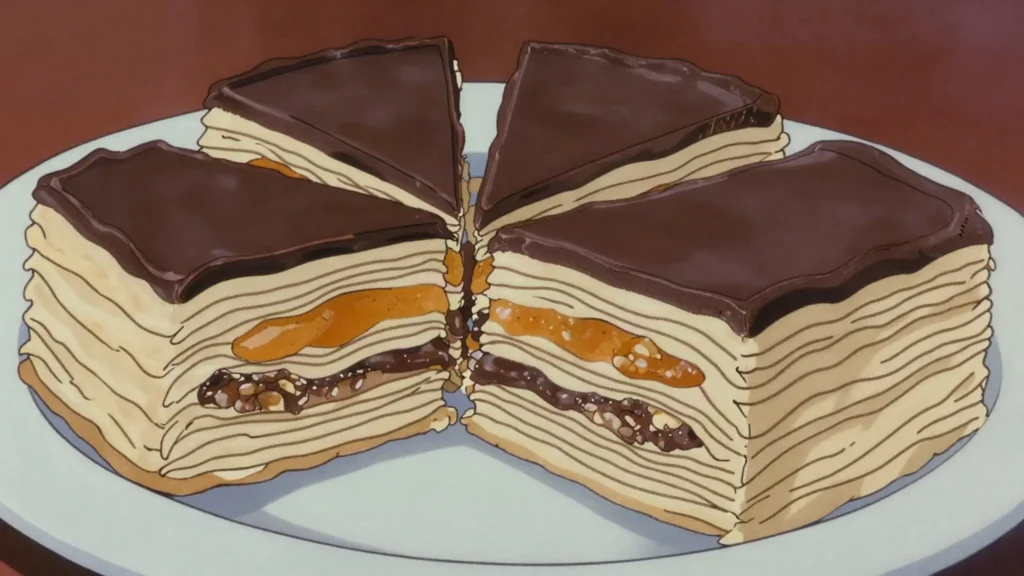
- Let it set at room temperature. Do not set it in the refrigerator. Use a long sharp knife. Warm the blade in hot water and dry it. A warm blade cuts chocolate cleanly. Press down firmly in one motion. Do not saw at it. Cut small squares, since it is rich. Trim the edges first for neat squares. Serve it at cool room temperature. Fridge-cold chocolate tastes of very little.
- Take it out twenty minutes beforehand. Serve it with strong coffee. It keeps a week in an airtight tin. Keep it somewhere cool, not refrigerated. Wrap it well before freezing.
Technique
- The dough is yeasted, which surprises people making this for the first time. It is not puff pastry and not a short pastry — it is an enriched yeasted dough rolled thin, which rises only slightly and gives a tender rather than flaky layer. Treating it as puff pastry gives a different cake entirely.
- Roll each layer on baking paper so you can lift the paper to move it. Thin yeasted dough tears when lifted bare, and this trick removes the hardest part of the assembly.
- Prick the top layer all over with a fork before baking. Without it the top domes and separates from the filling.
- Let it cool completely in the tin, two hours at least or overnight. The jam is molten while warm and sets as it cools to hold the layers together; a warm slice will not cut cleanly.
- Use thick jam. Runny jam soaks into the dough and makes the layers slide apart — reduce a loose jam briefly and cool it, and sieve out large fruit pieces.
- Grind the walnuts fairly coarsely and add a spoonful of the sugar while grinding to absorb the oil. A fine powder gives a pasty layer, and over-processed walnuts turn to butter.
- Do not let any water reach the melting chocolate. A single drop makes it seize into a grainy solid mass and there is no recovering it.
- Set the glaze at room temperature, never in the fridge. Cold setting dulls the surface and causes condensation that leaves a whitish bloom.
- Cut with a long knife warmed in hot water and dried, pressing down in one motion rather than sawing, wiping and rewarming between cuts. A cold blade cracks the chocolate.
- The slice is named for Emil Gerbeaud, the Swiss confectioner who took over a Budapest café in the 1880s and made it internationally famous. Café Gerbeaud still stands on Vörösmarty Square, one of the survivors of a Budapest café culture that two wars and forty years of communism largely dismantled.
- Tree nut allergy can be severe and walnuts are the body of the filling. Tell guests.
Substitutions
- Lard replaces butter in the dough and is the more traditional fat, giving a shorter layer.
- Ground almonds or hazelnuts replace walnuts, though walnut is the characteristic Hungarian nut.
- Plum jam or damson replaces apricot; both are used, though apricot is traditional.
- Milk chocolate replaces dark for a sweeter glaze, though dark balances the sweet filling better.
- Fresh yeast replaces the dried sachet; use about 20 g crumbled into the warm milk.
- A tablespoon of golden syrup or glucose in the glaze gives extra shine and a softer set.
Variations
- Beigli, the rolled walnut or poppy seed log, is the other great Hungarian Christmas bake.
- A poppy seed version of zserbó, using ground poppy seed in place of walnut, is made in some households.
- Some bakers add a layer of raisins soaked in rum alongside the walnut.
- Café Gerbeaud sells its own version alongside its other historic confections.
- Related layered nut and jam slices are made across Austria, Slovakia and the Czech Republic.
- A version with four dough layers rather than three is made by some bakers for a taller slice.
History
Created at Café Gerbeaud in Budapest and named after its Swiss owner Emil Gerbeaud.
Frequently asked questions
What is Zserbo?
Zserbo is a dessert from Hungary: layered walnut and apricot jam slice glazed with dark chocolate. Created at Café Gerbeaud in Budapest and named after its Swiss owner Emil Gerbeaud.
How long does Zserbo take to make?
Zserbo takes 1 hour plus 2 hours chilling of preparation and 40 minutes of cooking. The recipe makes makes about 24 squares. It is rated hard to make.
What can I substitute in Zserbo?
Yes, within limits. Lard replaces butter in the dough and is the more traditional fat, giving a shorter layer. Ground almonds or hazelnuts replace walnuts, though walnut is the characteristic Hungarian nut. Plum jam or damson replaces apricot; both are used, though apricot is traditional. Milk chocolate replaces dark for a sweeter glaze, though dark balances the sweet filling better. Fresh yeast replaces the dried sachet; use about 20 g crumbled into the warm milk. A tablespoon of golden syrup or glucose in the glaze gives extra shine and a softer set.
What is the most important thing to get right in Zserbo?
Grind them fairly coarsely for this. Use short pulses in a processor. Do not over-process them into butter. Simmer it briefly and let it cool. Sieve it if it has large fruit pieces. Warm it slightly to spread it more easily. Do not spread it hot onto raw dough.