
Ingredients
The melon
- 1large Turkmen melon
- gawun, Vaharman or Gulaby variety
- or any dense aromatic winter melon
- or a good Galia or Charentais
- heavy for its size
To serve fresh
- nothing at all, ideally
- or a squeeze of lime
- or a little salt
- green tea, to drink
For dried melon
- the same melon
- cut into long thin strips
- clean drying racks
- or a dehydrator
- muslin or netting, to cover
Sometimes served with
- flatbread
- fresh curd or suzma
- walnuts
- as part of a spread
Directions
- Press the blossom end gently with a thumb. It should give very slightly under pressure. Check the stem end for a clean scar. Torn stems mean it was picked too early.
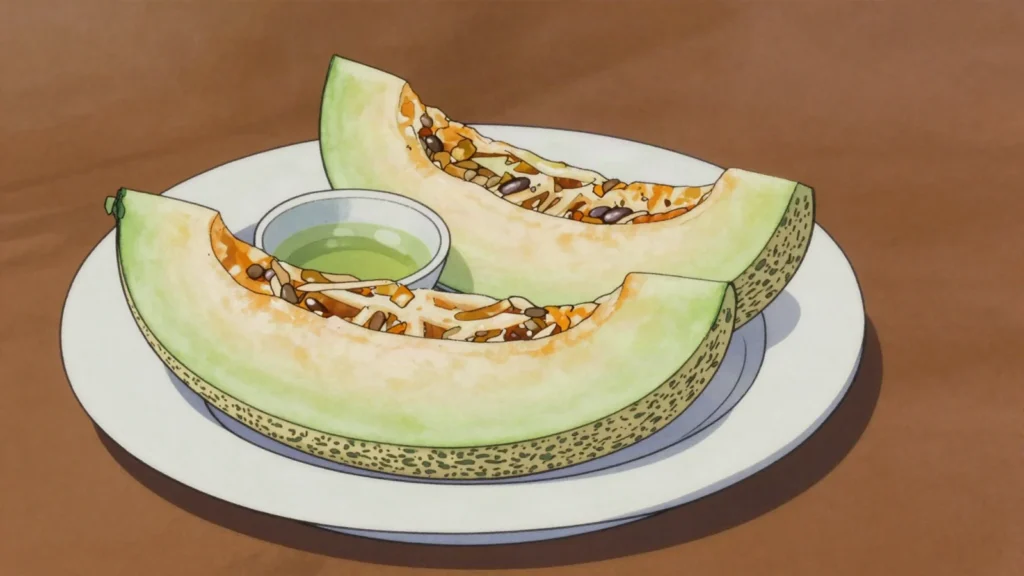
- Shake it and listen for sloshing inside. Dry it before you cut into it. Cut it in half from stem to blossom end. Scoop out the seeds and the fibres. Keep the seeds if you want to roast them. Cut each half into long thin wedges. Arrange the slices on a large platter.
- Serve it at cool room temperature. Fridge-cold melon tastes of far less. Take it out half an hour before serving. Neither is traditional but both help.
- Peel the melon and remove all the seeds. Cut the flesh into long thin strips. Half a centimetre thick is about right. Cover them with muslin or fine netting. That keeps flies and insects off them.
- Bring them in at night without fail. Turn them once they begin to firm up. Continue for four to seven days. Longer in humid weather, if it works at all.
- Press the thickest part to check it. Any softness means it needs more drying. Discard any strip showing any mould. Do not cut mould off and keep the rest. Keep it somewhere cool and dry. It keeps for many months that way.
- Check it occasionally for any dampness. Fresh melon does not keep once cut. Cover the cut surfaces with cling film.
Technique
- Melons have caused serious listeria and salmonella outbreaks, cantaloupe particularly. Bacteria sit on the rough rind and the knife carries them into flesh that is low in acid — a good growth environment at room temperature. Scrub the rind under running water before cutting, even though you will not eat it, and refrigerate cut melon promptly.
- Serve melon at cool room temperature rather than fridge-cold. Cold mutes aroma more than any other treatment, and taking it out half an hour beforehand improves it noticeably.
- Judge ripeness at the blossom end, opposite the stem: it should smell clearly sweet and give very slightly under a thumb. No smell means underripe; a fermented smell or sloshing when shaken means it has gone.
- Turkmenistan has marked a national Melon Day each August since 1994, established under Saparmurat Niyazov, whose rule involved an extensive personality cult — renamed months, a rotating gold statue, and a melon variety named in his honour. The melons are genuinely excellent and the pride in them long predates the holiday. Both things are true, and the atlas records both.
- Melons grow in irrigated oases in what is mostly desert, watered from the Amu Darya. Soviet-era irrigation for cotton from the same river system drained the Aral Sea, one of the great environmental disasters, and the atlas records that as context.
- When drying strips, bring them in every night without fail. Night dew rewets them, undoing a day’s work and encouraging mould. Cover them with netting while they dry.
- Dried strips must be genuinely dry. Incomplete drying allows moulds that produce toxins cooking does not destroy. Discard any mouldy strip rather than cutting the mould off — the threads run further than you can see. In humid climates a dehydrator is safer than sunlight.
Substitutions
- Turkmen varieties are rarely exported. Any dense aromatic melon works — Galia, Charentais and Ogen are all good — and the atlas does not pretend the result is identical.
- A squeeze of lime or a pinch of salt lifts a disappointing melon, though neither is traditional.
- A dehydrator replaces sun-drying and is genuinely safer in a humid climate.
- Dried melon can be replaced by dried apricot or dried persimmon in dishes calling for it, though the flavour differs.
- Melon seeds can be washed, dried and roasted with salt as a snack rather than discarded.
Variations
- Dried melon strips, plaited and hung to dry, are the winter form and are intensely sweet and chewy.
- Melon is served alongside flatbread, fresh curd and walnuts as part of a Central Asian spread.
- Uzbek and Tajik melon varieties are close relatives and are treated the same way.
- Melon seeds are roasted and salted as a snack in the region.
- A cold melon and yoghurt drink is made in some households in the hottest weeks.
- Chopped dried melon is added to pilaf and to rice puddings for sweetness.
History
Turkmenistan has celebrated a national Melon Day each August since 1994, and melons are a point of national pride.
Frequently asked questions
What is Turkmen melon?
Turkmen melon is a snack from Turkmenistan: intensely sweet Vaharman and Gulaby melons eaten fresh or dried. Turkmenistan has celebrated a national Melon Day each August since 1994, and melons are a point of national pride.
How long does Turkmen melon take to make?
Turkmen melon takes 15 minutes of preparation and none, or several days for drying of cooking. The recipe makes serves 6. It is rated easy to make.
What can I substitute in Turkmen melon?
Yes, within limits. Turkmen varieties are rarely exported. Any dense aromatic melon works — Galia, Charentais and Ogen are all good — and the atlas does not pretend the result is identical. A squeeze of lime or a pinch of salt lifts a disappointing melon, though neither is traditional. A dehydrator replaces sun-drying and is genuinely safer in a humid climate. Dried melon can be replaced by dried apricot or dried persimmon in dishes calling for it, though the flavour differs. Melon seeds can be washed, dried and roasted with salt as a snack rather than discarded.
What is the most important thing to get right in Turkmen melon?
Press the thickest part to check it. Any softness means it needs more drying. Discard any strip showing any mould. Do not cut mould off and keep the rest. Keep it somewhere cool and dry. It keeps for many months that way.