
Ingredients
The soy milk
- 250 gdried soybeans
- soaked overnight in cold water
- 2 litrescold water
- for blending and diluting
- a pinch of salt, optional
The setting agent
- 5 gglucono delta-lactone
- sold as GDL
- or 4 g food-grade gypsum
- calcium sulfate
- 2 teaspoonscornflour
- 3 tablespoonscold water
The sugar syrup
- 150 gwhite sugar
- or 150 g rock sugar
- or 150 g gula melaka, palm sugar
- 250 mlwater
- 2pandan leaves, knotted
- optional
Sometimes served with
- ginkgo nuts, cooked
- grass jelly, cubed
- sago pearls
- soy milk, to pour over
Equipment
- a powerful blender
- a large muslin or nut-milk bag
- a heavy-bottomed pan
- a wide heatproof bowl with a lid
- a fine skimmer
Directions
- Boil it properly for a full seven to ten minutes. Stir it constantly throughout that entire time. Do not shorten this step for any reason at all. Discard any that are shrivelled or discoloured.
- Rinse them well in several changes of cold water. Put them in a large bowl and cover generously. Soak them for at least eight hours in cold water. In hot weather soak them in the fridge always. Drain and rinse the soaked beans thoroughly. It is optional and it takes real patience.
- Work in batches so the blender is not overloaded. Use roughly three parts water to one part beans. Blend each batch for a good two minutes. The mixture should be smooth and pale white. Blend for longer if your machine is not powerful.
- Set a muslin or nut-milk bag over a large bowl. Pour the mixture through it in batches. Squeeze hard to force all the liquid through. It is edible but must itself be cooked first.
- Strain the milk a second time through fine muslin. Pour it into a heavy-bottomed pan and heat gently. Stir it constantly from the very beginning. As it heats, a thick foam will rise up the pan. Skim the foam off with a fine skimmer. Keep it at a genuine rolling boil once foam settles. Boil it for a full seven to ten minutes. Keep stirring throughout to stop it catching.
- Use a thermometer if you have one available. It should hold above ninety-five degrees throughout. Take the pan off the heat when the time is up. Let it cool to about eighty-five degrees. Too hot and the curd sets coarse and grainy.
- Use a wide heatproof bowl that has a lid. Put the GDL or gypsum into that bowl. Add the cornflour and the cold water to it. Whisk it into a smooth thin slurry with no lumps. Now pour the hot soy milk into the bowl quickly.
- Pour it in from a height in one steady stream. Do not stir it afterwards under any circumstances. Skim off any surface bubbles straight away. Cover the bowl with its lid immediately.
- Leave it completely undisturbed for twenty minutes. Do not move it, tilt it or peer under the lid. Put the sugar and water in with the pandan leaves. Knot the pandan leaves so they are easy to remove. Heat gently until the sugar dissolves completely.
- Simmer it for five minutes and then let it cool. Hot sugar syrup burns badly, so handle it carefully. Check the set after twenty minutes have passed. It should move as one soft, wobbling mass. Layer those sheets into individual bowls. Never dig down with a deep spoon into it. Ladle a little syrup over each serving bowl. It is also very good chilled in hot weather.
- Chill it in the setting bowl and scoop it cold. Some shops pour cold soy milk over the top. Pour that liquid off before serving it again. It cannot be frozen, because freezing destroys the set.
Technique
- Home-made soy milk must be boiled properly. Raw soybeans contain trypsin inhibitors and lectins that cause genuine gastrointestinal illness, and undercooked soy milk has caused documented outbreaks. Boil it at a real rolling boil for seven to ten minutes, stirring throughout.
- The specific trap is false boiling. Soy milk foams heavily and rises up the pan before it is genuinely hot enough, and cooks mistake the foam for a boil. Lower the heat, skim the foam, and then time the real boil from the moment the liquid itself is boiling.
- Okara, the pulp left in the straining cloth, is raw and carries the same warning. It is good in fritters and breads but it must be cooked first.
- Do not stir after pouring the hot milk onto the coagulant. The force of the pour does all the mixing needed; stirring afterwards breaks the curd as it forms and it will never set. This is the mistake that ruins most first attempts.
- GDL is more forgiving than gypsum for a first attempt because it dissolves completely and does not settle out of the slurry. Gypsum gives a slightly more traditional flavour and must be whisked immediately before use.
- Scoop in thin sheets across the surface with a flat ladle. Digging down with a deep spoon breaks the curd into lumps and loses the silky texture the dish is prized for.
- The pudding should taste of soybean, not of sugar. Singapore shops keep the syrup deliberately light for that reason.
Substitutions
- Shop-bought unsweetened soy milk replaces home-made and removes the boiling risk entirely, but it must be plain soy milk with a high soy content and no added thickeners or stabilisers. Many supermarket soy drinks will not set at all.
- Gypsum, food-grade calcium sulfate, replaces GDL and is the older coagulant. Use about 4 g and whisk it in immediately before pouring.
- Gula melaka replaces white sugar in the syrup and gives a darker, smoky caramel flavour. Rock sugar gives the cleanest and most delicate syrup.
- Pandan leaves are optional; a strip of ginger simmered in the syrup is another common flavouring.
- Sago pearls, grass jelly or cooked ginkgo nuts are all standard additions and none is required.
Variations
- Savoury douhua, served in China with soy sauce, chilli oil, preserved vegetable and spring onion, is the same curd treated as a savoury dish.
- Taho, the Philippine version, is served warm with arnibal, a dark caramel syrup, and chewy sago pearls, and is sold by street vendors in the morning.
- Beancurd skin, tau fu fa’s cousin, forms as a film on simmering soy milk and is lifted off and dried; it is a separate ingredient in its own right.
- Some Singapore shops serve it with a splash of cold soy milk poured over the warm curd.
- A version set with a little more coagulant, firmer and cut into cubes, is sold as a dessert with syrup and fruit.
- Black soybean tau huay, made from black soybeans, is darker and nuttier and appears in some specialist shops.
History
A Chinese street sweet naturalised in Singapore, where dedicated shops keep the curd unusually soft and pale.
Frequently asked questions
What is Tau Huay?
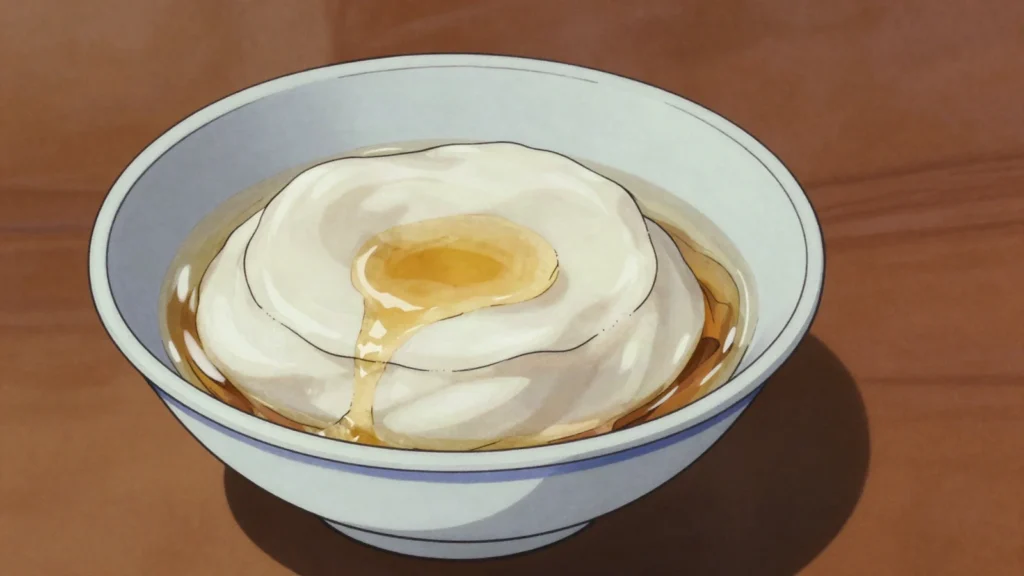
Tau Huay is a dessert from Singapore: silken soybean pudding served warm or cold with sugar syrup. A Chinese street sweet naturalised in Singapore, where dedicated shops keep the curd unusually soft and pale.
How long does Tau Huay take to make?
Tau Huay takes 20 minutes plus overnight soaking of preparation and 40 minutes of cooking. The recipe makes serves 6. It is rated hard to make.
What can I substitute in Tau Huay?
Yes, within limits. Shop-bought unsweetened soy milk replaces home-made and removes the boiling risk entirely, but it must be plain soy milk with a high soy content and no added thickeners or stabilisers. Many supermarket soy drinks will not set at all. Gypsum, food-grade calcium sulfate, replaces GDL and is the older coagulant. Use about 4 g and whisk it in immediately before pouring. Gula melaka replaces white sugar in the syrup and gives a darker, smoky caramel flavour. Rock sugar gives the cleanest and most delicate syrup. Pandan leaves are optional; a strip of ginger simmered in the syrup is another common flavouring. Sago pearls, grass jelly or cooked ginkgo nuts are all standard additions and none is required.
What is the most important thing to get right in Tau Huay?
Boil it properly for a full seven to ten minutes. Stir it constantly throughout that entire time. Do not shorten this step for any reason at all. Discard any that are shrivelled or discoloured.