
Ingredients
The dough
- 400 groasted red rice flour
- or white rice flour
- about 450 ml boiling water
- 1 teaspoonsalt
The equipment
- a string hopper press
- idiyappam press
- with a fine plate
- small woven mats
- or perforated discs
- a steamer
The kiri hodi
- 400 mlcoconut milk
- 1onion, sliced
- 2green chillies, split
- a sprig of curry leaves
- half a teaspoon turmeric
- 1 piecepandan leaf
- a squeeze of lime
- salt
To serve
- dhal curry, parippu
- pol sambol, coconut sambol
- seeni sambol, optional
- at breakfast
Directions
- Warm water gives a dough that falls apart. This is a hot water dough rather than a cold one. Use a spoon until it cools enough to handle. Hot rice dough holds heat for a long time. Let it cool for several minutes before kneading.
- Add it gradually rather than all at once. The dough should be soft but not at all sticky. Put the rice flour and salt in a large bowl. Use a heatproof bowl for this mixing. Pour boiling water in while stirring with a spoon. Add it gradually rather than all at once.
- Stir it in with a sturdy wooden spoon. Never use your hands at this stage. Keep stirring until no dry flour remains. Add a little more water if it stays crumbly. Stop when it holds together as one lump.
- Let the dough cool until you can handle it. Give it about five minutes in the bowl. Knead the warm dough until it is smooth. Knead it for about three or four minutes. It should become smooth and entirely even. Work it firmly rather than gently. It should feel like soft modelling clay.
- Adjust with water or flour to get there. Keep the dough warm while you work through it. Cover the bowl with a damp cloth. Cold dough is far harder to press through. Set the steamer up and bring the water to a boil. The steamer must be hot before the nests go in. Work quickly once you have begun. Oil the mats lightly before pressing onto them. That stops the hoppers sticking to them.
- Use a little coconut oil for that. Fill the press with a portion of the dough. Pack it in firmly without air pockets. Fill it about three quarters full. Press the dough out onto a mat in circles. Work in a spiral from the centre outward. Make each nest about eight centimetres across. Too many layers make a dense heavy hopper.
- Press with steady even pressure throughout. Jerky pressure gives thick and thin strands. Keep the press moving as you squeeze. This takes real practice to do neatly. Stack the mats in the steamer and cover it. Stack them with a little space between. Steam needs to circulate around them. Do not crush them together at all.
- Cover the whole steamer tightly. Steam them for about eight minutes. They also firm up considerably. Take them out as soon as they are set. Eight minutes is genuinely enough. Let them cool for a minute before lifting. A minute firms them enough to lift.
- Lift them gently from the mats. Use your fingers rather than a spatula. Stack them on a plate as they come out. They do not stick to each other much. Cover them with a cloth to keep them soft. They dry out quickly if left uncovered. Simmer the coconut milk with the aromatics.
- Add the onion, chilli, curry leaves and turmeric. Add a piece of pandan leaf as well. Simmer it gently for about ten minutes. Never let it boil hard at any point. Keep it at a bare simmer throughout. Stir it occasionally as it cooks. Season it with salt and a squeeze of lime. Add the lime off the heat at the end. It should be thin and pourable rather than thick.
- Serve the string hoppers warm with the curries. Set the curries alongside in separate bowls. Everyone takes what they want of each. Steam them briefly to soften them again. They keep a day covered at room temperature.
Technique
- The water must be genuinely boiling when it goes into the flour, since that partly gelatinises the starch and is what makes the dough hold together — warm water gives a dough that falls apart. Stir it in with a wooden spoon and never with bare hands at first: hot rice dough holds heat a long time, sticks to skin and keeps burning. Let it cool several minutes and test with one fingertip before kneading.
- A string hopper press is genuinely necessary and there is no good substitute; a potato ricer does an imperfect version. Pack the dough in firmly without air pockets, which give broken uneven strands, and press with steady even pressure — jerky pressure gives thick and thin strands.
- Steam for about eight minutes only, until they turn slightly translucent and firm. Oversteaming makes them gummy and dense, and longer does not improve them.
Substitutions
- White rice flour replaces red, giving a paler softer hopper where red gives a darker nuttier one; both are genuinely used across Sri Lanka. Roasted rice flour is what this needs, since the roasting changes how it absorbs water and gives a nuttier flavour — it is sold specifically for string hoppers.
- Perforated metal discs replace traditional woven palm or bamboo mats. Idiyappam is the same dish in Kerala and Tamil Nadu, from where it came to Sri Lanka — the technique is shared and the accompaniments differ. Plain hoppers, appa, are a completely different dish: fermented bowl-shaped pancakes sharing only part of a name.
Variations
- The dough should feel like soft modelling clay — too dry and it will not press through, too wet and the strands stick together — and different flours absorb different amounts, so add the water gradually and judge by feel. Keep it warm under a damp cloth while you work, since cold dough cracks rather than forming strands.
- Press each nest in a spiral from the centre outward and then back the other way, building two or three layers about eight centimetres across: a single layer falls apart when lifted and too many make it dense. This takes real practice and the first few are usually untidy — they taste exactly the same.
- Never boil the kiri hodi hard, since coconut milk splits into oil and watery liquid; keep it at a bare simmer and add the lime off the heat. It should be thin and pourable, a gravy rather than a curry sauce.
History
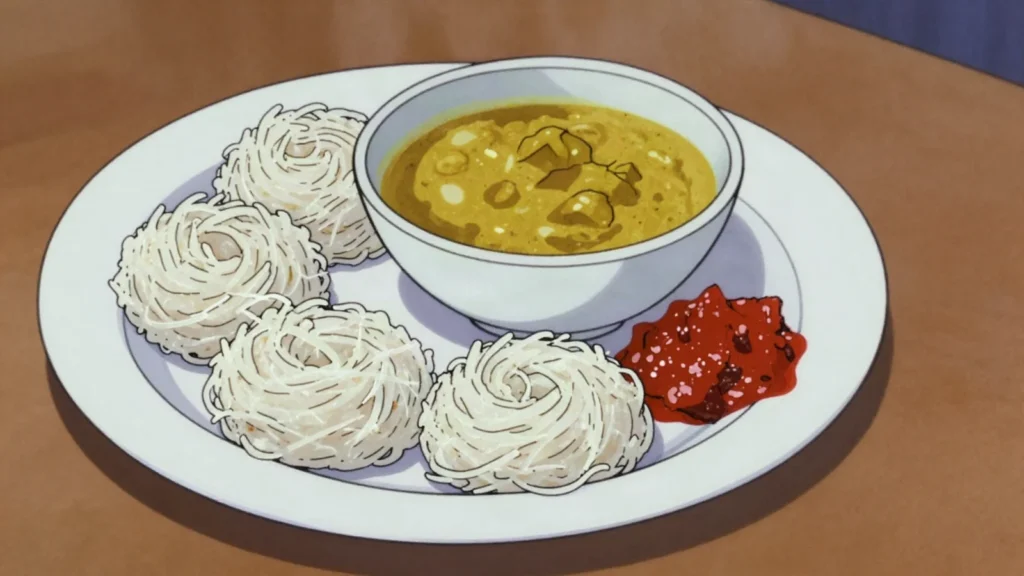
Steamed noodle nests, made by pressing a fermented rice flour batter through a mold directly into thin strands, then coiling them into small round nests before steaming, closely related in technique to South Indian idiyappam, reflecting long-documented trade and cultural contact across the Palk Strait separating Sri Lanka from South India for many centuries. Their distinctive lacy, woven appearance comes specifically from the pressing technique, using a specialized mold with fine holes, distinguishing string hoppers clearly from other rice-based Sri Lankan staples like plain rice or hoppers. They are traditionally eaten for breakfast or dinner alongside curry and sambol, with their mild flavour intended specifically to absorb and complement whatever spiced accompaniment is served with them.
Frequently asked questions
What is String Hoppers?
String Hoppers is a breakfast from Sri Lanka: steamed rice-noodle nests with dhal curry and coconut sambol. Steamed noodle nests, made by pressing a fermented rice flour batter through a mold directly into thin strands, then coiling them into small round nests before steaming, closely related in technique to South Indian idiyappam, reflecting long-documented trade and cultural contact across the Palk Strait separating Sri Lanka from South India for many centuries. Their distinctive lacy, woven appearance comes specifically from the pressing technique, using a specialized mold with fine holes, distinguishing string hoppers clearly from other rice-based Sri Lankan staples like plain rice or hoppers. They are traditionally eaten for breakfast or dinner alongside curry and sambol, with their mild flavour intended specifically to absorb and complement whatever spiced accompaniment is served with them.
How long does String Hoppers take to make?
String Hoppers takes 30 minutes of preparation and 30 minutes of cooking. The recipe makes makes about 20 nests. It is rated hard to make.
What can I substitute in String Hoppers?
Yes, within limits. White rice flour replaces red, giving a paler softer hopper where red gives a darker nuttier one; both are genuinely used across Sri Lanka. Roasted rice flour is what this needs, since the roasting changes how it absorbs water and gives a nuttier flavour — it is sold specifically for string hoppers. Perforated metal discs replace traditional woven palm or bamboo mats. Idiyappam is the same dish in Kerala and Tamil Nadu, from where it came to Sri Lanka — the technique is shared and the accompaniments differ. Plain hoppers, appa, are a completely different dish: fermented bowl-shaped pancakes sharing only part of a name.
What is the most important thing to get right in String Hoppers?
Warm water gives a dough that falls apart. This is a hot water dough rather than a cold one. Use a spoon until it cools enough to handle. Hot rice dough holds heat for a long time. Let it cool for several minutes before kneading.