
Ingredients
What to buy
- sonru, ready fermented
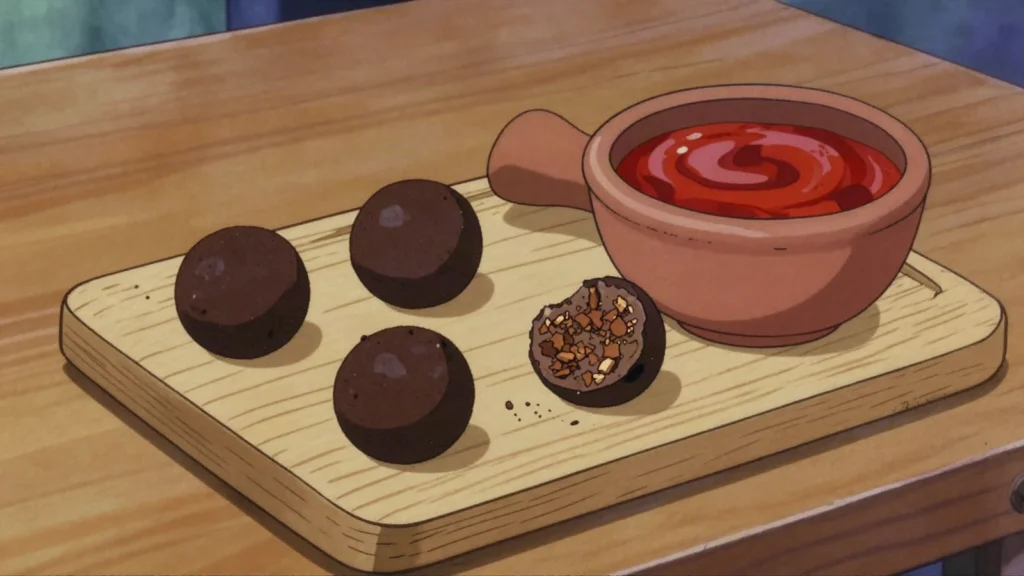
- shaped into balls or cakes
- from a Beninese or West African grocer
- or afitin, iru, dawadawa or soumbala
- as the nearest available
- see the note on why no method is given
To cook with
- 1 tablespooncrumbled, per dish for four
- no more, see the note
- added early, with the onion and tomato
What it goes into
- tomato and pepper sauces
- leaf and okra sauces
- groundnut stew
- bean and grain dishes
- with akassa or pounded yam
Directions
- Use very little. About a tablespoon crumbled, for four people.
- Start with half of what you think. You cannot take it out again.
- Crumble the ball between your fingers.
- Add it early, with the onion and tomato. It needs time to dissolve into the sauce.
- Taste before salting a dish that contains it. That matters, because fish and meat usually do that job.
- Keep them double-sealed or the cupboard smells.
- Discard anything that moulds, bulges or smells chemical.
Technique
- The atlas’s own description does not name the seed sonru is made from, and sources differ — some describe African locust bean as in afitin, some describe other seeds including soybean. The atlas will not pick one and present it as settled, because naming a species it cannot confirm would be inventing a fact. Everything in this entry applies whichever seed it is.
- That uncertainty is a real problem for anyone with an allergy, which is exactly why the atlas states it first. These condiments are made from legumes or beans, and if it is soybean, soy is a declarable allergen in many countries — anyone with a legume or soy allergy should ask before eating it.
- The atlas gives no method: this is a warm, low-acid, high-protein ferment left wrapped for days, and specifically an alkaline one in which the pH rises rather than falling, so it does not protect itself with acid the way the ferments the atlas does describe do. The afitin entry carries the full reasoning.
- These condiments are eaten daily by millions of people. The atlas declines on the risk class rather than on any record of harm.
- Use very little — about a tablespoon crumbled for four. Too much makes a dish smell of ammonia rather than taste of depth. Start with half of what you think, because you cannot take it out again.
- Crumble the ball between your fingers so it disperses. A whole ball sits in the sauce and releases unevenly.
- Add it early, with the onion and tomato. It needs time to dissolve; added at the end it stays as grit.
- It is a seasoning rather than an ingredient, and should sit behind the dish rather than in front of it — a cook who can taste it has used too much.
- Taste before salting a dish that contains it. These condiments carry salt and how much varies by producer.
- Always cook it; it is not eaten raw. Cooking is not a substitute for buying well, and sourcing is the real control.
- The strong ammonia smell is normal, from protein breakdown during the ferment, and is not spoilage. Coloured or fuzzy mould, a chemical or solvent smell distinct from the ferment, or a bulging container all mean discard — and do not taste a bulging container to check.
- Sonru is less widely exported than iru or soumbala, and you may find those instead. Afitin, iru, dawadawa, soumbala and netetou all serve the same role — not identical, but close.
- It is a plant product, and it is what gives depth to a vegetarian West African sauce, where fish and meat usually do that job.
- Keep dried balls double-sealed, or the cupboard smells.
Substitutions
- Afitin, iru, dawadawa, soumbala or netetou all substitute.
- Miso gives a related fermented depth.
- Fermented black beans give savouriness with a different character.
- Fish sauce adds umami but not the aroma, and is not vegetarian.
- Natto is the closest Japanese relative by process.
- Ground powder replaces a crumbled ball and disperses faster.
Variations
- Afitin is the other Beninese locust bean condiment.
- Iru in Nigeria comes whole as woro or mashed as pete.
- Dawadawa in Ghana is pressed into flat cakes.
- Soumbala in Burkina Faso and Mali is shaped into balls.
- Netetou in Senegal is the same condiment.
- Soybean versions are made where locust beans are scarce.
Frequently asked questions
What is Sonru?
Sonru is a fermented & pickled from Benin: fermented seed condiment shaped into balls and crumbled into stews for depth.
How long does Sonru take to make?
Sonru takes 5 minutes of preparation and in the dish of cooking. The recipe makes buy a small quantity; a little goes far. It is rated easy to make.
What can I substitute in Sonru?
Yes, within limits. Afitin, iru, dawadawa, soumbala or netetou all substitute. Miso gives a related fermented depth. Fermented black beans give savouriness with a different character. Fish sauce adds umami but not the aroma, and is not vegetarian. Natto is the closest Japanese relative by process. Ground powder replaces a crumbled ball and disperses faster.
What is the most important thing to get right in Sonru?
The atlas gives no method: this is a warm, low-acid, high-protein ferment left wrapped for days, and specifically an alkaline one in which the pH rises rather than falling, so it does not protect itself with acid the way the ferments the atlas does describe do. The afitin entry carries the full reasoning.