
Ingredients
What to buy
- afitin, ready fermented
- or iru, dawadawa, soumbala or netetou
- the same condiment under other names
- in balls, cakes or loose seeds
- from an African grocer
- see the note on why no method is given
To cook with
- 1to 2 tablespoons per dish for four
- no more, see the note
- added early, with the onion and tomato
- into sauces, soups and stews
What it goes into
- tomato and pepper sauces
- okra and leaf sauces
- groundnut stew
- bean dishes
- with akassa or pounded yam
Directions
- Use very little. Too much makes a dish smell of ammonia rather than taste of depth.
- Start with half of what you think. You cannot take it out again.
- Add it early, with the onion and tomato. It needs time to soften and to release into the sauce.
- Keep them double-sealed or the cupboard smells. A moist paste keeps weeks refrigerated.
- Discard anything that moulds, bulges or smells chemical.
Technique
- The atlas gives no method: this is a warm, low-acid, high-protein ferment wrapped and left for days, which is the combination botulinum needs, and its toxin gives no smell, taste or visible sign. It is specifically an alkaline fermentation in which the pH rises rather than falling, so unlike the sauerkrauts, pickles and sour doughs the atlas does give methods for, it does not protect itself with acid. What protects it is a dense Bacillus population establishing fast through long boiling, warmth and practice — skill rather than chemistry — and that practice cannot be compressed into a paragraph.
- The atlas is not aware of this condiment being a notable cause of illness, and it is eaten daily by millions. It declines on the risk class rather than on a record of harm, and says so plainly rather than leaving an impression it did not intend.
- Use very little — one or two tablespoons of seeds for a dish for four. It is intensely savoury, and too much makes a dish smell of ammonia rather than taste of depth. Start with half of what you think, because you cannot take it out again.
- Add it early, with the onion and tomato. It needs time to soften and release into the sauce; added at the end it sits there as lumps. Crushing the seeds first releases the flavour faster, though whole seeds left in the pot are also eaten as they come.
- Always cook it into a dish; it is not eaten raw. Cooking is standard practice and reduces risk, but it is not a substitute for buying well — sourcing is the real control.
- The strong ammonia smell is normal and expected, coming from protein breakdown rather than spoilage. The same Bacillus fermentation makes natto in Japan, and the stickiness and smell come from the same place.
- Buy packaged, labelled product from a proper shop. Commercially produced and inspected product is the safer route; unlabelled paste of unknown age and handling is not.
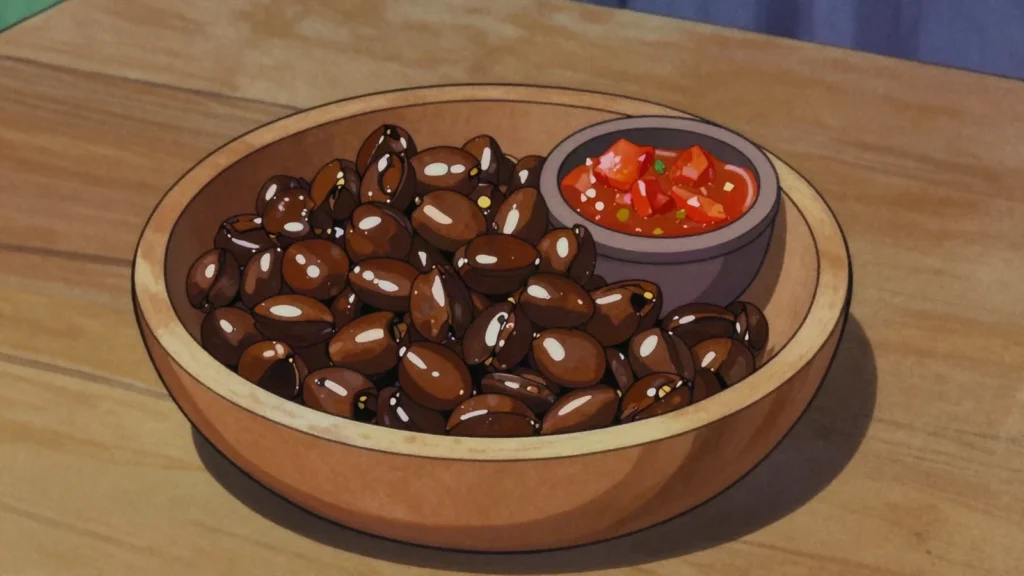
- Judge it by dark brown to near black colour, a strong ammonia and fermented-bean smell, and a dry to slightly sticky texture. Coloured or fuzzy mould, a sharp chemical or solvent smell distinct from the ferment, or any bulging or hissing container all mean discard — and do not taste a bulging container to check.
- It is made from the seeds of Parkia biglobosa, the African locust bean tree, whose pods also hold a yellow floury pulp eaten as a sweet food in its own right. The tree is protected and valued rather than felled.
- Afitin, iru, sonru, dawadawa, soumbala and netetou are the same broad condiment across West Africa, but the names do not map neatly onto one another — different peoples use different words and different preparations, and the atlas records the family without claiming exact equivalence.
- It is a seasoning rather than an ingredient, sitting behind the dish rather than in front of it, and doing the job umami does in other cuisines.
- Fermented locust bean is high in protein and is a significant protein source in savanna diets, and fermentation improves nutrient availability while reducing antinutritional factors in the seed.
- There is no true substitute. Miso, natto or fermented black beans give a related depth and fish sauce gives savouriness without the character — the atlas records that rather than pretending they match.
- Keep dried seeds double-sealed, or the cupboard smells.
Substitutions
- Iru, dawadawa, soumbala or netetou substitute directly.
- Miso gives a related fermented depth in the absence of any of those.
- Fermented black beans give savouriness with a different character.
- Fish sauce adds umami but not the aroma, and is not vegetarian.
- Natto is the closest Japanese relative by process.
- Ground powder replaces whole seeds and disperses faster.
Variations
- Sonru is another Beninese fermented seed condiment.
- Iru in Nigeria comes as woro, whole, or pete, mashed.
- Dawadawa in Ghana and northern Nigeria is often pressed into cakes.
- Soumbala in Mali and Burkina Faso is shaped into balls.
- Netetou in Senegal is the same condiment.
- Soybean dawadawa is made where locust beans are scarce.
History
One of Benin’s traditional locust-bean condiments alongside iru and sonru, boiled then wrapped and left to ferment for several days.
Frequently asked questions
What is Afitin?
Afitin is a fermented & pickled from Benin: fermented African locust bean seeds, dark and pungent, dropped whole into sauces. One of Benin’s traditional locust-bean condiments alongside iru and sonru, boiled then wrapped and left to ferment for several days.
How long does Afitin take to make?
Afitin takes 5 minutes of preparation and in the dish of cooking. The recipe makes buy a small quantity; a little goes far. It is rated easy to make.
What can I substitute in Afitin?
Yes, within limits. Iru, dawadawa, soumbala or netetou substitute directly. Miso gives a related fermented depth in the absence of any of those. Fermented black beans give savouriness with a different character. Fish sauce adds umami but not the aroma, and is not vegetarian. Natto is the closest Japanese relative by process. Ground powder replaces whole seeds and disperses faster.
What is the most important thing to get right in Afitin?
Use very little. Too much makes a dish smell of ammonia rather than taste of depth.