
Ingredients
Fruit
- 1 kgsmall firm strawberries, sour cherries, whole figs, green walnuts or quince, all of one kind and all of a size
Syrup
- 1 kggranulated sugar
- 400 mlwater
- Juice of 1 lemon, or ½ tsp citric acid
- 1 tbsprose water, if making rose or strawberry slatko
To serve
- A small crystal or glass bowl
- One teaspoon per guest
- A glass of cold water per guest
Directions
- Choose fruit that is ripe but firm, small, and all of the same size. The whole point of slatko is that the fruit stays whole and glossy, so anything soft, bruised or overripe is out.
- Prepare according to the fruit: hull strawberries without cutting into them, stone cherries with a pin through the stem end so they keep their shape, prick figs all over, or peel and cube quince.
- Layer the fruit and sugar in a wide bowl, ending with sugar, and leave overnight in a cool place. The sugar draws out the juice by osmosis and firms the fruit so it will not disintegrate later. Do not stir.
- Next day, tip the fruit and all the syrup that has formed into a wide, shallow pan with the water. A wide pan is important: depth means long boiling and long boiling means broken fruit.
- Bring slowly to a boil and skim the pink foam carefully as it rises. Failing to skim gives a cloudy slatko, and clarity is prized.
- Simmer gently, never at a rolling boil, and instead of stirring, shake the pan or move the fruit with a wooden spoon in a lifting motion. Cook 30–45 minutes depending on the fruit.
- Add the lemon juice about 10 minutes before the end. It stops the sugar crystallising in the jar and lifts the flavour, which would otherwise be flatly sweet.
- Test the syrup: a drop on a cold plate should hold its dome and not run. Slatko syrup should be thick and honey-like but still pourable, thinner than jam and never set. The fruit should look candied and translucent.
- Rest the pan off the heat for 15 minutes so the fruit reabsorbs syrup and stops floating, then ladle into sterilised jars, seal, and store in a cool dark cupboard.
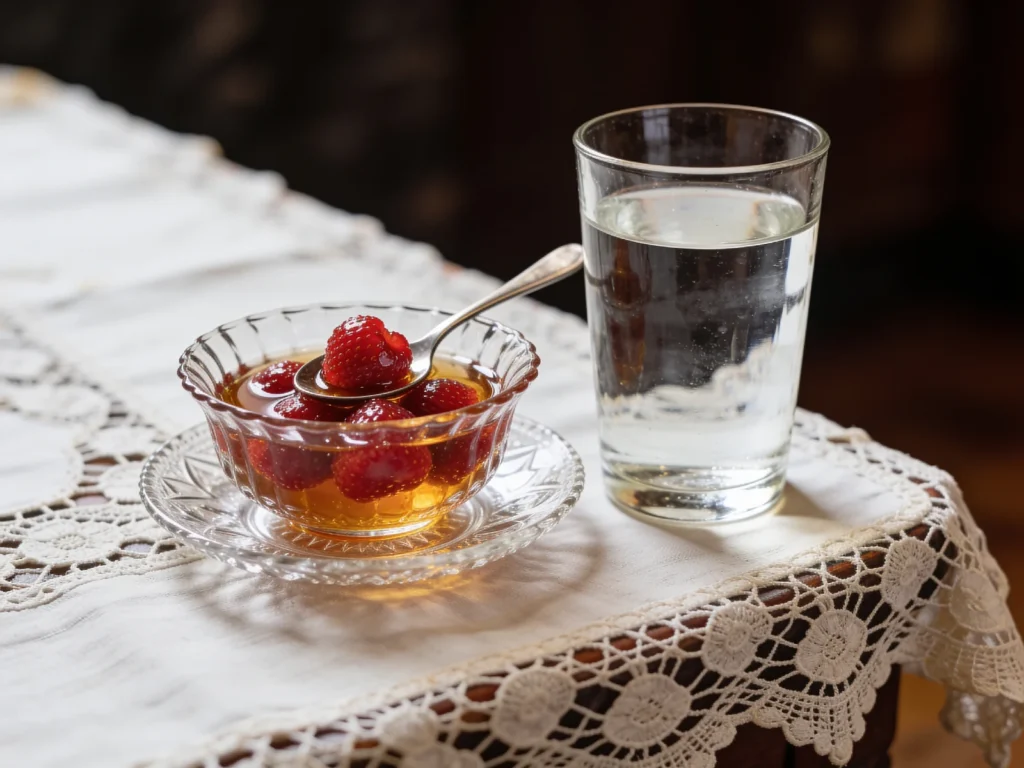
- Serve the Serbian way: a single spoonful in a small glass bowl, offered to a guest with a glass of cold water, as the first thing that happens when they enter the house.
Technique
- The overnight sugaring is what keeps the fruit whole. Skipping it and boiling raw fruit in syrup produces jam, which is a different preserve entirely and is called džem or pekmez.
- Slatko is an act of hospitality first. The guest takes one spoonful only, eats it, puts the spoon in the water glass, and drinks the water; taking a second spoonful is considered greedy.
- Wide pan, gentle heat, no stirring. Every rule in slatko exists to keep the fruit intact and the syrup clear.
- Sugar at close to 1 to 1 with the fruit is what preserves it. Reducing the sugar substantially makes a nice compote that will not keep in the cupboard, so refrigerate any low-sugar version.
Substitutions
- No fresh sour cherries? Frozen ones work, thawed and drained first, though they will be softer.
- Green walnut slatko, the most prestigious version, needs unripe walnuts picked in June and soaked in changes of water for a week to remove bitterness; it is a project rather than a substitution.
- Citric acid at ½ tsp replaces the lemon juice and is what most Serbian households actually use.
Variations
- Slatko od ruže, made from the petals of the damask rose, pale pink and intensely perfumed.
- Slatko od šljiva, whole small plums, a Šumadija speciality.
- Slatko od oraha, green walnuts, black and dense, served at Slava.
History
Serbian hospitality ritual: a visitor is served one spoon of slatko and a glass of cold water on arrival.
Frequently asked questions
What is Slatko?
Slatko is a dessert from Serbia: whole fruit in thick syrup, a spoonful offered with water to guests. Serbian hospitality ritual: a visitor is served one spoon of slatko and a glass of cold water on arrival.
How long does Slatko take to make?
Slatko takes 30 min plus overnight resting of preparation and 1 hr of cooking. The recipe makes about 1 litre, 3 small jars. It is rated medium to make.
What can I substitute in Slatko?
Yes, within limits. No fresh sour cherries? Frozen ones work, thawed and drained first, though they will be softer. Green walnut slatko, the most prestigious version, needs unripe walnuts picked in June and soaked in changes of water for a week to remove bitterness; it is a project rather than a substitution. Citric acid at ½ tsp replaces the lemon juice and is what most Serbian households actually use.
What is the most important thing to get right in Slatko?
Choose fruit that is ripe but firm, small, and all of the same size. The whole point of slatko is that the fruit stays whole and glossy, so anything soft, bruised or overripe is out.