The soft, seeded, honeyed fruit of the eastern Mediterranean — eaten fresh for a few weeks in late summer, dried for the rest of the year, and one of the first plants humans ever cultivated.
Where it comes from
Figs were being grown in the Jordan valley eleven thousand years ago, perhaps before wheat; they are in Genesis, in Homer and in the Roman diet as the poor man’s sweetener. The tree grows across the Mediterranean and western Asia and the Spanish carried it to California, which now grows most of America’s crop. Turkey, Egypt, Morocco, Algeria and Iran are the largest producers, mostly of dried figs, which have been a trade good since antiquity.
Fresh figs do not travel or keep, which is why most of the world knows them dried. Dried figs are dense, chewy and deeply sweet, eaten with nuts and cheese, cooked into compotes and puddings, and stuffed with walnuts and almonds in Turkey and Greece. Fresh figs are a different fruit — soft, cool, faintly floral — eaten as they are, with ham or cheese, or briefly roasted with honey.
Varieties
- Black Mission — Small, purple-black skin, deep pink flesh, rich and sweet; the Californian standard, from the Spanish missions.
- Brown Turkey — Large, brownish-purple, mild and sweet; the most common fresh fig in Europe.
- Kadota — Green-skinned, amber-fleshed, mild; often preserved or dried.
- Smyrna / Calimyrna — Large, golden, nutty; the classic dried fig of Turkey and California.
- Adriatic — Green skin, bright red flesh, intensely sweet; a fresh-eating fig.
- Dottato — The Italian dried fig, pale and honeyed; from Calabria, sometimes stuffed and baked.
In the kitchen
Fresh figs need nothing: pulled open, with prosciutto, with fresh goat’s cheese or ricotta, with honey. Halved and roasted or grilled for a few minutes with honey and thyme they go with duck, lamb and cheese; baked into a tart or a clafoutis they are one of the best late-summer desserts. Do not peel them.
Dried figs are poached in wine or syrup with spices for a compote, chopped into breads and stuffings, or simmered into the Provençal and Spanish sauces for game and pork. Stuffed with a walnut or an almond and dusted with sesame or dipped in chocolate they are a Mediterranean sweet.
Choosing and keeping
A ripe fig is soft, heavy and slightly drooping on its stem, with a bead of syrup sometimes at the eye; it smells sweet and may be slightly split. It does not ripen after picking. Eat within a day or two; refrigerate only briefly.
Dried figs should be soft and pliable, not hard; they keep for months in a sealed container and a year in the fridge. A white dusting is sugar, not mould.
Dishes with fig
 GazozSoda water poured over fermented fruit and herb syrups, garnished in the glass.
 PicaronesSquash and sweet-potato doughnut rings drenched in chancaca syrup
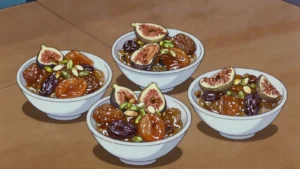 DebyazahDried apricot and fruit compote cooked with nuts, served in small dishes.
 PašticadaDalmatian beef braised with prošek and prunes, served with gnocchi
 SlatkoWhole fruit in thick syrup, a spoonful offered with water to guests.
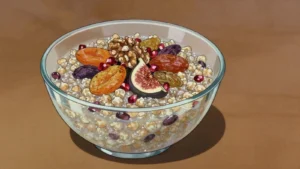 Asurepudding of grains, pulses, dried fruit and nuts, shared with neighbours
 DebyazaPumpkin cooked down with dates, dried fruit, nuts and spices into a thick preserve
 Petullafried dough served with honey, feta or jam
Fig is tagged on 26 dishes from 21 countries in the atlas. These notes are written from general knowledge and carry no per-fact citation — see About.