
Ingredients
Skewers
- 800 gboneless chicken thigh, cut into 2 cm cubes
- 4 tbspketjap manis (sweet Indonesian soy)
- 2 tbsplight soy sauce
- 4garlic cloves, crushed
- 2cm ginger, grated
- 1 tspground coriander
- 1 tspground cumin
- 1 tbspsambal oelek
- 1 tbspbrown sugar
- juice of 1 lime
- 16bamboo skewers, soaked 30 min
Pindasaus, peanut sauce
- 250 gunsweetened smooth peanut butter, or 250 g roasted peanuts ground fine
- 300 mlhot water or unsweetened coconut milk
- 2garlic cloves, crushed
- 1small onion, finely chopped
- 2 tbspketjap manis
- 1 tbspsambal oelek, or 1 Madame Jeanette pepper minced
- 1 tbspbrown sugar
- juice of 1 lime
- 1 tbspoil
- salt
To serve
- 8 slicessoft white bread, or steamed white rice
- 3 tbspcrisp fried onions
- ½cucumber, sliced
Directions
- Mix the ketjap manis, soy, garlic, ginger, coriander, cumin, sambal, sugar and lime into a marinade and turn the chicken through it. Cover and refrigerate at least 4 hours, or overnight.
- Thread 4 to 5 cubes onto each soaked skewer, pushing them close together so the meat stays juicy, and leave a bare handle at one end.
- For the sauce, fry the onion and garlic in the oil over medium heat until soft and just golden, 5 minutes.
- Whisk in the peanut butter, then add the hot water a splash at a time; it will seize and then loosen. Keep going until it is smooth and coats a spoon.
- Add ketjap manis, sambal, sugar and salt and simmer 5 minutes, stirring, until the oil beads at the edges. Finish with lime juice off the heat and keep it warm and thick, not runny.
- Get a charcoal grill to a medium-hot bed of coals with no flame, or heat a ridged grill pan until smoking.
- Grill the skewers 3 to 4 minutes a side, turning often and basting with the leftover marinade, until the edges are charred black in places and the sugar in the ketjap has lacquered the surface.
- Check one cube: it should be just firm with no pink at the centre, about 5 to 7 minutes in total. Do not grill past that or the lean thigh dries.
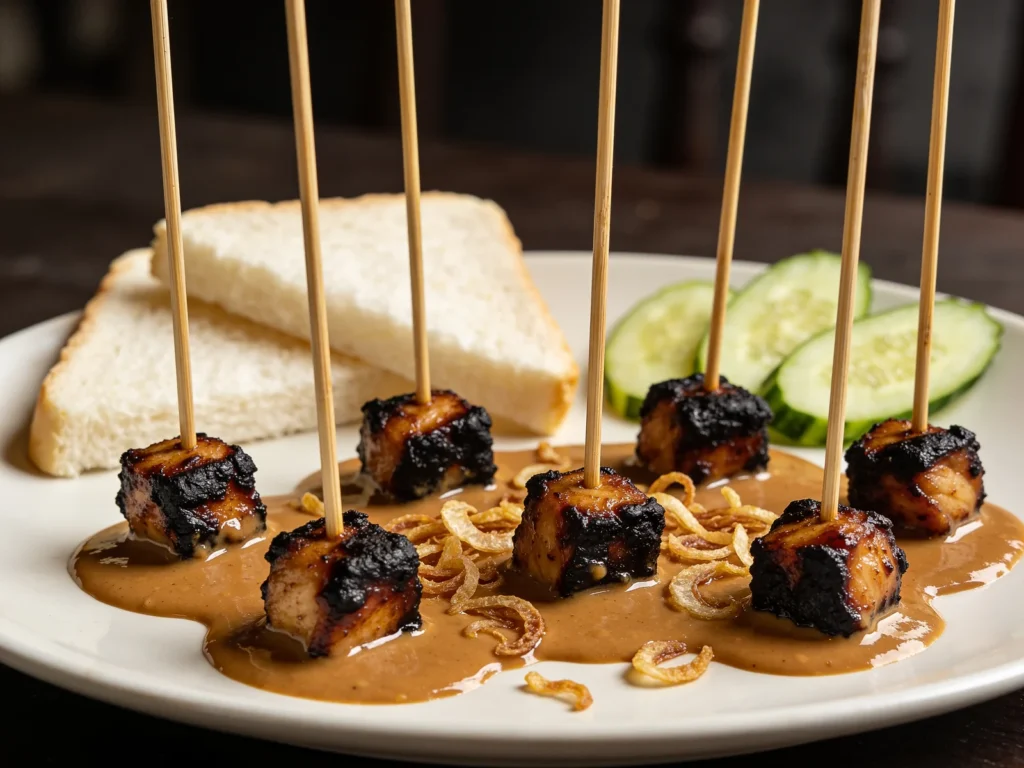
- Pile the skewers on a plate, ladle the warm peanut sauce over so it pools underneath, and scatter the fried onions on top.
- Serve with soft white bread to mop the sauce or with rice and cucumber, and pull the meat off the stick with your teeth.
Technique
- Surinamese saté came with Javanese contract workers from 1890 onwards and then went to the Netherlands with Surinamese migration, which is why it now anchors both countries’ takeaway menus.
- The sauce should be thick enough to hold a ridge from the spoon. Thin peanut sauce runs off the meat and tastes of nothing but water.
- Ketjap manis is not soy sauce. It is thick, molasses-sweet and it is what makes the char taste right; light soy alone will not caramelise the same way.
Substitutions
- No ketjap manis: simmer 4 tbsp light soy with 3 tbsp palm or dark brown sugar until syrupy.
- No charcoal: a very hot ridged grill pan or the top shelf under a fierce grill gives usable char, though not the smoke.
- Ground roasted peanuts give a rougher, more authentic sauce than commercial peanut butter if you have a mill.
Variations
- Saté babi, made with pork, common in Javanese-Surinamese households.
- Broodje saté, the skewers stripped into a soft roll and drowned in peanut sauce.
- Saté with extra Madame Jeanette in the sauce, for people who want it genuinely hot.
History
Brought by Javanese contract workers who began arriving in 1890; now Suriname’s most common street and party food.
Frequently asked questions
What is Saté?
Saté is a street food from Suriname: grilled chicken skewers with thick peanut sauce, eaten with bread or rice. Brought by Javanese contract workers who began arriving in 1890; now Suriname’s most common street and party food.
How long does Saté take to make?
Saté takes 30 min plus 4 hr marinating of preparation and 20 min of cooking. The recipe makes 4 servings, 16 skewers. It is rated easy to make.
What can I substitute in Saté?
Yes, within limits. No ketjap manis: simmer 4 tbsp light soy with 3 tbsp palm or dark brown sugar until syrupy. No charcoal: a very hot ridged grill pan or the top shelf under a fierce grill gives usable char, though not the smoke. Ground roasted peanuts give a rougher, more authentic sauce than commercial peanut butter if you have a mill.
What is the most important thing to get right in Saté?
Check one cube: it should be just firm with no pink at the centre, about 5 to 7 minutes in total. Do not grill past that or the lean thigh dries.