
Ingredients
Pastry
- 500 gall-butter puff pastry, in two sheets
Cream
- 6egg whites
- 400 gsugar
- 150 mlwater
- 1 tbsplemon juice
- 1 tspvanilla
- a pinch of salt
To set
- 15 gpowdered gelatine in 80 ml cold water
- or 8 sheets gelatine
To finish
- icing sugar
Equipment
- a sugar thermometer
- a square tin
- a stand mixer, ideally
Directions
- Bake the pastry first and let it cool completely. Roll each sheet to fit the tin, prick it all over with a fork, and bake at 200°C (390°F) for 15 minutes until deep golden and dry.
- Prick it thoroughly and weigh it down with a second tray if it puffs too much, because you want flat sheets rather than pillows. Bake it properly dry and dark. Pale underbaked pastry goes soggy under the cream within hours.
- Begin whisking the egg whites with the salt in a stand mixer until they hold soft peaks. The lemon juice stops the syrup crystallising, and the temperature is what determines whether the meringue is stable.
- Use a thermometer. Below 118 the meringue never firms properly; much above it and the sugar seizes as it hits the whites. Pour it down the side rather than onto the beaters, which would fling molten sugar around the bowl and set it into threads.
- Keep the mixer whisking on high throughout. Melt the bloomed gelatine gently until liquid and add it to the meringue while it is still whisking. Add the gelatine while the meringue is still warm, because it seizes into strands in a cold mixture. Now whisk until the bowl is barely warm to the touch, which takes 10 minutes or more.
- Whisk it right down to lukewarm. Assembled while hot, the cream slumps and never sets tall. Add the vanilla at the very end of whisking. Now work fast, because the gelatine begins setting within minutes.
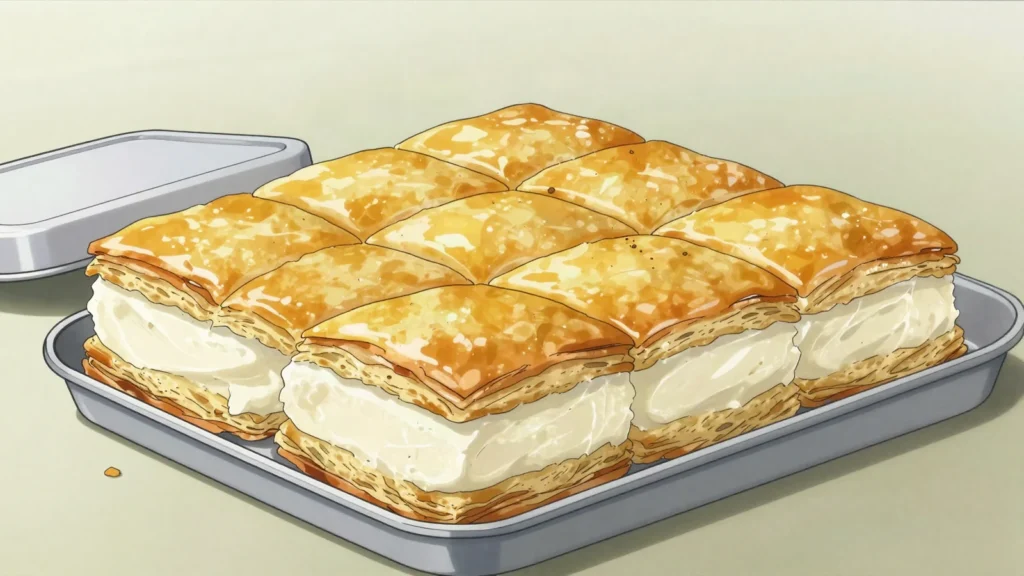
- Lay one pastry sheet in the tin. Pile all the meringue on top and level it quickly with a palette knife. Pile it thick, at least 4 cm. The height is the whole character of a šampita and a thin layer misses the point entirely.
- Lay the second pastry sheet on top and press it down very gently. Press lightly. Now chill it for at least 4 hours, and overnight is better. Dust the top thickly with icing sugar. Cut it with a single decisive stroke rather than sawing, or the top pastry shatters and the cream drags. Serve it cold, and it keeps two days refrigerated before the pastry softens.
Technique
- Krempita is the custard-filled relative and the two are usually made together.
- The cream contains cooked egg white rather than raw, because the hot syrup cooks it.
- It is sold cut into large squares and is substantial.
Substitutions
- Ready-rolled all-butter puff pastry.
- Agar in place of gelatine, adjusting the quantity for a firmer set.
Variations
- Krempita, with vanilla custard instead.
- With a layer of both custard and meringue.
- With lemon zest through the cream.
History
An Austro-Hungarian pastry adopted in Bosnian cake shops, sold in the same window as krempita.
Frequently asked questions
What is Sampita?
Sampita is a dessert from Bosnia and Herzegovina: puff pastry squares filled with a tall block of set egg-white cream. An Austro-Hungarian pastry adopted in Bosnian cake shops, sold in the same window as krempita.
How long does Sampita take to make?
Sampita takes 40 min plus 4 hr chilling of preparation and 25 min of cooking. The recipe makes 16 pieces. It is rated hard to make.
What can I substitute in Sampita?
Yes, within limits. Ready-rolled all-butter puff pastry. Agar in place of gelatine, adjusting the quantity for a firmer set.
What is the most important thing to get right in Sampita?
Prick it thoroughly and weigh it down with a second tray if it puffs too much, because you want flat sheets rather than pillows. Bake it properly dry and dark. Pale underbaked pastry goes soggy under the cream within hours.