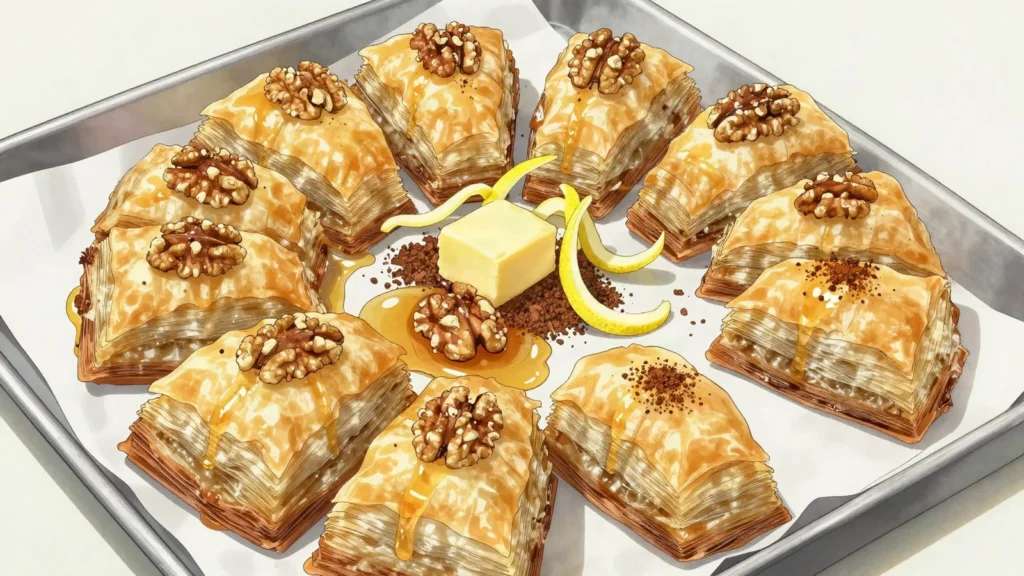

Ingredients
Pastry
- 500 gthin phyllo sheets, about 20 leaves
- 300 gunsalted butter, clarified
Filling
- 500 gwalnuts, coarsely chopped, not ground
- 80 gcaster sugar
- 1 tspground cinnamon
- ¼ tspground clove
Syrup
- 600 gsugar
- 500 mlwater
- 2 tbsplemon juice
- 1strip lemon peel
- 1 tbsphoney
Directions
- Clarify the butter by melting it gently and pouring off the clear fat, leaving the milky solids behind; those solids burn and make the layers taste bitter.
- Mix the walnuts with the sugar, cinnamon and clove. Keep the pieces the size of coarse gravel so the filling stays crunchy.
- Butter a 30 by 25 cm metal tray. Lay 8 phyllo sheets in, brushing each one with butter and letting the edges climb the sides.
- Spread half the walnut mixture, cover with 4 buttered sheets, spread the rest, then finish with the remaining 8 sheets, buttering as you go and buttering the top generously.
- Cut all the way to the base before baking, first in parallel lines 4 cm apart, then diagonally across to make lozenges. Cutting after baking shatters the pastry.
- Bake at 160°C (325°F) fan for 55 to 65 minutes, until the whole surface is an even deep amber and the pastry sounds crisp when tapped with a knife.
- While it bakes, boil the sugar, water, lemon juice and peel for 10 minutes to a light syrup, stir in the honey and take it off the heat.
- Pour the cooled syrup over the hot baklava, slowly and evenly, until it stops absorbing; it should hiss steadily. Leave uncovered at room temperature for at least 6 hours, ideally overnight, before lifting out the pieces.
Technique
- One of the two must be cold. Hot syrup on hot pastry steams the layers soft; cold syrup on hot pastry keeps them crisp. Albanian bakers use cold syrup.
- Walnut, not pistachio, is the Albanian filling, and the baklava is cut in lozenges rather than squares. It appears at New Year and at weddings on a stacked tray.
- Never cover it while it soaks and never refrigerate it. Trapped steam softens the top leaves within an hour.
Substitutions
- Half walnut and half almond is common in the south and gives a milder, sweeter filling.
- If you cannot get very thin phyllo, use the thicker country style and drop to 6 sheets top and bottom, adding 10 minutes to the bake.
Variations
- Baklava me arra dhe mjaltë, the Gjirokastër style, replaces a third of the sugar syrup with mountain honey.
- Some Shkodër families layer in a spoon of ground rusk between the nut layers to hold the syrup.
History
A layered, syrup-soaked pastry whose exact birthplace is genuinely contested among the many cuisines of the former Ottoman Empire, each with a claim: Ottoman Turkish court kitchens in Istanbul, Byzantine Greek predecessors built on an even older honey-and-nut pastry called gastris, and separate Levantine traditions all fed into what became baklava. The clearest documented point is the Topkapi Palace’s own kitchen records, which describe a version served to the Janissary guard each Ramadan from at least the 15th century onward, and from that Ottoman court the dish spread with the empire itself, taking a different name and slightly different nut, syrup and pastry-thickness in almost every region it reached, Albania included.
Frequently asked questions
What is Baklava?
Baklava is a dessert from Albania: walnut phyllo in syrup, New Year’s favorite. A layered, syrup-soaked pastry whose exact birthplace is genuinely contested among the many cuisines of the former Ottoman Empire, each with a claim: Ottoman Turkish court kitchens in Istanbul, Byzantine Greek predecessors built on an even older honey-and-nut pastry called gastris, and separate Levantine traditions all fed into what became baklava. The clearest documented point is the Topkapi Palace’s own kitchen records, which describe a version served to the Janissary guard each Ramadan from at least the 15th century onward, and from that Ottoman court the dish spread with the empire itself, taking a different name and slightly different nut, syrup and pastry-thickness in almost every region it reached, Albania included.
How long does Baklava take to make?
Baklava takes 40 min of preparation and 1 hr plus 6 hr soaking of cooking. The recipe makes 1 tray, 30 lozenges. It is rated medium to make.
What can I substitute in Baklava?
Yes, within limits. Half walnut and half almond is common in the south and gives a milder, sweeter filling. If you cannot get very thin phyllo, use the thicker country style and drop to 6 sheets top and bottom, adding 10 minutes to the bake.
What is the most important thing to get right in Baklava?
Bake at 160°C (325°F) fan for 55 to 65 minutes, until the whole surface is an even deep amber and the pastry sounds crisp when tapped with a knife.