
Ingredients
At the maguey
- 1mature maguey pulquero (Agave salmiana or A. mapisaga), 8–12 years old, just before it throws its flower stalk
- 1acocote, the long dried gourd used to suck up the sap, or a food-grade siphon
- 1raspador, the curved scraping blade
- Clean covered buckets or a wooden barrel
In the tinacal
- 20 litresfresh aguamiel, strained
- 2 litressemilla, live pulque from a previous batch, as the starter
- 1clean fermenting vat of wood, fibreglass or, traditionally, cured hide
To serve
- 1 litrefresh pulque, cold
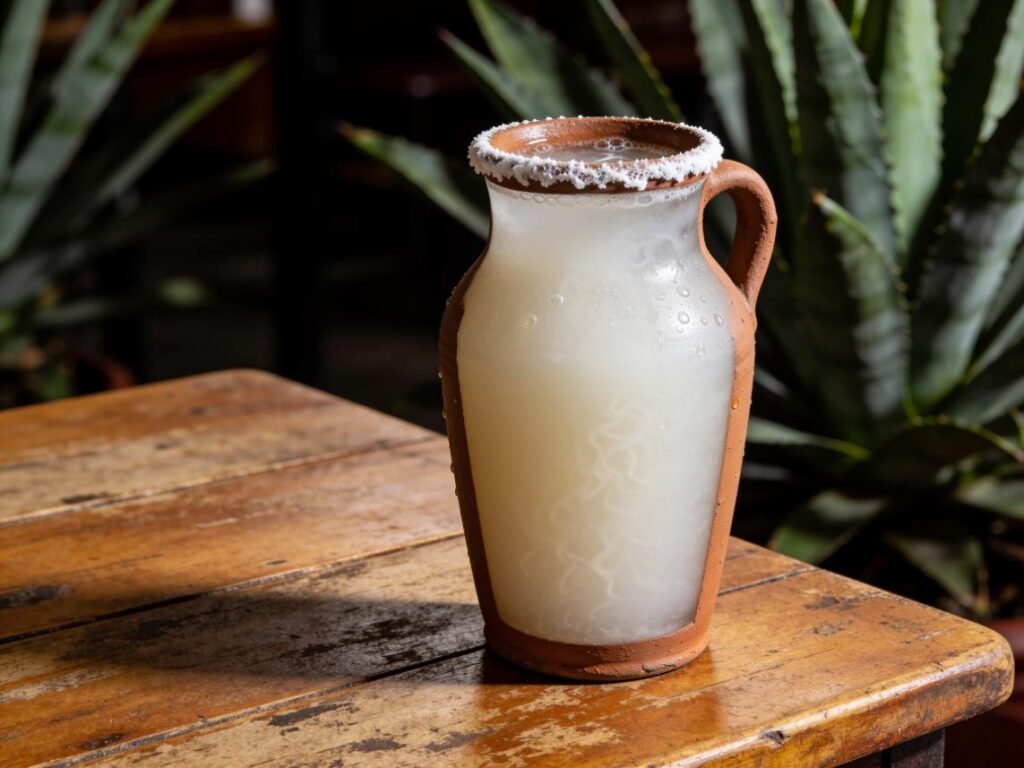
- 1clay jarro or a tall catrina glass
- For a curado: 300 g fruit such as guava, prickly pear, strawberry or pineapple, blended with 2 tbsp sugar
Directions
- Select a maguey that is about to send up its quiote, the giant flower spike. All the sugar the plant has stored for a decade is heading into that stalk, and tapping intercepts it.
- Castrate the plant: cut out the central bud and hollow a basin, the cajete, into the heart. Cover it with a flat stone and leave it to heal and start weeping for 2 to 6 months. The plant will die after its tapping season, having given its whole life’s sugar.
- Twice a day, morning and evening, scrape the walls of the cajete with the raspador to reopen the tissue, then draw the pooled aguamiel up into the acocote by mouth suction and blow it into the bucket. A good plant gives 4 to 6 litres a day for 3 to 6 months.
- Taste the aguamiel: it should be clear, sweet like light honey water and faintly herbal, around 10 percent sugar. It is drunk fresh as a soft drink in its own right.
- In the tinacal, strain the aguamiel into the vat and add the semilla, the live pulque held back from the last batch. There is no yeast to buy; the culture is a mixed community of Saccharomyces, Lactobacillus and, crucially, Zymomonas mobilis.
- Ferment at ambient temperature, roughly 20–28°C (70–80°F), for 8 to 24 hours, stirring occasionally. It foams hard, turns from clear to milky white, thickens noticeably and smells bready and sour.
- Judge it by feel: pulque is ready when it is viscous and ropy enough to string slightly off a spoon, faintly sour, and around 4–6 percent alcohol. The viscosity comes from the Zymomonas, and it is the single most distinctive thing about the drink.
- Draw it off and hold back some as the semilla for the next batch, exactly as a sourdough is kept back.
- Drink it the same day, cold, from a clay jarro. Pulque never stops fermenting, so within 24 to 48 hours it turns thin, sharp and unpleasant, which is why it has never travelled and why pulquerias sell only what was made that morning.
- For a curado, blend fresh fruit with a little sugar and stir it into the pulque just before pouring.
Technique
- Pulque cannot honestly be made at home without a mature maguey. There is no shortcut: the aguamiel comes from a plant that took a decade to grow and that dies for the drink. Anything sold as instant pulque made from sugar and yeast is a different beverage.
- The drink is pre-Hispanic and was sacred to the Mexica, tied to Mayahuel and the Centzon Totochtin, and its consumption was regulated by law before the Spanish arrival.
- The slippery, viscous texture puts off first-time drinkers and is precisely what regulars look for. A thin pulque is an old one.
- Cleanliness in the tinacal is everything. Because the ferment relies on a mixed wild culture rather than a single pitched yeast, a dirty vat turns a batch acetic within hours.
- Tinned or bottled pulque is pasteurised and stabilised; it keeps, but the live texture and the lactic freshness are gone.
Substitutions
- No access to a plant: buy fresh from a pulqueria in Mexico City, Hidalgo or Tlaxcala, or accept the tinned version as a rough approximation.
- For the flavour without the plant, a lightly fermented agave-nectar drink cultured with kefir grains gets somewhere near the sourness but never the viscosity.
- Aguamiel itself, sold chilled, is worth drinking on its own and is what pulque tastes like before the ferment.
Variations
- Curados de fruta, blended with guava, strawberry, prickly pear, oat or pine nut, are the standard pulqueria menu.
- Pulque blanco or natural is the unflavoured original, drunk by the litre.
- Aguamiel reduced by boiling makes miel de agave, the syrup, an entirely different product.
History
Called octli by the Mexica, who restricted it to priests and elders; pulquerias filled Mexico City until beer overtook it in the 20th century.
Frequently asked questions
What is Pulque?
Pulque is a wine & spirit from Mexico: milky, viscous fermented agave sap, lightly sour and mildly alcoholic. Called octli by the Mexica, who restricted it to priests and elders; pulquerias filled Mexico City until beer overtook it in the 20th century.
How long does Pulque take to make?
Pulque takes 30 min twice a day at the plant of preparation and 8–24 hr fermenting; the plant takes 8–12 years to reach maturity of cooking. The recipe makes about 5 litres a day from one mature maguey. It is rated hard to make.
What can I substitute in Pulque?
Yes, within limits. No access to a plant: buy fresh from a pulqueria in Mexico City, Hidalgo or Tlaxcala, or accept the tinned version as a rough approximation. For the flavour without the plant, a lightly fermented agave-nectar drink cultured with kefir grains gets somewhere near the sourness but never the viscosity. Aguamiel itself, sold chilled, is worth drinking on its own and is what pulque tastes like before the ferment.
What is the most important thing to get right in Pulque?
Drink it the same day, cold, from a clay jarro. Pulque never stops fermenting, so within 24 to 48 hours it turns thin, sharp and unpleasant, which is why it has never travelled and why pulquerias sell only what was made that morning.