
Ingredients
The masa
- 6green plantains
- 500 gtaro or yautía
- peeled
- 1green banana, optional
- 200 mlmilk or stock
- 3 tablespoonsannatto oil
- salt
The pork filling
- 700 gpork shoulder, diced small
- 2onions, chopped
- 1red pepper, chopped
- 4garlic cloves, crushed
- 2 tablespoonstomato paste
- 1 teaspoonoregano
- 2 tablespoonsannatto oil
- green olives and capers
- salt and pepper
To wrap
- plantain leaves
- wilted over a flame
- baking paper
- kitchen string
To boil
- a large pot of salted water
Directions
- Rinse well if your hands start itching. Oil your hands before peeling. Annatto seeds are steeped in warm oil. Warm the oil with annatto seeds. Let them steep for ten minutes. Strain out the seeds and discard them. Do not let the oil get too hot.
- Warm it gently rather than frying it. Heat annatto oil in a large pan. Add the chopped onion and pepper. Cook them for about ten minutes. Add the diced pork to the pan. Brown it well on all of its sides. Dice the pork small for this filling. About one centimetre is right. Add the garlic, oregano and tomato paste. Season it with salt and pepper.
- Cook it for a few more minutes. Add a little water to the pan. Let it simmer for about thirty minutes. The pork should become tender. Stir in the olives and capers. Add them in near the very end. Let the filling cool completely. Hot filling makes the masa slump.
- Cool it right down completely first. Oil your hands or wear gloves. Peel all of the green plantains. Cut both of the ends off first. Score the skin lengthwise in strips. Peel the taro or yautia with a knife.
- Keep your gloves on for this part. Rinse it under water as you peel. Grate all the roots very finely. The masa must be smooth and fine. Use the finest side of the grater. Grate rather than puree the roots. Add a little liquid to help it turn. Put the grated roots in a bowl. Add the annatto oil and the salt.
- Add the milk or stock gradually. It should be a thick spreadable paste. Add liquid a little at a time. Taste the masa and adjust the salt. The masa needs real seasoning. Cut the plantain leaves into squares. A few seconds each side is enough. Brush it with a little annatto oil. The oil stops the masa sticking. Brush the centre of each leaf. Lay a square of baking paper down.
- Lay a plantain leaf on top of it. Spread masa in the centre of the leaf. Make it a rectangle about a centimetre thick. Too thin and it splits in the water. Spoon filling down the middle. Leave a clear border of masa all round. Do not overfill any of them at all.
- Fold the leaf over the filling. Use the leaf to bring the masa over. The masa should meet and seal itself. Fold the leaf into a neat parcel. Fold the paper around all of that. Fold both of the sides in first.
- Tie each parcel closed with string. Tie it firmly in both directions. Bring a large pot of salted water to a boil. Use plenty of water in a big pot. They must be fully submerged in it. Add more boiling water as it reduces. Cooking them takes about forty-five minutes.
- Let them boil for about forty-five minutes. The masa must cook right through. Boil the rest longer if it is not. Lift them out and let them drain. Let them drain before serving. Stand them on end to drain faster. Serving them is done piping hot. Serve them in or out of the leaf. They are eaten hot with a fork. Boil them from frozen to reheat.
Technique
- Raw taro and yautía contain calcium oxalate crystals that irritate the skin and cause real itching and stinging, so wear gloves or oil your hands when peeling and rinse well if it starts. Cooking destroys those crystals entirely and the cooked root is completely fine — the problem is only with raw handling. Green plantain also releases a sticky sap that stains hands and clothes darkly, so oil your hands for that too.
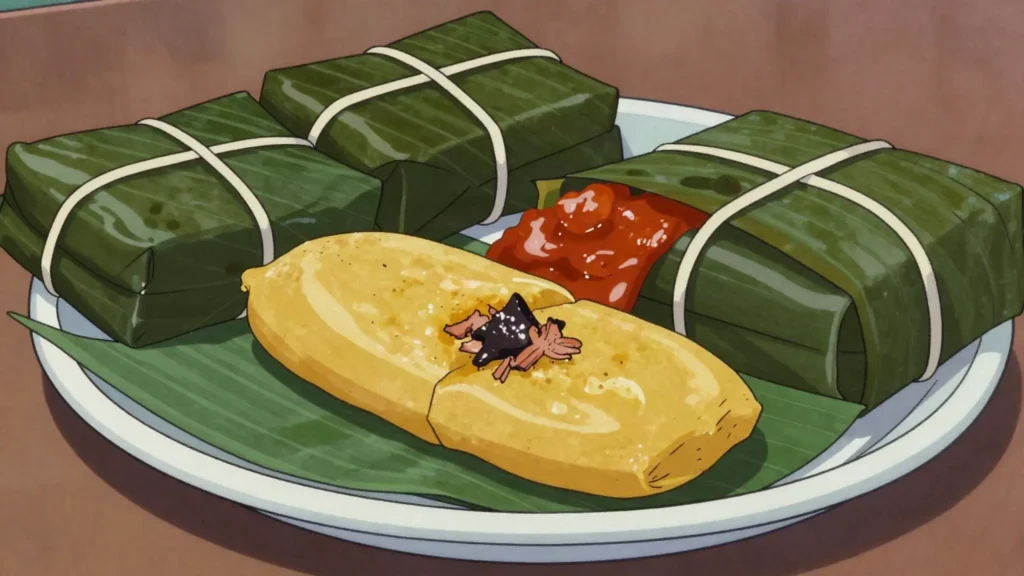
- The parcels are double wrapped: a wilted plantain leaf against the masa for its aroma, and baking paper outside that to keep water out. Both layers are needed. Pass each leaf briefly over a flame until it darkens and softens, since fresh leaf cracks when folded, and brush it with annatto oil so the masa does not stick.
- Use the leaf to fold the masa over the filling so it encloses it and seals to itself, leaving a clear border of masa all round for that. Tie each parcel firmly in both directions, since water getting in through any gap gives a waterlogged pastel.
Substitutions
- A food processor grates the roots far faster than a grater and saves a great deal of effort; grate rather than puree them, adding a little liquid to help it turn.
- Warm the annatto oil gently rather than frying it, since overheated annatto turns bitter; it gives colour more than flavour.
Variations
- They are related to the Puerto Rican pastel and to Venezuelan hallacas — leaf-wrapped starch parcels exist across the Caribbean, each country with its own dough and filling.
- Making them is a communal all-day job done in large batches for Christmas, which is part of the tradition; grating the roots and wrapping are both slow work.
- Cooked masa is firm and orange where raw masa is pasty and grey; unwrap one to check before taking the rest out.
History
Christmas food of the Dominican Republic, related to the Puerto Rican pastel and to Venezuelan hallacas, wrapped in plantain leaf and tied.
Frequently asked questions
What is Pasteles en hoja?
Pasteles en hoja is a main from Dominican Republic: parcels of green plantain and taro dough with pork, boiled in leaves. Christmas food of the Dominican Republic, related to the Puerto Rican pastel and to Venezuelan hallacas, wrapped in plantain leaf and tied.
How long does Pasteles en hoja take to make?
Pasteles en hoja takes 1 hour 30 minutes of preparation and 45 minutes of cooking. The recipe makes about 12 parcels. It is rated hard to make.
What can I substitute in Pasteles en hoja?
Yes, within limits. A food processor grates the roots far faster than a grater and saves a great deal of effort; grate rather than puree them, adding a little liquid to help it turn. Warm the annatto oil gently rather than frying it, since overheated annatto turns bitter; it gives colour more than flavour.
What is the most important thing to get right in Pasteles en hoja?
Rinse well if your hands start itching. Oil your hands before peeling. Annatto seeds are steeped in warm oil. Warm the oil with annatto seeds. Let them steep for ten minutes. Strain out the seeds and discard them. Do not let the oil get too hot.