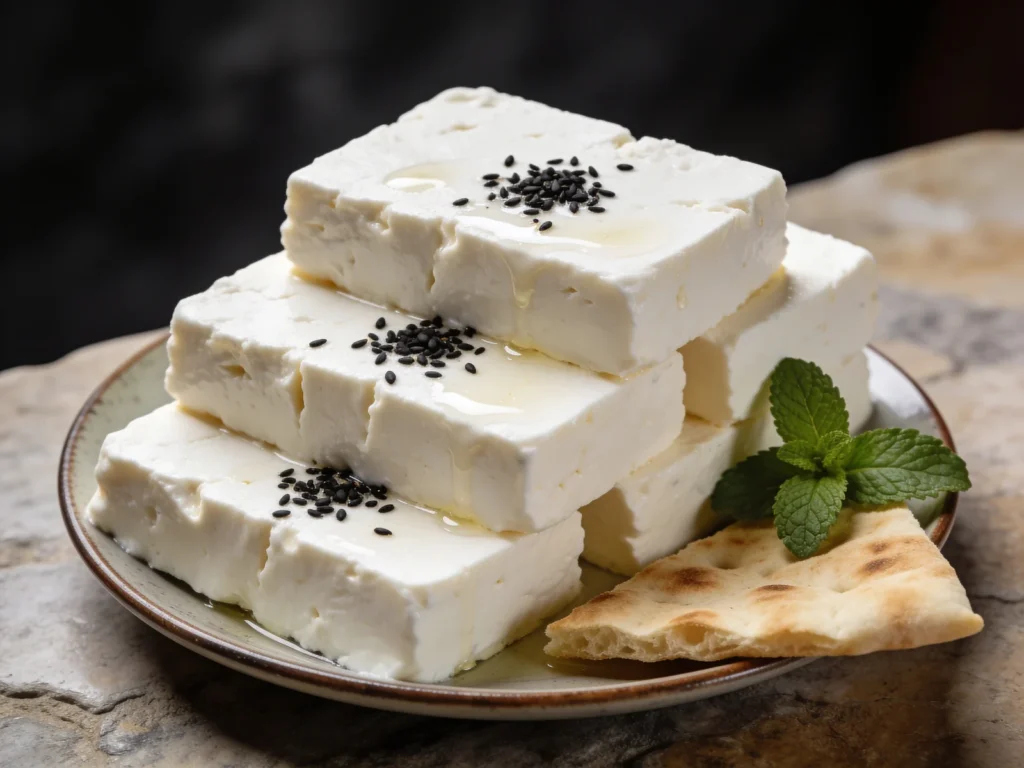

Ingredients
Curd
- 8 litresfresh sheep or goat milk, or whole cow milk
- ½ tspvegetarian microbial rennet, diluted in 50 ml cool water
- 30 gfine salt
Brine and aromatics
- 2 litreswater
- 400 gcoarse salt (a roughly 18–20% brine)
- 2 tbspmahlab (ground cherry-kernel), tied in muslin
- 2 tbspblack nigella seed (habbat al-baraka)
- 1 tbspmastic crystals, crushed with a little salt (optional)
Equipment
- cheese cloth
- a wooden or plastic press with weights
- a long-handled slotted spoon
- sterilised jars
Directions
- Heat the milk gently to 32–35°C (90–95°F), stirring, and hold it there. Do not overheat; scalded milk gives a weak curd.
- Stir in the diluted rennet with 20 slow strokes, then stop the milk moving entirely and leave it undisturbed, covered, for 45–60 minutes.
- The curd is set when a clean finger inserted at an angle and lifted gives a clean break, with clear yellow-green whey filling the split.
- Cut the curd into 2 cm cubes with a long knife, first in one direction, then the other, then horizontally. Rest 10 minutes, then stir very gently for 15 minutes as the cubes shrink and firm.
- Ladle the curd into a cloth-lined mould, fold the cloth over and press under a light weight for 1 hour, then increase the weight and press for 12–24 hours until the slab is firm, close-textured and squeaks slightly when bitten.
- Cut the pressed slab into rectangles about 8 by 5 by 2 cm and salt the surfaces with the fine salt.
- Bring the brine to a boil with the mahlab bag, nigella and mastic, then drop the cheese pieces in and boil them for 10–15 minutes. They will sink, then rise to the surface and puff slightly – this is the step that makes the cheese so distinctive, killing off residual bacteria and setting the protein so it melts and stretches rather than crumbling.
- Lift the pieces out and cool them on a rack for 20 minutes.
- Pack into sterilised jars with the nigella seeds, cover completely with the cooled boiling brine, seal, and store. It is edible next day, better after two weeks, and keeps up to a year, growing saltier and firmer.
- Before eating, soak in several changes of cold water for 2–4 hours to draw out salt, then fry in olive oil until golden, grill, or use in knafeh.
Technique
- Boiling the pressed cheese in brine is the defining Nabulsi step and is what allows a year of ambient storage without refrigeration – important in a region where cheese was made in spring and eaten all year.
- Traditional Nabulsi is made with sheep milk in spring, when the flocks are milking, and set with animal rennet; vegetarian microbial rennet works identically here and gives the same texture.
- Almost every recipe using Nabulsi – frying, grilling, knafeh – begins with desalting it in water. Skipping this makes the cheese inedible, and over-soaking robs it of the stretch.
Substitutions
- No mahlab? Use 1 tsp ground cardamom plus a scrape of almond extract; the perfume is close, if not identical.
- Sheep milk gives the richest, whitest cheese, but full-fat cow milk with 200 ml added double cream is a serviceable stand-in.
- Akkawi is the closest commercial cheese if you are not making your own – it is milder and unspiced but behaves the same way.
Variations
- Plain Nabulsi with no aromatics, the everyday breakfast cheese.
- Nabulsi heavy with nigella and mastic, the festive style used for knafeh.
- Jibneh baladi, the fresh unboiled curd eaten within days, before it is brined.
History
Made in Nablus from sheep’s milk and boiled in brine so it keeps for months; the essential knafeh cheese.
Frequently asked questions
What is Nabulsi cheese?
Nabulsi cheese is a cheese & dairy from Palestine: brined white cheese scented with mahlab and nigella, fried or baked into knafeh. Made in Nablus from sheep’s milk and boiled in brine so it keeps for months; the essential knafeh cheese.
How long does Nabulsi cheese take to make?
Nabulsi cheese takes 1 hr of preparation and 24 hr pressing, plus 30 min boiling of cooking. The recipe makes about 900 g. It is rated hard to make.
What can I substitute in Nabulsi cheese?
Yes, within limits. No mahlab? Use 1 tsp ground cardamom plus a scrape of almond extract; the perfume is close, if not identical. Sheep milk gives the richest, whitest cheese, but full-fat cow milk with 200 ml added double cream is a serviceable stand-in. Akkawi is the closest commercial cheese if you are not making your own – it is milder and unspiced but behaves the same way.
What is the most important thing to get right in Nabulsi cheese?
Heat the milk gently to 32–35°C (90–95°F), stirring, and hold it there. Do not overheat; scalded milk gives a weak curd.