
Ingredients
Meat
- 3 kglamb on the bone
- shoulder and leg
- 3 tablespoonssalt
- 2 tablespoonsblack pepper
- 3 tablespoonsbaharat
- 2 tablespoonsground turmeric
- 6garlic cloves, crushed
- 4cm ginger, grated
- 200 mloil or melted ghee
- juice of 2 lemons
The rice
- 1 kgbasmati rice
- soaked for thirty minutes
- 3onions, sliced
- 4 tablespoonsghee
- 6cardamom pods
- 2cinnamon sticks
- 4bay leaves
- 1 tablespooncumin seed
- a pinch of saffron
- salt
To wrap
- banana leaves
- or heavy foil
- or a cloth sack
To serve
- on a large communal platter
- salata, chopped salad
- laban, yoghurt drink
- chilli sauce
Directions
- Pit cooking runs across the Arabian peninsula. Long slow cooking has a real risk if the heat falls too far. Cut the lamb into large pieces. Leave the bones in throughout. Rinse it and pat it completely dry.
- Mix the salt, pepper and baharat. Add the ground turmeric to them. Add the crushed garlic and grated ginger. Add the oil and the lemon juice. Work it all into a thick paste. That proportion is about right. Rub the paste over every surface. Work it into every fold and crevice.
- Cut slashes in the thick parts. Marinating it properly takes time. Cover it over and refrigerate it. Give it at least four full hours. Rinse the rice until the water runs clear. Soak it for about thirty minutes. Drain it thoroughly afterwards.
- Heat the ghee in a large heavy pot. Add the sliced onions to the pot. Cook them for a good fifteen minutes. Let them go deep golden brown. Take them further than for a normal base. Do not let them burn at all though. Add the cardamom, cinnamon and bay. Add the cumin seed to the pot. Fry them for about a full minute.
- Add the drained rice to the pot. Turn it through the onions and spices. Let it toast for about two minutes. Season the whole pot well with salt. Set the rice in a deep roasting dish. Add water to about a finger above the rice. Set a wire rack over the dish. Lay the marinated meat on that rack. Cover the whole thing tightly with foil.
- Seal the edges all the way round. The steam must not escape at all. Seal it more thoroughly than feels necessary. Heat the oven to one hundred and forty degrees. Cook it for about five full hours. Check it after about three hours. Add hot water to the rice if it has dried. Judging when it is done takes a check.
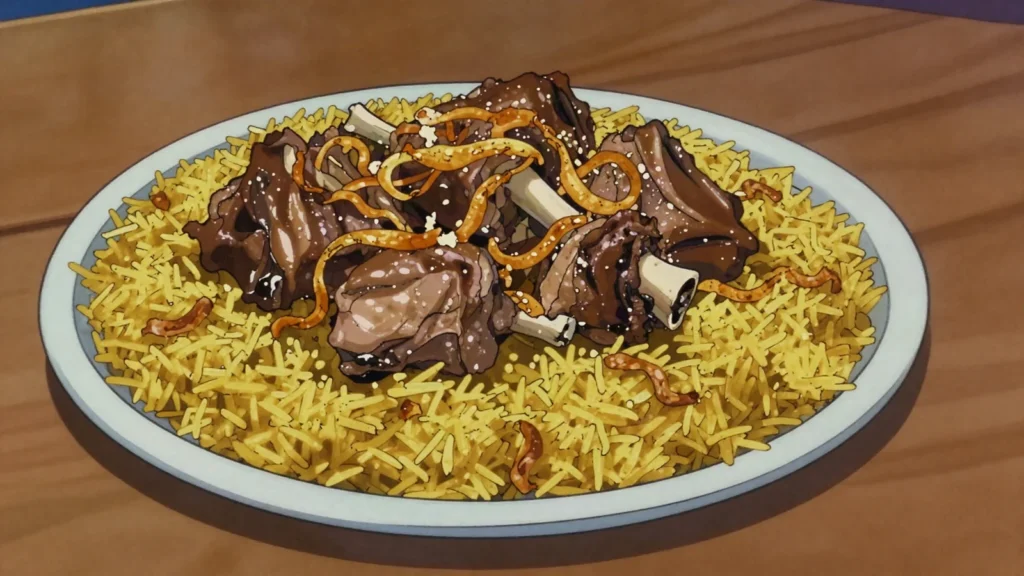
- Take all of the foil off entirely. Give it about fifteen minutes. Let it rest for fifteen minutes. Fold all the juices through it. Serving it is done on a large platter. Spread the rice over a wide platter. Pile the meat up on top of it. Serve a chopped salad alongside. Put chilli sauce on the table. It keeps three days refrigerated.
Technique
- A pit must be genuinely hot when sealed and must stay above the range where bacteria grow, roughly five to sixty degrees, throughout the cooking; an underfired pit holds meat in exactly that range for hours and is genuinely dangerous. Traditional practice manages this by heating the pit hard, and a very low oven both approximates the falling heat and holds a controlled safe temperature, which is why the atlas gives it as the practical method.
- The meat sits above the rice so its fat and juices drip down into it, which is what flavours the rice and is the essential part of the dish; a rack over the roasting dish reproduces the pit arrangement.
- Long slow heat at around a hundred and forty degrees breaks connective tissue down into gelatine gradually, which is what makes the meat fall from the bone; high heat toughens it instead, and if it still resists it simply needs longer.
Substitutions
- A very low oven with the meat racked over the rice is the practical method where a pit is not possible.
- Goat works in place of lamb and is used across the region.
Variations
- Omani shuwa, Jordanian zarb and Bedouin pit cooking share the same principle.
- The foil comes off for a final blast of high heat to brown the pale meat.
- It is served on one communal platter and eaten with the right hand.
History
Its name means buried; the pit method is shared with Omani shuwa and Bedouin cooking across the peninsula.
Frequently asked questions
What is Madfoon?
Madfoon is a main from Saudi Arabia: meat and rice buried in an underground oven and cooked overnight in the sand. Its name means buried; the pit method is shared with Omani shuwa and Bedouin cooking across the peninsula.
How long does Madfoon take to make?
Madfoon takes 1 hour plus marinating of preparation and 5 hours of cooking. The recipe makes serves 8. It is rated hard to make.
What can I substitute in Madfoon?
Yes, within limits. A very low oven with the meat racked over the rice is the practical method where a pit is not possible. Goat works in place of lamb and is used across the region.
What is the most important thing to get right in Madfoon?
Heat the ghee in a large heavy pot. Add the sliced onions to the pot. Cook them for a good fifteen minutes. Let them go deep golden brown. Take them further than for a normal base. Do not let them burn at all though. Add the cardamom, cinnamon and bay. Add the cumin seed to the pot. Fry them for about a full minute.